Ab

Monday, 31 August 2020

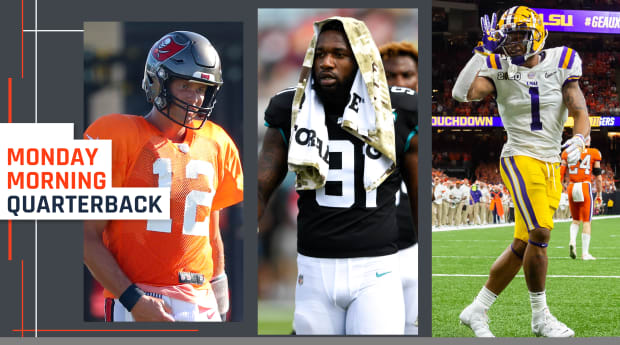
New on SI: How Tom Brady is Already Getting the Most Out of His Teammates in Tampa

Tom Brady's training camp in Tampa Bay: high standards, encouraging words and a players-only meeting. Plus, how football took a back seat to social justice issues this week, Yannick Ngakoue's move to Minnesota, recapping Albert's camp trip and much more.

TAMPA— I spent two days down here and, full disclosure, Day 1 had me wondering.

There were throws in the dirt. There were drops. Maybe strangest of all, there was No. 12, the hyper-intense, hyper-detailed legendary prize-fighter of a quarterback, in the middle of it all, handing the situation with, weirdly enough … positivity?

Nice play, Huddy!

Way to go, Mike!

Great bench route, Chris!

All day, fellas!

This, at least to me, looked like a different Tom Brady than the one I’d seen in New England over the last two decades. And coupled with the practice I was watching—the kind that would set him off on the practice fields of Foxboro—I started to think about, and probably overthink, what I was seeing.

That was eight days ago. The next day, last Monday, I asked Bruce Arians about this relentless sunshine-pumping, coming from the most relentless competitor I’ve ever been around.

“Oh, I don’t think there’s any doubt about it,” Arians told me, laughing. “I mean, he has not gotten on anybody’s ass at all. If he’s gonna get on anybody’s ass, it’s back behind when somebody else is taking reps. Then, he’ll talk to them.”

And then, Arians revealed that Brady actually did say something after that practice.

“He gave a great speech to the whole offense, once the coaches left the room,” Arians continued. “His leadership is unquestionable. But man, he is so positive with those guys out there. They’re just eating it up.”

Meet the new Tom Brady, same as the old Tom Brady.

The packaging is different. But the idea hasn’t changed.

The second day I was there was much better.
***

We’re 10 days out from real NFL football. I can’t wait, nor can I wait for all of you to get a look inside this week’s column. Here, you’ll find …

• A look at a wild week in the NFL on the social justice front.

• Details on the big Sunday trade that made Yannick Ngakoue a Viking.

• A fun look at the seven-camp swing I took.

• A ton of notes.

But we’re starting at Camp 12.

***

As it turns out, that players-only meeting wasn’t exactly Brady flipping over the Gatorade table, either. Instead, the quarterback, after waiting for the coaches to clear the room, delivered a very clear, concise message to his teammates.

“You gotta show up every day,” is how O.J. Howard recalled it. “There’s no days off. With a lot of guys in general, for me, playing football over the years, when you have so much talent, it can get to the point where you start going through the motions, because you can depend on someone else to step up and make a play. But it shouldn’t be that way. It should be everyone on the same page, everyone coming with their hard hat every day.”

“Tom, he expects us to come to work with a lot of energy and to compete every single day,” second-year slot receiver Scotty Miller added. “And we set these goals, and we gotta put in the work to achieve these goals. That’s what he expects from us every single day, to go out there with our goals in mind, give it our all and compete with energy. If we do that, as you know, we got all the talent in the world, all the talent we need to get to where we want to go.

“That’s what Tom wanted out of us—we cannot take a day off, ever.”

Which is how we get back to this being the same Brady.

He’s 43 now and, by all accounts, he’s done everything he can to blend in with everyone else here. The stories of how he greets new teammates—Hi, I’m Tom—as if he needed the introduction to them are the same as they were in New England. By now, you know

he organized the workouts on the campus of tony Berkeley Prep this summer, and he played a couple rounds of golf before camp with Arians and quarterbacks coach Clyde Christensen.

“I think we split,” Arians said. “He had the pro for his partner, the pro shot like 65. So we got our ass kicked that day. But I think Clyde and I got him the next time.”

But make no mistake about this—his presence is felt in every inch of this place, and has been since the minute he arrived. That, in fact, is part of what attracted the Bucs to him in the first place. They knew that Brady’s standard would be their collective standard once he punched the clock the first time and they’ve gotten what they paid for, in full, in that regard.

That meeting was one piece of it. There are plenty more.

Attention to detail. Brady’s played quarterback in the NFL for two decades, so his volume of knowledge is off the charts. That much doesn’t need to be restated. But what you may not know is that it’s at the point now where he’s not just capable of running an offense—if you’re a teammate of his, he could probably be your position coach too.

And by that, I mean, there are pretty minute details he’s drilling the fellas on.

“Last year, I had a problem—I never really noticed it, it was just a bad habit. I would, when I was running my vertical routes, or routes down the field, turn my head back too soon, and it’d have me running with my shoulders sideways,” Howard said. “And Tom kept stressing to me, Keep your shoulders forward, keep your arms pumping, and find the ball late, just track it. He’s done a great job with me on that. I’m keeping those shoulders straight, and it helps allow me not to slow down in my routes.”

“One thing that he’s focused on with me, let’s say I’m running a deep ball, whether it be a fade or go, there’s certain yardage where, once we beat the DB, he wants us to get our eyes up, get our eyes back to him,” Miller said. “That way, he can really feel us out, he can tell if we want a back-shoulder ball, or if we really beat the guy, he’ll put it over the top. We have a bunch of different deep concepts where he wants us to give us his eyes at specific yard markers. That’s one detail that’s been key for us.”

So in Howard’s example, a teammate of Brady’s is playing faster. In Miller’s, a teammate is helping Brady throw a better ball. And everyone benefits.

Building confidence. Here’s why I chose to speak to Miller and Howard: Several Bucs people brought them up as guys who’ve exploded as players for having Brady as their quarterback. Part of that’s from details like the ones mentioned above. Another part is simpler. They’re more confident, in general, getting to work with him.

“When the Greatest of All Time tells you you’re pretty good—like, Hey, what a route! Great job!­ Or, Try this, and it works—it gives you a ton of confidence,” Arians said. “That’s really all it takes, that one little bit of confidence, and he can take that next step to become a heck of a player.”

Both guys confirmed that, as I was told, they are playing with more confidence than they had been before. It helps, of course, being in their second year in Arians’s offense.

But neither questioned that Brady’s helping to unlock that self-assuredness, too.

“He just gives us so many specifics, in where he wants us to be, so many details,” Miller said. “So when I know those things, and I know exactly what I’m doing out there, and what he wants me to do, I think that really helps me go out there and play fast, and be myself and make plays.”

“How to get open on certain routes, how he’s expecting the defender to play certain coverages vs. certain routes, and what he expects out of us as receivers and tight ends, all of that has allowed me to play fast,” Howard said. “It’s definitely been really helpful for me.”

The standard’s up for the coaches, too. Over the years, both Josh McDaniels and Bill O’Brien have said how tough it was coaching Brady—he was so smart, and so prepared, that an offensive coach had to work overtime to give him something new or challenge him in a way he hadn’t been challenged before.

Arians has certainly felt that.

And for him, Christensen and senior assistant Tom Moore, the time they had working with Peyton Manning in Indianapolis helped ready them for this experience. So just as Brady’s been pushed to learn a whole new language (Howard told me the offense is “really the same” as it was last year), he’s pushing the staff in his own way—which probably explains why he and OC Byron Leftwich were inseparable in the two days I was here.

“The verbiage was all new, so that part was a little hard on him,” Arians said. “Just learning all the verbiage—Hey, I wanna change this protection, what’s that called? And getting to where it’s a second language to him, that’s still happening. But yeah, having been with Peyton, as his coach, if it was an hour meeting, you better have two hours’ worth of stuff, because if you brought an hour, he’d buzz through it, and get bored, then get pissed.

“And it’s the same with Tom. He wants all the information. It’s fun, I’m happy he’s into the virtual reality stuff too, because that really has allowed him to get live reps over again.”

He’s holding himself to that standard too. Which is probably the ultimate key here. It’s hard to preach it if you’re not practicing it. Brady is, without question, doing that, and that virtual reality program is proof.

Per Arians, Brady hadn’t used the technology, from a company called Strivr, before. The coach actually started with it back in Arizona, and Carson Palmer raved about it to Arians (see Peter King’s 2015 story for The MMQB about Palmer using it), so Arians went to Brady with the idea. Brady, in turn, saw it as a new way to stack more work on top of what he was already doing in learning his new offense.

That is to say, he embraced it right away.

“Everything we do, we film for virtual reality with Strivr,” Arians said. “When you go back in, you put a headset on and you’re actually back at practice. And you see the exact play you just ran, versus the right blitz, so you can have all those practice reps over again. You can sit in the room and drop back, or just sit there and watch it. We did this all the time in Arizona, our backup quarterbacks, that’s how they got a lot of reps in practice.

“He’d never had it. He was like, ‘Wow, this is really cool.’ You turn around and see the running back, you look out, you see the coach. It’s crazy how good it is.”

So when another player walks by the room, after another 100-degree practice, and sees Brady wearing a headset in a dark room, and moving his feet around like a boxer during some downtime? Chances are, he’ll feel compelled to be just as invested.

***

Now, the elephant in the room is that what Brady’s doing is, and continues to be, without precedent. We saw how fast Manning lost it at the end. Brett Favre, too. And Brady’s 43, which makes it difficult not to think that a quick demise will eventually be in play.

But the quarterback the players are seeing in Tampa is the same one many of them have watched since they were kindergartners—and that’s not an exaggeration (Howard was a first-grader when Brady won his first Super Bowl, and Miller was in preschool). And if he can maintain that, which, again, isn’t guaranteed, then there are a lot of pieces in place here.

Brady’s got Mike Evans, Chris Godwin and Miller at receiver; Howard, Rob Gronkowski and Cam Brate at tight end; Ronald Jones and Shady McCoy at tailback; plus a line that’s improved, and is adding a first-round tackle.

“I’m pretty stoked, man,” Howard said. “We have a lot of talent. It’s gonna be special to see. Every week, it’s gonna be a new guy making plays. There are always guys making plays here, every practice. Live bullets, it’s gonna be fun to go out there every week and see—Hey, it may be your day, it may be Scotty’s day, it may be someone else’s day. It’s gonna be fun.”

Miller then used the same word, stoked, before adding, “I’m extremely excited.”

Arians is too, for sure. And it’s not just because of that talent he’s putting around Brady, either. It’s all of the above, plus how this has become Camp 12 and how that’s affected everyone in the building.

The expectations externally are, of course, higher than they’ve been for Tampa since Jon Gruden’s heyday. And that’s OK with the guys here. Because internally, thanks to Brady, that bar’s been set even higher. For the coach, that much was clear on that Sunday, eight days ago, after he heard what came out of that meeting.

“It was just reinforcement, Hey, there’s too much talent in here. We’ve gotta pick it up, we don’t have that much time left,” Arians recounted, before emphasizing that he’s trying to drive that home too. “Every day I talk to them about it. If we stay healthy, if we beat the virus, we’re gonna beat a lot of teams.”

And if you listen to Brady out there, it’s not hard to hear how he deeply he believes it.

***

FOOTBALL TAKES A BACK SEAT

Overnight, Monday into Tuesday, Lions coach Matt Patricia got a text from his chief of staff, Kevin Anderson, that was pretty simple and direct.

You see what’s happening in Wisconsin?

Patricia woke up to that on Tuesday morning and, since he’d been knee deep in camp work, answered that he hadn’t seen much yet, but that he’d get right on it. It didn’t take long for the 45-year-old, as he started reading, to understand the gravity of the situation.

“I don’t really feel like talking about football,” he told the players, as they gathered for a team meeting a couple hours later, coming back from a day off on Monday.

So for about two-and-a-half hours thereafter, the coaches and players spoke frankly and openly about the shooting of Jacob Blake, which, to those in the room, felt like a continuation of the discussions they had in the aftermath of George Floyd’s killing in May. And as the meeting wound down, the coaches handed the baton to the players, asking them how they’d like to handle the rest of the day.

On Tuesday, practice wound up getting canceled and the team staged a demonstration outside its practice facility, one that went viral on social media, with veteran safety Duron Harmon addressing the media thereafter. Eventually, later in the week, the Lions would get back to work. But the precedent they set sparked a tidal wave of cancellations across sports.

On Wednesday, the Milwaukee Bucks decided to strike instead of playing against the Orlando Magic, and the NBA’s whole playoff slate for that night was canceled. And NFL teams started to follow the Lions’ lead too.

In Indianapolis, the Colts’ social impact committee went to coach Frank Reich to voice its feeling that football needed to take a backseat for a day, after a players-only meeting earlier Wednesday night. Reich agreed, and addressed the team on Thursday morning, fully willing to concede that he needed to follow the players’ lead on this one.

What he said, I’m told, was along these lines: What happens with white privilege, we want to talk about these things when it’s convenient for us. The Black man doesn’t have that luxury.

From there, the Colts had all players and coaches register to vote, then the players went into six hours of meetings with David Thornton and player engagement staff. They came out with four areas where they wanted to focus their efforts: voter registration, police relationships in the Black community, education for underprivileged children and food access for school kids who might be missing classroom time due to the pandemic.

So did teams like the Lions and Colts change the world this week? Maybe not.

But I’d tell their stories to give you a microcosm of what’s happening in the NFL. These are sensitive topics for a lot of people and, as such, in some places the discussions within teams got emotional and even contentious, from what I understand. But as I see it, that’s a good thing.

That means people are being honest with each other, and making themselves vulnerable, and my feeling is that’s what leads to real progress. In fact, that’s probably why we saw so many teams emerge from these meetings with actionable plans—because they were able to sort through what was really important to the guys in the room.

And that says, to me, that the league took more steps forward on the social front this week, and more meaningful ones than those taken simply by writing checks.

What’ll be interesting from here is to see owner involvement. Eagles owner Jeffrey Lurie, who’s been pretty progressive in this area for some time, said on a call with local and national media on Sunday that he sees a “sea change” among owners—“they’re embarrassed by our country, embarrassed and hurt.”

I can say that players are eager to see the owners show it. I’ve been asked a lot the last couple days if I think NFL players might walk away from games like the NBA, WNBA, MLB and NHL players did last week. The truth is, I’d need to know what’s happening in our country at a given time to answer that. I don’t know what the climate will be in America in 10 days, when the Chiefs and Texans kick off, nor do I have a clue what it’ll be in two months.

But I do know this—the players will want the support of their bosses going forward, no matter what happens next, and that could impact their decision-making in how they handle wherever all of this goes. If Lurie’s right, they’ll get it.

***

YANNICK GETS HIS WISH

Overnight on Saturday into Sunday, the Vikings and Yannick Ngakoue’s camp were working through proposals—some that included a lower base and incentives, others just a hard cut from the $17.788 million franchise tag Ngakoue had been assigned in March—and by the time the sun came up in the Central time zone, the deal was done. And one thing was abundantly clear.

Ngakoue very badly wanted out of Jacksonville.

How badly? He was willing to take $5.788 million less (without incentives) than he otherwise would’ve made just to stay with the Jaguars for the next four months. And so now, on that one-year, $12 million deal, he gets to play opposite Danielle Hunter, and for Mike Zimmer, on a team that’s made the playoffs in three of the last five years and had a top-10 scoring defense the last five years in a row.

The rest of the fallout for the parties involved …

For Ngakoue: The trouble here is next year’s franchise tag number might wind up being lower than this year’s (because of the falling cap) and, in taking the pay cut, he loses the benefit of the second tag being 120% of his previous year’s cap number. That said, the Vikings made a good-faith pledge to Ngakoue’s camp to negotiate a fair long-term deal when it’s allowed by rule, after the 2020 season. He’ll still be just 25 then. And he’s seen as an exceedingly good fit for Mike Zimmer’s defense, which should help him put up the kind of year that would prompt a mega-offer from Minnesota.

For the Vikings: They replace Everson Griffen and, again, have one of the best bookend pass-rush tandems in football, and give a core that’s aging—Kirk Cousins is 32; Harrison Smith is 31; Kyle Rudolph and Adam Thielen are 30; Anthony Barr and Eric Kendricks are 28—another Pro Bowl-level talent to go to battle with. And Hunter, also 25, and Ngakoue set up as pieces to build around long-term, after the older guys are gone.

For the Jaguars: All the way back at the draft, you heard, Jacksonville’s the Trevor Lawrence team, which was essentially a way of saying that the Jags were stripping down the operation in 2020 with their eyes on 2021 and beyond. Hard to argue that now, when you look at the list of players gone from a stellar defense that carried the team to the AFC title game just 31 months ago …

• DE Yannick Ngakoue

• DE Dante Fowler

• DL Calais Campbell

• DT Marcell Dareus

• DT Malik Jackson

• LB Paul Posluszny

• LB Telvin Smith

• CB Jalen Ramsey

• CB A.J. Bouye

That’s a lot of talent out the door. Conversely, the Jags had three of the top 42 picks in April’s draft (C.J. Henderson, K’Lavon Chaisson, Laviska Shenault), and have four picks in the first two rounds of next year’s draft. That doesn’t guarantee anything, and they’d still almost certainly need to be the worst team in football to get Lawrence (it’s unlikely whoever lands that pick trades it). But at the very least, the direction here is clear. Also, waiting wound up being prudent. The Vikings’ haul was the first hard offer they got that involved a second-round pick (and they got the 2022 conditional fifth, that could be a third or fourth, to boot).

And so, with five days left until final cuts, the trade market finally moved. We’ll have more on that in a minute.

***

A CAMP TRIP UNLIKE ANY OTHER

This year’s camp trip was super different for me. Normally, I’ll try and see close to three-quarters of the league between the end of July and the opener. And this year, because of (very understandable) access rules, there wasn’t great value in doing that.

But what’s happening now is historic, and so there was plenty of value in getting out and seeing how all of this was working. So I decided I’d rent a car, go down the East Coast and hit all the teams I could along the way—then go to Florida to see a certain older man who spent his professional prime in the Northeast, and chose to go to a warmer climate to close out his career.

The result was a seven-camp itinerary, and a bunch of stories gathered along the way. And some smaller stuff for me to parcel out to you guys too. Here’s some of that …

Signs of COVID-19

Patriots: At the far end of the team’s practice field, there’s a giant trailer that’d been used for … I’m not sure what over the years. I’ve never seen it open before. This year, there are two windows that, from far away, almost look like where you’d order from a food truck. One has a sign that says “athletic training” on it, the other “equipment,” two vital pieces of the football operation displaced as a result of distancing measures taken.

Jets: When you pull into the team’s expansive suburban facility, and get past the guard shack, you basically circle the practice field to get to the parking lot—and once you take a right at the corner, you can see a line of four tents set up to left, with maybe a dozen workers in hospital scrubs, plastic jackets and masks. By the time I arrived, their busy time had just ended. Media was instructed not to show up before a certain time, which allowed for all the testing to happen as guys arrived, and before reporters got there.

Giants: Four luxury coach busses are parked right at the side of the practice field, in a way that looks vaguely like a visiting high school team would arrive for a scrimmage. Why are they there? The Giants moved 90% of their football operations into MetLife Stadium, across a massive parking lot. So the players and coaches commute over from the stadium to the team’s practice facility, to use the fields there, via bus.

Eagles: I brought a neck gaiter and a cloth mask with me on the trip. The Eagles were the one team I visited where that wasn’t good enough. As all reporters enter, and go through the normal protocol—getting your temperature taken, and showing that you answered the standard questionnaire online—they’re handed paper masks (the kind you’d get in a hospital) for practice. Which, I learned on that day, get really warm when it’s 90 and humid.

Ravens: Anyone who’s been to Baltimore’s facility knows why it’s referred to as The Castle. It was modeled after a well-known country club, and looks palatial as a result. And while that ambiance is still there, it’s definitely a different feeling pulling past security and entering the facility, which is tucked in the woods in Owings Mills. The first thing you see? Three signs: Testing A-G, Testing H-Q, Testing R-Z.

Buccaneers: Here, media arrives at a prescribed time, and then lines up for temperature taking—without anyone getting out of a car. Once you pull up to the gate of a fenced-in parking lot, to the right of the team facility, you show the guard a green checkmark on your phone, signifying completion of a COVID-19 questionnaire, and then you dip your head, so he can take your temperature.

Dolphins: After going through the same stuff I did at the previous six stops—filling out a questionnaire on symptoms and who I’d crossed paths with, and getting my temperature taken—a PR assistant handed me a pass with a seat assignment (not normal at camp). It said 118 and basically had me sharing a relatively expansive pavilion area atop the stands with the Miami Herald’s Armando Salguero. The purpose, obviously, was to keep reporters spread out, and we got an internet connection, large fan, and power outlet for our troubles.

Name to watch

Patriots: OLB/ILB Josh Uche. Primarily an EDGE player at Michigan, New England saw inside/outside versatility with Uche because of his build and instincts, and it’s clear that he’s made an impression early in training camp. Bill Belichick has overseen transitioning EDGE/linebacker hybrids off the line of scrimmage in the past (Tedy Bruschi, Mike Vrabel, Kyle Van Noy). And if Uche can pull it off, it sure could help fill the void left by Dont’a Hightower’s opt out.

Jets: TE Chris Herndon. It wasn’t hard to see him jump out on the day I was there, and it’s just as obvious, talking to people there, how losing Herndon last year (he only played in one game, due to injury and suspension) affected Sam Darnold. The staff loves the rapport they’ve seen between the two with Herndon back now. If Darnold’s draft classmate can stay healthy, he could well wind up being a centerpiece in the passing game.
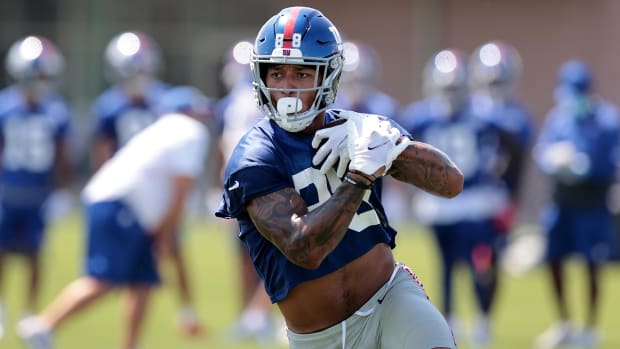
A 2017 first-rounder, Engram had 44 catches last season despite missing eight games.

Giants: TE Evan Engram. It’s not breaking any news to say Engram’s got a boatload of ability. Everyone knows that. Everyone also knows that injuries have been a problem. But what was interesting to me was just how dominant he was in practice the day I was there, and how he’s fit into new coach Joe Judge’s program. In the former first-round pick, the staff has found a worker, and a very football-intelligent player, which is exactly what they’re looking for across the board.

Eagles: DE Josh Sweat. The former five-star prep recruit looked freakish on the day I was there, and Philly has pretty consistently seen the big, long defensive end flash that ability the last few weeks. I watched him at the end of a two-minute period absolutely turnstile left tackle Andre Dillard (obviously, before Dillard got hurt) for a sack. Sweat’s another guy where health remains the question. But man, he can play.

Ravens: WR Hollywood Brown/TE Mark Andrews. Alright, so these aren’t really breakout candidates—these guys were 1-2 in catches, yards and touchdown catches for the team last year. But both guys changed their bodies this offseason, and the coaches believe both are playing faster as a result now. Which is a pretty scary prospect, given all the Ravens were already giving defenses to account for.

Bucs: CB/S Antoine Winfield Jr. The second-round pick has been making plays on a daily basis, and Tampa’s going to find a way to get him on the field as a rookie. For Arians, Winfield brings hints of what the coach had in Tyrann Mathieu and Budda Baker in Arizona, a combo safety who can do a million different things. Having a player like that also should go a long way in further unlocking Todd Bowles’s hyper-aggressive scheme.

Dolphins: G Solomon Kindley. Post-Laremy Tunsil, Miami needs help all over the offensive line. Kindley, a fourth-round pick, looks ready to give it to the Dolphins. Through a physical camp, he’s excelled to the point where I’d be surprised if he isn’t starting against the Patriots on Sept. 13. He’ll likely be one of two or three rookies on that line, which also happens to be why going with Ryan Fitzpatrick, for now, is the smart play for Miami.

Lingering question

Patriots: How will the rookies play? New England may wind up relying on more of them this year, and more heavily on them at certain spots (LB, TE), than they’ve relied on a group of rookies in a decade, going back to the Devin McCourty/Rob Gronkowski/Aaron Hernandez class of 2010.

Jets: Who’s playing receiver? There are questions about the line, too, but at least there they know who’ll be on the field. At receiver, it’s more of a scramble, with Breshad Perriman, Chris Hogan, Jamison Crowder, Denzel Mims, Braxton Berrios and darkhorse Jeff Smith in the mix.

Giants: How will rookies fare at the tackle spots? It sure looks like you could have both spots manned by draft picks, with Andrew Thomas on the left side and Matt Peart on the right. How they hold up should help determine Daniel Jones’s 2020 fate.

Eagles: Who’s playing guard? With Dillard down, and Jason Peters back out at left tackle, the question is who’ll take Brandon Brooks’s old spot. They’ve spent a lot of time developing Matt Pryor, drafted Jack Driscoll high and have an intriguing prospect in ex-Australian rugby star Jordan Mailata as contenders. But it’s important to remember that, in Brooks, they’re replacing an elite player.

Ravens: How do the pieces in the secondary fit together? With Earl Thomas gone, DeShon Elliott slides into his old role. But then the questions become how they deploy Jimmy Smith, who could become the kind of combo player Brandon Carr was last year, and how Chuck Clark is affected. High-class problem here, but one that has to be worked out for Wink Martindale to run as flexible a scheme as he did last year.

Bucs: Is there enough offensive line depth? Tristan Wirfs turned a corner over the last 10 days at right tackle and Alex Cappa’s coming along at guard, so Tampa feels good about the two question marks they entered camp with up front. But a couple injuries could create a very real problem.

Dolphins: How young is too young on the offensive line? Yup, another line question in a year where lines are going to be tested, thanks to the relative lack of work they’ve gotten together. Miami has three guys in Austin Jackson, Robert Hunt and Kindley who they like. Would you be OK playing all three? There’s not a ton of NFL precedent for it.

***

TEN TAKEAWAYS

The trade market’s been slow, and I’m not sure how much the Ngakoue deal shifts that paradigm. Thing is, we knew for months that Ngakoue was available. There was another trade this week, with linebacker Raekwon McMillan going from Miami to Vegas, but that was the result of the Dolphins actively shopping McMillan. Situations like those are fairly cut and dried. The players were clearly available. Conversely, deals aren’t happening organically this year, as they normally would be, for a few different reasons.

1) No one is getting to see other teams’ players in preseason. So most talks between teams to this point, I’m told, have consisted of personnel guys asking, Where are you guys heavy and where are you guys light? And there’s a lot of guessing going on.

2) The prospect of a cap shortfall in 2021 gives teams less financial flexibility to take on guys with big numbers in future years, or work on extensions with guys in contract years.

3) Despite the NFL’s outstanding start on the COVID front, teams still have their guard up, and they know that depth could wind up being a bigger factor this year than ever before (and it’s always important). So, naturally, spare parts are less dispensable.

4) Expanded practice squads, and the allowance for six veterans to be among the 16, changes some dynamics. There might be, for instance, a guy who won’t make your 53 this year that you’d have shopped in the past, but now want to sneak through to your practice squad.

Now, some things may wind up shaking loose this week. I certainly think there’ll be players out there on the block for fiscal reasons. And in other cases, maybe some team will take a swing on a guy who might not have been thought to be available—and hit. But for the most part, the way things are trending, I’d guess there’ll be less trade action in general than we’ve had in the past, and maybe a lot less than we had in a very active 2019.

LSU WR Ja’Marr Chase is one college opt-out who should get your attention. Not only is he fully expected to be the top receiver taken next year, had he been draft-eligible, he may have been the first receiver to go back in April, too. “He’s easy [to evaluate],” said one AFC college scouting director. “He’s a first-rounder, no doubt about it, and the best receiver in the class. You can compare his height and weight to [Minnesota opt-out Rashod] Bateman, but he’s a step faster, he’s stronger, just a really strong kid, with very good hands. And he’s a really good athlete. … He comes from a good [high school] program there in New Orleans, he was a five-star recruit, yeah, he’s an easy evaluation. He blocks, he plays hard, just does everything. He’s just really good, there are no holes in skill set. You’ll have to see how fast he is, that’s the question, but word out of there is he’s faster than you’d think.” So yeah, tough to argue with the call Chase is making.

I think Brian Urlacher’s social-media activity last week is indicative of how we’ve stopped listening to each other. If you missed it, the Hall of Famer lined up Brett Favre playing through his father’s death—and starring in a MNF game the night after it happened—as an equivalent to NBA players deciding not to play playoff games this week. It’s a little ridiculous to compare the two to begin with. Favre played through personal tragedy, in part because he thought it was the best way to honor his dad. If he’d decided he couldn’t go that night? I don’t think anyone would’ve thought less of him. He made a choice that was his own, and his way of going through the grieving process was, I’m pretty sure, respected by everyone. What happened in Wisconsin last week connects in no way to that, nor does the response of the NBA players. In fact, if I try and contort myself to find the connection, it’d actually be this—just as Favre’s decision to play that night illuminated his dad’s life, the basketball players’ collective decision not to play illuminated a problem that’s deeply personal for a whole lot of them. But that’s just the false equivalency piece of it. To me, what’s worse is completely ignoring what athletes across sports were doing in skipping practices and games this week. My interpretation is that they were saying, We won’t be your distraction this time around. I’d say it worked, too. Instead of listening to that, though, Urlacher drew his own conclusions. Which, to me, reflects how we’ve become so divided as a country. No one seems to listen to anyone outside their own echo chamber anymore. And that sucks.

I’m excited to see what the Seahawks secondary looks like. Jamal Adams has come as advertised through his first few weeks in Seattle. But just as notable has been the emergence of second-year centerfielder Marquise Blair—who flashed speed and playmaking ability throughout, now 16 months out from Seattle having taken him in the second round. And theoretically, you could say that he’d be easy to slot into the old Earl Thomas role, with Quandre Diggs as a movable piece. The only thing is that Blair has the flexibility to move down and cover in the slot. And Adams does too. And this is why Pete Carroll and those in Seattle have been pretty tight-lipped about where the defense he’s run for over a decade there is going next. Given the versatility of the three safeties, and that the Seahawks are happy with outside corners Shaquill Griffin and Tre Flowers, Carroll and DC Ken Norton have a lot at their fingertips, and I’d expect they’re going to look a little different on defense than they have as a result.
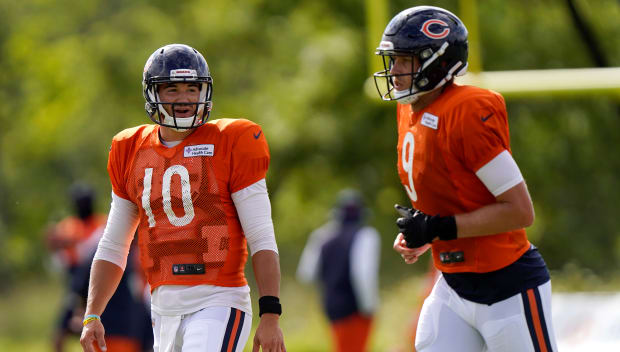
Newcomer Foles (right) appears to have the upper hand on Trubisky.

My sense is that Nick Foles is a nose ahead of Mitch Trubisky in the Bears’ QB competition. And it doesn’t surprise me, while we’re there, that Matt Nagy would want to try and keep quiet who the winner of that derby is until the very end (which is what he said he’ll do after Saturday’s scrimmage at Soldier Field). To me, it’s the only true-to-life battle at that position in the league. In Miami, Ryan Fitzpatrick is taking the first-team reps. Tyrod Taylor’s doing the same for the Chargers. And Cam Newton’s clearly emerged in New England. It’s hard to blame those coaches, given the constraints at hand, and the need to build rapport and develop a scheme for the offensive players ahead of Week 1. In Chicago, as Nagy promised, the reps have been split, and if you’re going this far into the summer with it (we’re seven days away from a game week), then I understand wanting to keep the Lions, at the very least, in the dark on who they’re preparing to face in Week 1 for long as possible. In the end, I do think Foles will maintain the slim lead he has now. But I also believe the Bears coaches are being earnest in wanting to see more before making the call there final.

Alexander Mattison’s emergence in Minnesota adds an interesting layer to the Dalvin Cook saga. One big reason why NFL teams are so reluctant to give running backs big money is pretty simple—they’re too easy to find. You don’t need to spend a first-round pick on one. And maybe if you’re looking in the third or fourth round, you won’t find Zeke Elliott or Saquon Barkley. But what you might find is often close enough. Which brings us to Mattison. The Vikings spent a third-round pick on him in 2019, he averaged 4.6 yards per carry as a rookie and he’s hit the ground running in Year 2. I’m told he looks faster and more explosive than he did before, and has had a great camp carrying himself like a seasoned pro. Now, is he Cook? Probably not. But consider this—Mattison is due just $2.2 million total over the next three years. Re-upping Cook might cost you $15 million per year. I’m not great at math, but I’d say it wouldn’t be hard to come by an analysis that going with Mattison over Cook after this year is the right thing to do. And that also, by the way, is why Cook has to do all he can to get paid. His leverage, based on all the above, isn’t getting stronger with time.

I’ve heard the Texans’ work through a month has been crisp. And that’s, at least in part, thanks to the focus over the last couple years on culture. The players the Texans have brought in—guys like Brandin Cooks and Randall Cobb—are pros, and the practices have reflected that, as has the toughness of a team that’s now built through the lines of scrimmage. It took some gambling, of course, to get here, and it’s certainly possible the exodus of guys like Jadeveon Clowney and DeAndre Hopkins will exact a price when the games come. But my sense is Bill O’Brien has the building where he wants it. And it’s something he actually brought up, when we discussed players policing each other this year, in being careful COVID-wise. “Every year, your team’s different. This year we really wanted to have a team that had really good leaders,” he told me. “Deshaun Watson and J.J. Watt and Brandon Dunn and Bernardrick McKinney and Darren Fells, and then we added other great leaders like Brandin Cooks and Randall Cobb, in addition to Nick Martin and Laremy Tunsil, guys like Justin Reid, there’s no doubt that they’re going to police each other. These guys wanna win. It’s really important to them to be a winning football team.” And, again, that’s shown up, with kickoff just 10 days away.

I’m not surprised in the least to hear Dwayne Haskins’s assessment of his relationship with Alex Smith, a few weeks in. In meeting with the D.C. media, Haskins referred to Smith as a “big brother” and a mentor, and that would surprise no in San Francisco or Kansas City, who saw him with Colin Kaepernick or Patrick Mahomes. Just the same, I know Haskins’s excitement for Smith is genuine. “He got some 9-on-9 reps in, and a couple times, he felt how real that pass rush is," Haskins said. “Alex is an ultra-competitive guy, and we had a conversation after practice today about just how important it was for him to get back out there. I'm extremely happy for him, proud of him, have so much respect for him and know what type of guy he is on and off the field.” There’s also, obviously, real football benefit here for Haskins and Kyle Allen, in working with Smith. The staff there has seen it up close—how Smith is able to draw on his own experiences, and his ups and downs, to give the younger QBs lessons. And his off-the-charts retention in learning the offense has both set a high bar for the others and given Smith instant credibility as not just a player, but a teacher in that room. I don’t know if Haskins will wind up being the long-term answer in D.C., or if Allen will be either, for that matter. But I do know that both guys have a better shot at it, and the team will probably get an answer on it more quickly, because Smith is in the room.

File this away: Solomon Thomas is playing really well in Niners camp. The first draft pick of the Kyle Shanahan/John Lynch era has been largely a disappointment in San Francisco, and the team didn’t pick up his injury-guaranteed fifth-year option for 2021. And yes, the thought of it clicking for Thomas has come up before—a year ago the arrival of then-new D-line coach Kris Kocurek, who brough an aggressive style and wider splits, was expected to be a boon for Thomas. Thing is, last year, in a loaded position group, snaps were hard to come by. This year, with DeForest Buckner gone, there should be more opportunity for Thomas. And the Niners are at least hopeful that the former third overall pick is in as good a position as he’s ever been to take advantage of it.

One thing that was crystal clear at training camp: There was a ton more 11-on-11 than I’ve become accustomed to seeing. So the idea that coaches might rethink the idea of camp? Yeah, you can throw that out the window all together. The loss of joint practices and preseason games, and any semblance of offseason on-field work, simply had coaches trying to replace what they could of what they were missing. And it was interesting in talking to John Harbaugh about his brother Jim, and whether he’d consulted with the Michigan coach on how they work around time constraints at the college level. John said he had, but then added that even what colleges are working with isn’t totally applicable. “I always know what they’re doing as far as how he organizes his camp, his scripts, his timeframe,” John said. “It is like the colleges, but the difference is the colleges, they have spring practices, and they also build up to this. They bring their guys back in June and they’re there all summer, they’re working conditioning all summer, they’re doing individual workouts. They even do 7-on-7 on their own, they do group work on their own. According to the rules, it’s legal. So it is like college in the pure sense of training camp. It’s not like college in that we’re not getting as much work as they’re getting leading into it. It’s not exactly like college.” And thus, in many ways, NFL coaches were working, in certain ways, from scratch on this one. And that the result of that was fairly consistent, from camp to camp, to me, was interesting.

***

SIX FROM THE SIDELINE

1) Yes, I watched Austin Peay-Central Arkansas on Saturday night. And yes, I checked on Saturday morning to see if College GameDay was on. (It wasn’t.)

2) In the weirdest of college football seasons, we have more games this coming weekend, but not a major conference game until the weekend after that. The first one? Trevor Lawrence and Clemson take on Wake Forest at noon on Sept. 12.

3) The Big Ten’s handling of the cancellation of its fall season has been a total crapshow. That’s established, and reinforced, by how the other conferences were caught off guard by the announcement, after working with the Big Ten on plans before that. And now, as I see it, the league (and I’m a fourth-generation Big Ten alum, for clarity’s sake) has an opportunity. They can watch the SEC, ACC and Big 12 open camps. They can watch the rates at their own schools. They can, yes, communicate with their football coaches. And they can be open-minded in considering an October start in the process. Whether the conference office or school presidents like it or not, the Big Ten is much more SEC than it is Ivy League. Football is a huge part of the identity of our schools. And it should be treated as such.

4) Really great idea by the NBA to turn their arenas into polling places in November, and it should be especially important in an election year when, because of COVID, having a lot of space is really important.

5) That mess between the Mets and MLB commissioner Rob Manfred on canceling the game the other night was … not that surprising, given how baseball has handled 2020.

6) My camp trip was the first time I'd left New England since the lockdown began in March, and I gotta say that I'm worried for our cities. Pretty tough seeing these places I'd been countless times looking like ghost towns, with storefronts boarded up, and pieces of their identities stripped away. I don't know how we're going to fix it, but it’s going to take a lot of work.

***

BEST OF THE NFL INTERNET

Good message, but I have a feeling there’s a BCC on this tweet, so to speak.

We all thought 2012 was a banner draft class for quarterbacks. I’m not sure many thought the 5' 10" guy who was the sixth taken among them would wind up being the best one.

Mike Tomlin’s going into Year 14 in Pittsburgh, just one shy of Bill Cowher’s 15 years. Watch this, and you’ll see how he’s been able to last that long. And you’ll also see, or get a reminder, that X’s and O’s aren’t the biggest part of that job.

This, from the team that’s been at Ground Zero for all this over the last three months. S/o to Mike Zimmer, for turning it over to his players.

This is great.

Not hard to notice how Joe Burrow was out in front in May in the aftermath of George Floyd’s killing, and now he’s out in front again. Good for him.

Listen to Brian Flores.

Didn’t expect the no-look from Ryan Fitzpatrick (and while we’re here, I’ll send our best to him and his family as they grieve the loss of Fitzpatrick’s mother).

And here’s the guy we do expect the no-look from, plus a reminder that we’re now 10 days away from getting to watch him play in a real true-to-life football game.

Imagine trying to cover Emmanuel Sanders.

You won’t find an NFL person who hasn’t been rooting for Teddy Bridgewater the last four years. One of the most likable, genuine guys in the league, and now a fantastic story, too.

J.K. Dobbins has already impressed the Ravens coaches with his competitive streak and his feel out there. And I’m told Mark Ingram’s really taken him under his wing, recognizing that Dobbins is in great position to be his successor as Baltimore’s bell cow.

I usually don’t use my own tweets here, but Lurie wasn’t screwing around on that call.

***

WHAT YOU NEED TO KNOW

Media access to practice ended in a lot of cities on Sunday. And I’m not telling you that to complain. I’d hope most of us in my line of work have made peace with this being a very different year, and this is after we’d normally be getting kicked out of practice (calendar-wise) anyway.

But I do believe we’ll feel two impacts on that end.

1) The information flow heading toward opening weekend is going to shift in the coming days.

2) Teams can now effectively set their depth charts and work on more specific scheme stuff without as much concern for it becoming public knowledge.

And so, really, this just sets another piece of uncharted territory as we continue on with this season of unprecedenteds.

Wednesday, 26 August 2020

New top story on Hacker News: Belarus turned off the internet – citizens hot-wired it

Belarus turned off the internet – citizens hot-wired it
50 by rbanffy | 13 comments on Hacker News.


New top story on Hacker News: Motoko, a programming language for building directly on the internet

Motoko, a programming language for building directly on the internet
49 by markdog12 | 6 comments on Hacker News.


New on SI: 10 Best Chicago Bears Defensive Players of All Time

Here are the 10 greatest defensive players in Bears history. Some of the NFL’s most legendary linebackers, defensive linemen and defensive backs have played in Chicago. See who made this list of the best of the best.

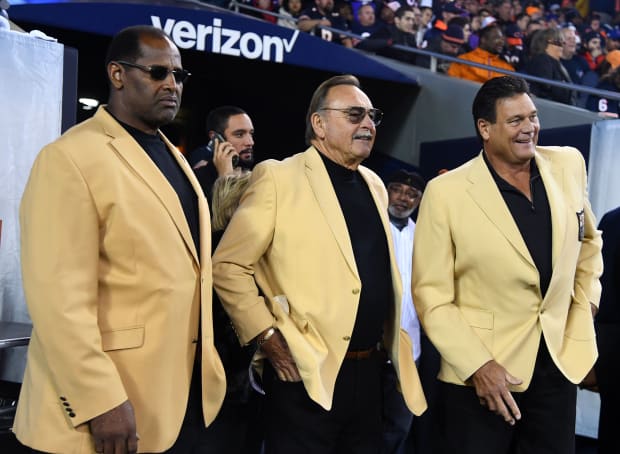
Richard Dent, Dick Butkus and Dan Hampton are Hall of Famers and three of the greatest Bears defensive players of all time.

If you love football, it is tough not to love the Chicago Bears. They are a storied franchise packed with legendary players and personalities who have made pro football what it is today. The organization dates back to 1920 and the dawn of the NFL. NFL players have done some incredible things in the past 100 years, and many of them did so while wearing a Bears jersey.

This is a team with a history of toughness. During their best years, the Bears dominated and bullied opponents with powerful defenses. Names like Butkus, Singletary and Atkins are highly revered in the football world. They were all Bears, and they are all in the Hall of Fame.

For many football fans, the Bears symbolize what football is all about. Although, if you are a Lions, Vikings or Packers fan, it is forgivable if you feel differently.

In this article, I will attempt to choose the top defensive players of all time, but it is unlikely that you will agree with all of my choices—10 spots just aren’t enough.

When evaluating a player I will consider:

  • All-Pro nominations
  • Pro Bowls
  • Super Bowl and NFL championships
  • Dominance in the era when they played
  • Overall value to the Bears organization during their playing time
  • Hall of Fame credentials

Here are the 10 greatest defensive players in the history of the Chicago Bears.

10. Ed Sprinkle (1944–1955)

At only 206 pounds, Sprinkle wasn’t the kind of player modern fans would think of as a dangerous edge rusher. But as a defensive end, he was among the most feared players of his generation and is known as one of the NFL’s hardest hitters.

Chicago only had three losing records during Sprinkle’s 12 years with the team, and they even won an NFL championship in 1946. He intercepted four passes and recovered 12 fumbles on defense, but he played when the NFL didn’t keep official numbers on quarterback sacks. On the offensive side of the ball, he caught 32 passes for 451 yards and seven touchdowns.

Sprinkle made four Pro Bowls during his career. The NFL posthumously welcomed him into the Hall of Fame with the expanded class of 2020.

Position: Defensive End

Jersey Number: 7

Years With Bears: 12

Accolades With Bears

  • Four Pro Bowls
  • NFL champion, 1946
  • Hall of Fame, 2020

Stats With Bears

  • 132 games
  • Four interceptions for 55 yards
  • 12 fumbles recovered, two touchdowns

9. Dan Hampton (1979–1990)

Hampton was a powerful defensive end who helped Chicago win a Super Bowl after the 1985 season. Along with fellow defensive linemen Richard Dent, Steve McMichael and William Perry, he formed the core of Defensive Coordinator Buddy Ryan’s famed 46 Defense.

The Bears' ‘85 defensive unit ranked first in the league while giving up only 12.4 points per game. It has gone down in history as one of the greatest defenses of all time.

In 12 seasons, Hampton made four Pro Bowls and one All-Pro team. His 57 sacks rank him third all-time in Bears history. He was enshrined in the Hall of Fame with the Class of 2002.

Position: Defensive End

Jersey Number: 99

Years With Bears: 12

Accolades With Bears

  • One All-Pro Team
  • Four Pro Bowls
  • Super Bowl champion, 1985
  • Hall of Fame, 2002

Stats With Bears

  • 157 games
  • 57 sacks
  • 10 fumbles recovered, one touchdown

8. George Connor (1948–1955)

Connor made All-NFL at offensive tackle, defensive tackle and linebacker during his eight-year career. Connor was already formidable at both offensive and defensive tackle when the Bears tried him at linebacker in a game against the Eagles.

Philadelphia had been killing Chicago with the same sweep all game, and Chicago's coaching staff reasoned that a big, agile player like Connor might be able to disrupt the play. The move worked, and the Bears won the game.

Connor made All-NFL at offensive tackle, defensive tackle and linebacker during his eight-year career. He made both the Pro Bowl and All-Pro rosters four straight years, from 1950 to 1953. Connor was inducted into the Hall of Fame with the class of 1975.

Position: Linebacker, Defensive Tackle

Jersey Numbers: 81, 71

Years With Bears: Eight

Accolades With Bears

  • Four All-Pro Teams
  • Four Pro Bowls
  • Hall of Fame, 1975

Stats With Bears

  • 91 games
  • Seven interceptions for 66 yards
  • 10 fumbles recovered, one touchdown

7. Richard Dent (1983–1993, 1995)

Dent played alongside defensive linemen Dan Hampton and Steve McMichael for most of his career, and all three are Bears legends. They were ferocious pass rushers, and in 1985, they were key players on one of the greatest defenses in NFL history.

Dent is the all-time franchise leader for sacks, with 124.5. He made four Pro Bowls and one All-Pro team and won the Super Bowl as part of the ’85 Bears.

After 11 years in Chicago, he signed with the 49ers for the 1994 season. Even though injuries kept him off the field for most of the year, he collected another Super Bowl ring with San Francisco before returning to Chicago for the 1995 season.
Dent was enshrined in the Hall of Fame with the Class of 2011.

Position: Defensive End

Jersey Number: 95

Years With Bears: 12

Accolades With Bears

  • One All-Pro Team
  • Four Pro Bowls
  • Super Bowl champion, 1985
  • Hall of Fame, 2011

Stats With Bears

  • 170 games
  • 124.5 sacks
  • Eight interceptions for 89 yards and one touchdown
  • 13 fumbles recovered, one touchdown
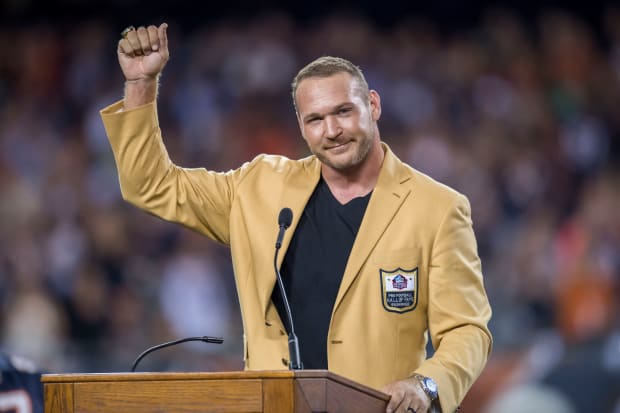
Brain Urlacher is one of the greatest Bears linebackers of all time.

6. Brian Urlacher (2000–2012)

With his incredible combination of size and speed, Urlacher was the prototypical middle linebacker for the new millennium. He made an immediate impact as a rookie when he not only earned a starting spot, but he also made his first Pro Bowl and garnered the Defensive Rookie of the Year honor.

Urlacher made eight All-Pro teams and eight Pro Bowls during his career, and he earned Defensive Player of the Year in 2005. He helped lead the team to an NFC championship in 2006, though they lost Super Bowl XLI to the high-powered Colts team.

Urlacher followed Bears middle linebackers Bill George, Dick Butkus and Mike Singletary, to the Hall of Fame. He was inducted with the Class of 2018 and is now considered one of the

greatest linebackers in Bears history.

Position: Linebacker

Jersey Number: 54

Years With Bears: 13

Accolades With Bears

  • Four All-Pro Teams
  • Eight Pro Bowls
  • Defensive Rookie of the Year, 2000
  • Defensive Player of the Year, 2005
  • Hall of Fame, 2018

Stats With Bears

  • 182 games
  • 41.5 sacks
  • 22 interceptions for 324 yards and two touchdowns
  • 15 fumbles recovered

5. Clyde Turner (1940–1952)

“Bulldog” Turner was a two-way player and an outstanding center on the offensive side of the ball. On defense, he served as an intimidating linebacker.

He played during a time when the Bears routinely demolished whatever hapless team the NFL schedule had lined up for them. Chicago appeared in five NFL championship games during his 13-year career and won four of them.

Turner made four Pro Bowls and seven All-Pro rosters during his 138 games as a Bear. He intercepted 17 passes, recovered five fumbles and scored three defensive touchdowns.

He was enshrined in the Hall of Fame with the Class of 1966.

Position: Linebacker

Jersey Number: 66

Years With Bears: 13

Accolades With Bears

  • Four All-Pro Teams
  • Seven Pro Bowls
  • Four-Time NFL champion (1940, 1941, 1943, 1946)
  • Hall of Fame, 1966

Stats With Bears

  • 138 games
  • 17 interceptions for 298 yards and two touchdowns
  • Five fumbles recovered, one touchdown

4. Bill George (1952–1965)

George was one of the first great middle linebackers in the NFL. He began his career as a middle guard in a 5-2 defense, but made the shift to linebacker after realizing he could get back into pass coverage faster if he started the play on his feet. This led to the evolution of the modern 4-3 defense.

He made the Pro Bowl every season from 1954 to 1961 and was named All-Pro eight times. Over 14 seasons as a Bear, he appeared in 159 games. George and the Bears won an NFL championship in 1963.

Interestingly, the Bears occasionally called George into duty as a kicker. In 1954, he kicked four field goals and converted on 13 of 14 extra-point attempts.

George entered the Hall of Fame with the Class of 1974.

Position: Linebacker, Middle Guard

Jersey Number: 61

Years With Bears: 14

Accolades With Bears

  • Eight All-Pro Teams
  • Eight Pro Bowls
  • Hall of Fame, 1974

Stats With Bears

  • 119 games
  • 22 interceptions for 166 yards

3. Mike Singletary (1981–1992)

Singletary was among the best middle linebackers ever to play the game. In 1985, he helped lead the Bears to a 15–1 record and crush the New England Patriots in Super Bowl XX.

In many ways, the smart, intense and calculating Singletary marks the delineation between the blood-and-guts linebackers of the past and the cerebral players of today. But make no mistake; he was also one of the hardest hitters in the NFL, and he held down the middle of the field with tremendous tenacity.

Singletary spent 12 years as a Bear. He earned the NFL Defensive Player of the Year Award twice, made 10 Pro Bowls and was voted to seven All-Pro rosters. He was enshrined in the Hall of Fame with the Class of 1988.

Position: Linebacker

Jersey Number: 50

Years With Bears: 12

Accolades With Bears

  • Seven All-Pro Teams
  • 10 Pro Bowls
  • Super Bowl champion, 1985
  • Defensive Player of the Year, 1985
  • Defensive Player of the Year, 1988
  • Hall of Fame, 1998

Stats With Bears

  • 179 games
  • 19 sacks
  • Seven interceptions for 44 yards
  • 12 fumbles recovered

2. Doug Atkins (1955–1966)

Atkins was one of the most feared pass rushers in the league during his time with the Bears. He played before quarterback sacks were an official statistic, but Atkins himself estimated he may have had as many as 25 during his best seasons. When watching films of him in action, it is easy to believe that this wasn’t an exaggeration. At 6'8", he towered over most opponents and was simply unblockable at times. Some players of his era regarded him as the strongest man in the NFL.

Atkins played for 12 seasons in Chicago, during which he started 129 games while making eight Pro Bowls and one All-Pro team. He was inducted into the Hall of Fame with the class of 1982.

Position: Defensive End

Jersey Number: 81

Years With Bears: 12

Accolades With Bears

  • One All-Pro Team
  • Eight Pro Bowls
  • Hall of Fame, 1982
  • NFL champion, 1963

Stats With Bears

  • 146 games
  • Three interceptions for three yards
  • Nine fumbles recovered

1. Dick Butkus (1965–1973)

If there is one man who personifies the ideal Bears defensive player, it is Dick Butkus. He played in an era of great middle linebackers like Ray Nitschke, Mike Curtis and Willie Lanier, but he stood above them all.

He was big—at almost 250 pounds—and faster than a man his size should be. For nine seasons, he haunted the dreams of opposing offensive players on Saturday nights and turned their Sunday afternoons into nightmares.

Butkus started in 119 games during his career. He made five All-Pro teams and made the Pro Bowl every year but his last, when he started only nine games because of injury.

Today, many regard him as the greatest middle linebacker of all time. He was inducted into the Hall of Fame with the Class of 1979.

Position: Linebacker

Jersey Number: 51

Years With Bears: Nine

Accolades With Bears

  • Five All-Pro Teams
  • Eight Pro Bowls
  • Hall of Fame, 1979

Stats With Bears

  • 119 games
  • 22 interceptions for 166 yards
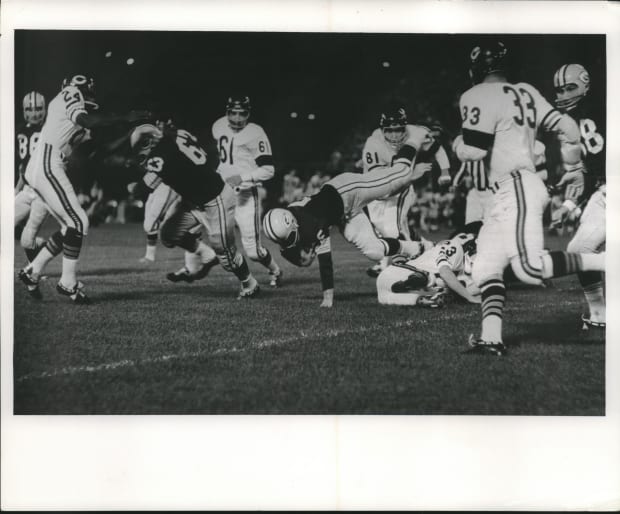
Bill George (61) and Doug Atkins (81) pursue Packers halfback Paul Hornung.

Honorable Mentions

It hurts to keep these guys off the main list. They’re some of the greatest Bears in the franchise's history, but with only 10 spots, I had to make some tough choices. You can think of them as honorable mentions, or you can think of them as among the top 15 Bears defensive players of all time.

Gary Fencik (1976–1987)

Fencik was a tough safety who holds the franchise record for career interceptions. He made two Pro Bowls and one All-Pro roster in his 12-year career, and he was a starter on the famed ’85 Bears defense that helped bring a Lombardi Trophy to Chicago.

Steve McMichael (1981–1993)

McMichael was another key player on the ’85 Bears. He spent 13 years in Chicago during which he made two Pro Bowls and two All-Pro teams.

Joe Fortunato (1955–1966)

Many Bears fans consider Fortunato to be one of the franchise’s biggest Hall of Fame snubs. He played alongside Bill George and Larry Morris in a group of linebackers that helped bring an NFL championship to Chicago in 1963.

Richie Petitbon (1959–968)

Petitbon played 10 years in Chicago and his 37 interceptions rank him second in franchise history. He made one All-Pro roster and four Pro Bowls in his career and helped the Bears win a championship in 1963.

Lance Briggs (2003–2014)

Briggs played 12 seasons in Chicago and made seven straight Pro Bowls and one All-Pro roster. He and the Bears won an NFC championship in 2006.

Who Is the Best Bears Defensive Player of All Time?

Dick Butkus was the greatest Bears defensive player in the franchise's history. He is one of the greatest NFL players of all time as well, and was an absolute force of nature at middle linebacker. Butkus never won a championship, and because he played for fewer seasons, he doesn’t have the accolades of some other players on this list. But, it’s hard to imagine opposing offensive players fearing any other Bear like they did Butkus.

Writing this article required making some tough decisions. I could stare at the names for days and always find reasons to rearrange them. Ultimately, a player’s dominance during their era factored heavily into my choices.

You may be asking, "What about McMichael, Fencik and Fortunato as honorable mentions?" And in response, I can’t say I feel good about not including them in the top 10. They have to be part of any conversation about the greatest Bears defensive players, but if I put them in the top 10, who would I bump?

This is what you call a conundrum. However, if you are a Bears fan, it is a good conundrum to have. Your team has fielded some of the greatest defensive players in NFL history. Over the decades, they’ve brought championships to Chicago and helped define pro football.

New on SI: Top 10 Players in Arizona Cardinals History

The Cardinals are not the most successful franchise in NFL history. But with 100 years on the field, their all-time roster has numerous Hall of Famers. This article will explore the 10 greatest players in Cardinals history.

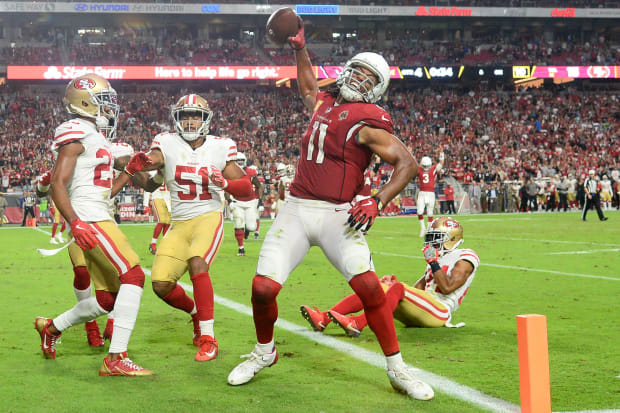
Cardinals wide receiver Larry Fitzgerald spikes the ball after scoring a touchdown against the 49ers during the 2018 season. Fitzgerald has been the face of the franchise for 16 years, but is he the greatest Cardinals player of all time?

Who Are the Greatest Cardinals Players of All Time?

The Cardinals haven’t been the most successful NFL franchise over the past 100 seasons, but they’ve still employed some of the most recognizable names in history. As one of the charter members of the NFL, the Cardinals have racked up 22 Hall of Famers and made it to the postseason 10 times.

Selection Criteria

  • Legacy Honors (Hall of Fame, Ring of Honor, retired number, etc.)
  • Single-Season Honors (MVP, All-Pro, Pro Bowl, league leader, etc.)
  • On-Field Success (winning percentage, winning seasons, playoff appearances, etc.)
  • Longevity (years with Cardinals, percentage of career with Cardinals, etc.)

Only games played with the Cardinals are factored into this list, so while Hall of Famer Emmitt Smith is a prime candidate for a list about the Cowboys, his two seasons with the Cardinals won't make the cut here.

Following this list, I've also included a few honorable mentions.

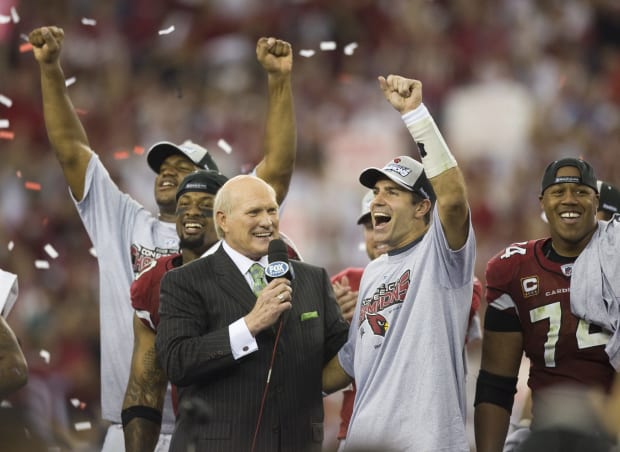
Quarterback Kurt Warner celebrates during an interview with FOX broadcaster Terry Bradshaw after leading the Cardinals to the 2008 NFC championship.

10. Kurt Warner

  • Years With the Cardinals: 2005–09
  • Position: Quarterback
  • Playoff Appearances: 2008–09
  • Pro Bowl: 2008
  • Legacy Honors: Hall of Fame (2017), Cardinals Ring of Honor
  • Awards: NFL Man of the Year (2008)

Kurt Warner is the only quarterback to ever lead the Cardinals to the Super Bowl, but he did more than just that in his five-year tenure with the franchise. Warner first came to the team on a basic one-year deal and ended up having to compete for the starting position for three years. But once he nailed down that starting role in 2008, the Cardinals made the postseason for the first time in a decade and made a magical run to the Super Bowl. Over five years in Arizona, Warner completed 1,371 of 2,105 passes for 15,843 yards and 100 touchdowns.

9. Ollie Matson

  • Years With the Cardinals: 1952, 1954–58
  • Position: Running back
  • All-Pro: 1952, 1954–57
  • Pro Bowl: 1952, 1954–58
  • Awards: Co-Rookie of the Year (1952)
  • Legacy Honors: Hall of Fame (1972), Cardinals Ring of Honor, NFL 1950s All-Decade Team

It was clear the Cardinals were getting a speedy running back when they selected Ollie Matson with the third pick in the 1952 NFL Draft. Not only did Matson lead the nation in rushing as a senior at the University of San Francisco, he also won a pair of medals at the 1952 Helsinki Olympics.

Matson was among the NFL’s best from the beginning of his career—picking up Pro Bowl and All-Pro selections in each of his first five seasons. He missed the 1953 campaign while serving in the Army. Though he was primarily known as a running back, Matson was an all-around athlete who also played defense and returned kicks and punts—including three kick returns of at least 100 yards. Matson finished his Cardinals career with 5,481 yards from scrimmage and 40 touchdowns, while also intercepting three passes and scoring on nine returns.

8. Dick (Night Train) Lane

  • Years With the Cardinals: 1954–59
  • Position: Cornerback
  • All-Pro: 1956
  • Pro Bowl: 1954–56, '58
  • Legacy Honors: Hall of Fame (1974), Cardinals Ring of Honor, NFL 75th Anniversary Team, NFL 100th Anniversary Team

Dick (Night Train) Lane established himself as a premier defensive back as a rookie with the Rams in 1952. When the Cardinals acquired him as part of a three-team trade in 1954, they already knew what kind of player they were getting. Lane promptly rewarded his new team with a league-leading 10 interceptions for 181 yards in his first season, along with the first of three straight Pro Bowl selections.

Ultimately, he snared 30 interceptions for the Cardinals, which was a team record at the time. Lane also saw the occasional snap on offense, and was on the receiving end of a 98-yard pass in 1955, which remains tied for the longest pass play in team history.

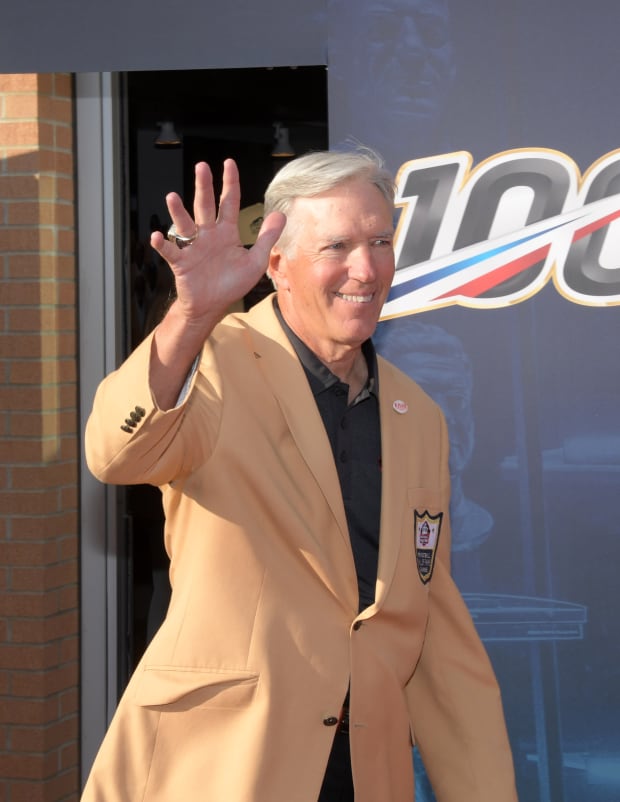
Roger Wehrli arrives during the 2019 Pro Football Hall of Fame Enshrinement at Tom Benson Hall of Fame Stadium in Canton, Ohio.

7. Roger Wehrli

  • Years With the Cardinals: 1969–82
  • Position: Cornerback
  • Playoff Appearances: 1974–75, '82
  • All-Pro: 1975–77
  • Pro Bowl: 1970–71, 1974–77, '79
  • Legacy Honors: Hall of Fame (2007), Cardinals Ring of Honor, NFL 1970s All-Decade Team

Roger Wehrli rarely missed a game during his 14-year career with the Cardinals, and considering how good he was in the defensive backfield, only the opposition had a problem with it. Wehrli missed just six games during his career and had at least one interception in all but two seasons. Wehrli ranks third all-time for the Cardinals with 40 career interceptions—two of which were returned for a touchdown. He also scored an offensive touchdown on a fake field goal attempt in the 1982 season finale—helping the Cardinals secure a playoff spot in what was his final regular-season game.

Some of Wehrli’s highest praise came from a rival in Hall of Fame Cowboys quarterback Roger Staubach, who coined the phrase “shutdown corner” when describing Wehrli’s talent.

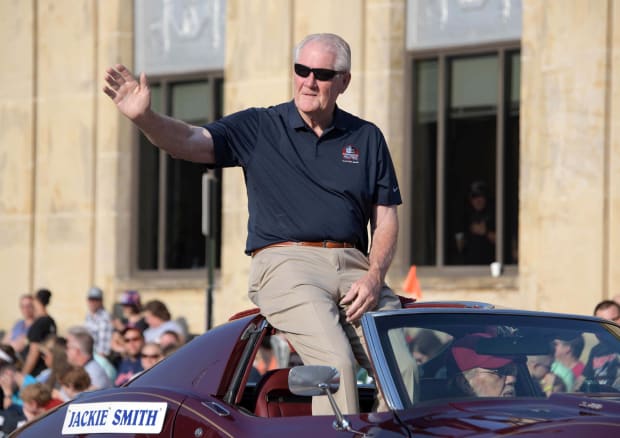
Hall of Famer Jackie Smith rides during the annual Grand Parade prior to the 2018 Pro Football Hall of Fame induction ceremony.

6. Jackie Smith

  • Years With the Cardinals: 1963–77
  • Position: Tight end
  • Playoff Appearances: 1974–75
  • Pro Bowl: 1966–70
  • Legacy Honors: Hall of Fame (1994)

The Cardinals did not draft Jackie Smith expecting to get a Hall of Famer. Smith was a 10th-round selection in 1963, but made the team and became a staple of the offense for much of the next 15 years. His 212-yard effort against the Steelers as a rookie remains the third-best single-game showing in team history. He closed his Cardinals career with 480 receptions for 7,918 yards and 40 touchdowns.

When he retired from the NFL after one additional season with the Cowboys, he was the all-time leader in receiving yards among tight ends. Despite his historic standing, Smith is the franchise’s longest-tenured Hall of Famer not inducted into the Cardinals’ Ring of Honor.

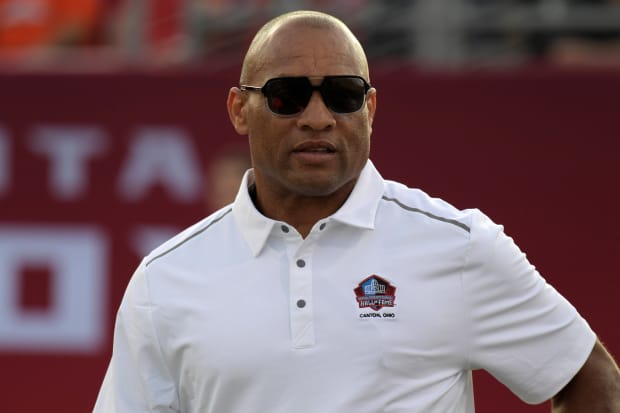
Hall of Famer Aeneas Williams walks on the sideline prior to the 2019 Hall of Fame Game in Canton, Ohio.

5. Aeneas Williams

  • Years With the Cardinals: 1991–2000
  • Position: Defensive back
  • Playoff Appearances: 1998
  • All-Pro: 1995, ‘97
  • Pro Bowl: 1994–99
  • Legacy Honors: Hall of Fame (2014), Cardinals Ring of Honor, NFL 1990s All-Decade Team
  • Awards: NFL All-Rookie (1991)

Aeneas Williams is among the most dependable players ever to wear a Cardinals uniform, playing in all 160 games during his 10 seasons with the franchise. Williams intercepted a pass in his first two games as a rookie and never looked back. With 46 interceptions and 14 fumble recoveries, he positioned himself as one of the greatest defensive players in team history.

He led the NFL with nine interceptions in 1994, setting off a brilliant four-season stretch that saw him snare 27 interceptions and score five times. He is Arizona’s all-time leader with six career interception returns for a touchdown and is also tied for the longest fumble return in NFL history (104 yards). Also included among the greatest highlights of Williams’ tenure with the Cardinals are his two interceptions during a 20–7 victory over the Cowboys in a 1998 playoff game—which was the franchise’s first playoff win since 1947.

4. Charley Trippi

  • Years With the Cardinals: 1947–55
  • Position: Running back
  • Playoff Appearances: 1947–48
  • All-Pro: 1948
  • Pro Bowl: 1952–53
  • Legacy Honors: Hall of Fame (1968), Cardinals Ring of Honor, NFL 1940s All-Decade Team

Charley Trippi did a little bit of everything for the Cardinals and played an instrumental role when the franchise won its first championship. Trippi was a member of the “Million-Dollar Backfield” that pushed the Cardinals to the 1947 NFL title and the 1948 championship game. He had 104 total yards from scrimmage and two touchdowns in the 28–21 championship win over the Eagles in ‘47. Trippi scored on a 44-yard rush to open the scoring and added a 75-yard punt return in the third quarter.

Though mostly remembered for his exploits as a running back, Trippi was also proficient as a quarterback, punter, return man and on defense. He gained 3,506 yards and 23 touchdowns on 687 carries, while also passing for 16 career touchdowns, averaging 40.3 yards per punt on 196 attempts, and intercepting four passes defensively.

3. Dan Dierdorf

  • Years With the Cardinals: 1971–83
  • Position: Offensive tackle
  • Playoff Appearances: 1974–75, 1982
  • All-Pro: 1976–78
  • Pro Bowl: 1974–78, '80
  • Legacy Honors: Hall of Fame (1996), Cardinals Ring of Honor, NFL 1970s All-Decade Team

In the mid-1970s, Dan Dierdorf served as an anchor for the offensive line during one of the best three-season stretches in Cardinals history. Dierdorf started every game from 1974 to '76, helping the Cardinals make the playoffs twice and win at least 10 games every year. In each of those seasons, the Cardinals finished in the top 10 in the NFL in scoring and offensive yardage, while also unofficially surrendering the fewest sacks in the NFL. Included was a then-NFL record of eight sacks allowed in 1975. Dierdorf remained a fixture in the offense beyond that stretch, starting every game in 1978 and from 1980 to '82.

2. Larry Wilson

  • Years With the Cardinals: 1960–72
  • Position: Safety
  • All-Pro: 1966–70
  • Pro Bowl: 1962–63, 1965–70
  • Legacy Honors: Hall of Fame (1978), Cardinals Ring of Honor, Cardinals No. 8 Retired, NFL 1960s All-Decade Team, NFL 1970s All-Decade Team, NFL 75th Anniversary Team, NFL 100th Anniversary Team
  • Awards: 1966 Defensive Player of the Year

The most decorated defensive player in the history of the Cardinals is Larry Wilson, who spent 13 seasons on the field and another 30 years in the team’s front office. Wilson was a seventh-round draft pick in 1960, but quickly developed into an elite defensive back. He did not invent the safety blitz but is regarded as one of the first players to frequently use the sneaky maneuver to pressure the quarterback. When he wasn’t in the backfield, he was often in tight coverage or intercepting passes.

Wilson holds franchise records with 52 career interceptions for 800 yards, and is second all-time with five returns for a touchdown. His best season came in 1966, when he intercepted an NFL-leading 10 passes. Along the way, he picked off a pass in seven straight games, including three in a win over the Bears.

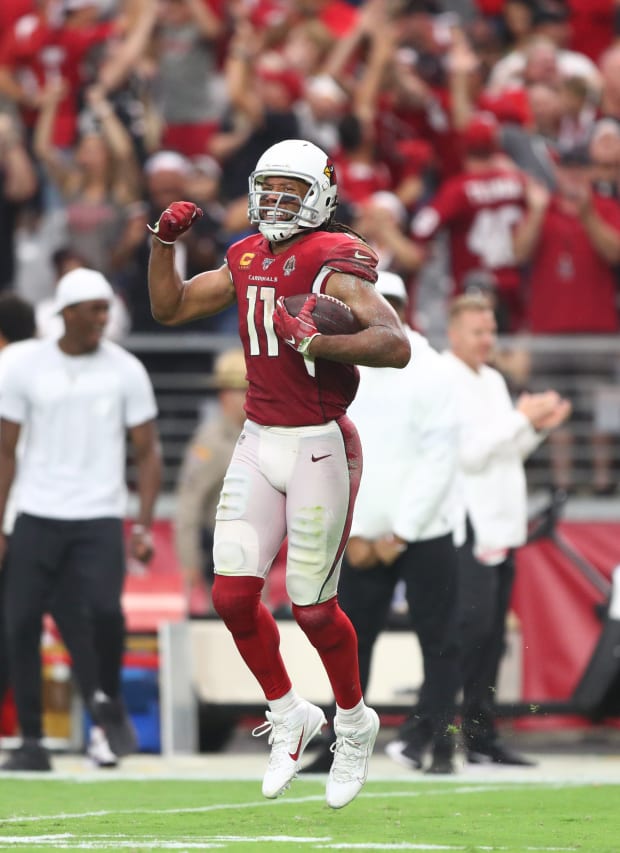
Wide receiver Larry Fitzgerald celebrates after making a catch in the fourth quarter during a 2019 game against the Lions.

1. Larry Fitzgerald

  • Years With the Cardinals: 2004–present
  • Position: Wide receiver
  • Playoff Appearances: 2008–09, 2014–15
  • All-Pro: 2008
  • Pro Bowl: 2005, 2007–13, 2015–17
  • Legacy Honors: NFL 2010s All-Decade Team, NFL 100th Anniversary Team
  • Awards: NFL Man of the Year (2016), Pro Bowl MVP (2008)

Larry Fitzgerald is still building his legacy with the Cardinals, but he’s already been so successful that I am comfortable claiming him as the greatest player in franchise history. Since being drafted in 2004, Fitzgerald has been one of the most consistent players in the NFL, and he played a significant role on the way to Arizona’s only Super Bowl appearance. Fitzgerald has missed just six games in 16 years and has been targeted at least 100 times every season. He’s made a catch in every game since Week 8 of his rookie season, a span of 243 games that is second in NFL history to Jerry Rice. His 1,378 career receptions and 17,083 career yards are also second all-time to Rice.

Fitzgerald was a key player in 2008 when the Cardinals made a memorable run through the playoffs to reach their first Super Bowl. After piling up 1,431 yards and an NFL-leading 12 touchdowns in the regular season, Fitzgerald posted 419 yards and five touchdowns in three playoff victories to help clinch the Super Bowl berth. In nine career playoff games, Fitzgerald has caught 57 passes for 942 yards and 10 touchdowns.

Honorable Mentions

While the above players are the best of the best in Cardinals history, there are a couple of other players who have made significant contributions to the franchise but fell just outside of the top 10.

Ernie Nevers

Ernie Nevers was known as one of the most complete football players in the NFL’s early history, and he became a charter member of the Pro Football Hall of Fame in 1963. Despite only playing for the Cardinals from 1929 to '31, Nevers scored 26 touchdowns and also served as the kicker. He set an NFL record when he accounted for all 40 points during a 1929 victory over the Bears.

Duke Slater

Duke Slater was one of the first prominent Black players in the NFL, and he played at an All-Pro level on offense and defense. Slater played for the Cardinals from 1926 to '31, and notably played all 60 minutes during a 1929 victory over the Bears, where he helped lead the way for Ernie Nevers to score all 40 of the Cardinals’ points. Slater was selected to the Pro Football Hall of Fame as a member of the Centennial Class of 2020.

Paddy Driscoll

Another of the NFL’s early superstars was Paddy Driscoll. He played for the Cardinals from 1920 to '25 as a quarterback, halfback and kicker. Driscoll scored 17 touchdowns and booted 37 field goals to help him earn a spot on the NFL’s 1920s All-Decade team. He was elected to the Pro Football Hall of Fame in 1965, and once held the NFL record by scoring 27 points in a game in 1923.

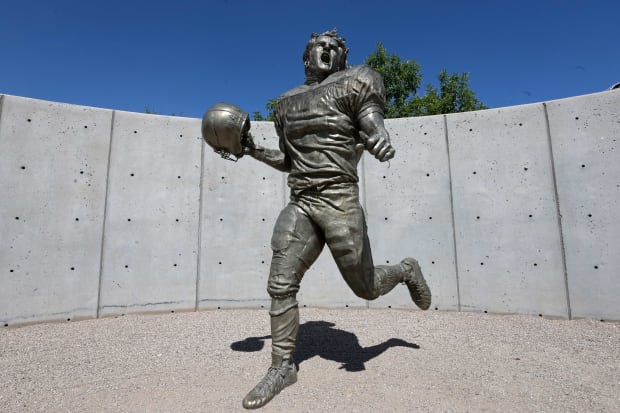
A statue dedicated to the memory of Pat Tillman is seen outside of the Cardinals’ stadium.

Special Mention

One particular Cardinals player was never given the chance to showcase his full potential, but the reason why is greater than football ever will be.

Pat Tillman

Pat Tillman, a rising star at safety, made 155 tackles during the 2000 season—his first as a full-time starter. He put his career on pause in 2002 to join his brother in enlisting with the U.S. Army on a three-year term. Sadly, his career ended when he was killed by friendly fire in Afghanistan in 2004. Tillman remains among the most remembered players to ever wear a Cardinals uniform, with many memorializing him for his principles and dedication rather than his play on the field—which is likely how Tillman would have wanted it.

Friday, 21 August 2020

New on SI: Detroit Lions Hall of Fame Players: A Complete History

There are 21 former Lions enshrined in the Pro Football Hall of Fame, including 15 who played most of their career in the Motor City.

Lions Hall of Famers Lem Barney, Joe Schmidt and Barry Sanders (left to right) stand on the field before a 2019 game at Ford Field.

How Many Lions Are in the Pro Football Hall of Fame?

As one of the oldest teams in the NFL, the Lions have developed some of the best players to ever grace a professional football field. As of the 2020 induction ceremonies, there are 21 individuals enshrined in the Pro Football Hall of Fame in Canton, Ohio, who spent at least one season with the Lions (6% of the 346 individuals inducted). Among them, 15 played a significant portion of their career in Detroit.

Included on this list are one of the greatest running backs to ever play in the NFL, four standout defenders who played at least 11 seasons with the Lions and numerous players who helped lead Detroit to three championships during the 1950s. With titles in 1952, '53 and '57, that decade proved to be the greatest dynasty in Lions history. Seven of Detroit's Hall of Famers were prominently featured on those championship teams.

What follows is a list of every Hall of Famer who has played at least one game for the Lions. The players are listed in order by the number of seasons each spent in the Motor City.

Including his coaching years, linebacker Joe Schmidt is the longest-tenured member among Lions Hall of Famers. He won championships in 1953 and ‘57.

Joe Schmidt

  • Position: Linebacker, coach
  • College: Pittsburgh
  • Seasons Played: 1953–65
  • Seasons With the Lions: 1953–65
  • Seasons Coached: 1966–72
  • Seasons Coached With the Lions: 1966–72
  • Year Inducted: 1973
  • Stats: 24 interceptions, 3 defensive TDs
  • Awards: NFL Defensive MVP (1960, '63), NFL Lineman of the Year ('57)
  • Legacy Honors: NFL Top 100 All-Time Team, NFL 1950s All-Decade Team
  • All-Pro: 1954–62
  • Pro Bowl: 1954–63

During a 13-year playing career with the Lions, Joe Schmidt was among the best defenders in the league and revolutionized the middle linebacker position. With 10 straight Pro Bowl and nine straight All-Pro selections, Schmidt burst onto the scene—despite being selected as a seventh-round draft pick. He didn't miss a start throughout his first seven years in the league, and his prowess in the middle of the field helped the Lions finish in the top three in scoring defense in three of those seasons. Detroit also won a pair of NFL championships during his tenure.

In 1955, Schmidt tied the NFL record by recovering eight fumbles lost by his opponents (the mark was broken in 1963), and his 17 career fumble recoveries are tied for the most in team history among defenders. He set his career high with six interceptions in 1958, a nice continuation of his postseason success in 1957. That year, he intercepted a pass in playoff wins over the 49ers and the Browns, which helped bring the Lions their third NFL championship in six seasons.

Schmidt sustained a shoulder injury in the 1960 preseason, which forced him to miss the first games in his career. Once he came back to the field, however, he returned an interception for the first touchdown of his career. Over his final five seasons, Schmidt started every game of a campaign three times, and in both 1961 and '65 he had four interceptions.

He announced his retirement in March 1966 and joined the team as an assistant coach. The next season, he was promoted to head coach and was involved in the drafting of multiple future Hall of Famers. Schmidt had a 43-34-7 record in Detroit and led the team to the playoffs in 1970. By the end of his coaching tenure in 1972, he had served the Lions for 20 straight seasons.

Former Lions defensive back Dick LeBeau served as the defensive coordinator for the Titans during the 2017 season. Between his playing days with the Lions and his seasons as a coach, LeBeau spent 59 years in the NFL.

Dick LeBeau

  • Position: Defensive back
  • College: Ohio State
  • Seasons Played: 1959–72
  • Seasons With the Lions: 1959–72
  • Year Inducted: 2010
  • Stats: 62 interceptions, 3 TDs
  • All-Pro: 1964–65, '70
  • Pro Bowl: 1964–66

Dick LeBeau spent 14 seasons as a defensive back for the Lions. Despite season after season of strong play, he is remembered just as much for his time as a defensive coordinator. He was drafted in the fifth round of the 1959 NFL Draft by the Browns but was cut in the preseason. LeBeau then came to Detroit, and by 1960, he was slated in the starting lineup and rarely missed time until he retired in 1972.

LeBeau became a ball-hawking defensive back, intercepting at least four passes in all but one season between 1960 and '71—which included a career-high nine in 1970. His career total of 62 is tied for 10th in NFL history and stands as the team's all-time record. In four separate seasons, he snared a pair of interceptions in two different games.

Following his playing career, LeBeau revolutionized NFL defenses by perfecting the zone blitz as a defensive coordinator. When he retired from coaching in 2017, he had spent 59 straight seasons in the NFL.

Alex Karras is interviewed by a reporter from the Detroit Free Press in 1957. He is the most recent Lions player to be inducted into the Hall of Fame.

Alex Karras

  • Position: Defensive tackle
  • College: Iowa
  • Seasons Played: 1958–62, 1964–70
  • Seasons With the Lions: 1958–62, 1964–70
  • Year Inducted: 2020
  • Stats: 16 fumble recoveries, 4 interceptions
  • Legacy Honors: NFL 1960s All-Decade Team, Pride of the Lions
  • All-Pro: 1960–61, ‘65
  • Pro Bowl: 1960–62, ‘65

Many Detroit fans long asked the question, "Is Alex Karras in the Hall of Fame?" As of 2020, they can finally answer that question with a resounding, "Yes!" He was inducted as part of that year's Centennial Class.

Karras had all the qualifications expected of a Hall of Famer, but some off-the-field concerns are believed to have left him out of Canton for so many years. He was suspended in 1963 due to gambling—a negative mark on his stellar on-field record that saw him make four Pro Bowls and earn seven first- or second-team All-Pro selections from the Associated Press.

He was credited with 97.5 sacks in his 12-year career, even though sacks weren’t an official statistic when he played.

Lions Hall of Famer Lem Barney arrives at the 2017 Pro Football Hall of Fame enshrinement ceremonies at Tom Benson Hall of Fame Stadium in Canton, Ohio.

Lem Barney

  • Position: Cornerback
  • College: Jackson State
  • Seasons Played: 1967–77
  • Seasons With the Lions: 1967–77
  • Year Inducted: 1992
  • Stats: 56 interceptions, 10 total TDs
  • Awards: Defensive Rookie of the Year (1967)
  • Legacy Honors: Pride of the Lions
  • All-Pro: 1968–69
  • Pro Bowl: 1967–69, 1972–73, 1975–76

Throughout 11 seasons with the Lions, Lem Barney was among the best defensive backs in the NFL. With multiple interceptions every season, he is remembered as one of the best defenders in Lions history. He is also tied for 18th all-time in NFL history for career interceptions.

Barney was a second-round draft pick in 1967, and he made an immediate contribution for the Lions. He intercepted Hall of Fame quarterback Bart Starr in the first quarter of his debut and returned it 24 yards for a touchdown. After four weeks, Barney already had six interceptions for the 3-0-1 Lions. He'd cool considerably in the middle of the season, but then he electrified a home crowd with three interceptions in the season finale. That showing gave him an NFL-leading 10 interceptions on the season, which he returned for a league-best 232 yards and three touchdowns. Those touchdowns remain a single-season franchise record.

In 1968, Barney led the NFL with five fumble recoveries and also added another seven interceptions. Over the next two seasons, he had 15 more interceptions. By the end of his career, he had snared 56 interceptions, which ranks second on Detroit's all-time list. His 1,077 interception return yards and seven touchdowns are both franchise records, and he is also tied for the all-time team lead among defenders with 17 career fumble recoveries.

Yale Lary

  • Position: Defensive back, punter
  • College: Texas A&M
  • Seasons Played: 1952–53, 1956–64
  • Seasons With the Lions: 1952–53, 1956–64
  • Year Inducted: 1979
  • Stats: 50 interceptions, 503 punts for 22,279 yards
  • Legacy Honors: NFL 1950s All-Decade Team, Pride of the Lions
  • All-Pro: 1956–59, 1962–63
  • Pro Bowl: 1953, 1956–62, '64

After being taken as a third-round draft pick in 1952, Yale Lary was a dependable defender and punter for the Lions for more than a decade. Other than missing two seasons due to military service, he played in all but seven games throughout an 11-year career. He grabbed at least two interceptions every season as a safety, while doubling as the team's punter. He led the NFL in punting average in three seasons.

In his first two seasons, he helped the Lions win the NFL championship, and he picked up a third title in 1957. In each of those seasons, Detroit defeated Cleveland for the league crown. Following his military service in 1954 and '55, Lary returned to the Lions and had his best season. In 1956, he intercepted a career-high eight passes and returned one for a 73-yard touchdown. He was joined in the defensive backfield at times throughout his career by three other Hall of Famers.

Known as one of the greatest punters in the history of the league, Lary had an average of 44.3 yards on 503 punts, and he booted a punt at least 60 yards in all but two seasons. He's ranked 32nd all-time in punting average, but when he retired, he was second only to fellow Hall of Famer Sammy Baugh. Among players whose careers began before 2000, he is ranked third. Lary led the NFL in punting average in 1959 (47.1 yards per punt), '61 (48.4 YPP) and '63 (48.9 YPP). His mark from 1963 is tied for the 16th-best mark in NFL history.

Lou Creekmur was a standout offensive lineman who helped the Lions claim NFL championships in 1952, ‘53 and ‘57.

Lou Creekmur

  • Position: Offensive lineman
  • College: William & Mary
  • Seasons Played: 1950–59
  • Seasons With the Lions: 1950–59
  • Year Inducted: 1996
  • Legacy Honors: Pride of the Lions
  • All-Pro: 1951–57
  • Pro Bowl: 1950–57

Lou Creekmur was nothing if not durable. He happened to be a pretty good offensive lineman, too. As a sturdy force up front for the Lions during the 1950s, Creekmur never missed a practice. Nor did he ever miss a preseason, regular season or postseason game during the first nine years of his 10-year career—all while helping Detroit win championships in 1952, '53 and '57. Despite that and his many All-Pro and Pro Bowl selections, it took 32 years for him to finally win election to the Pro Football Hall of Fame.

Creekmur began his career as an offensive guard, but he switched to left tackle after two seasons and dominated that side of the line for many years. He was a 26th-round draft pick of the Eagles in 1948, but Creekmur elected to keep playing in college. The Lions acquired his rights in 1950, and they watched him block for several high-flying offenses. From 1950 to '57, the Lions never finished worse than fifth in total offense, and only twice did they finish outside the top five in scoring offense.

Toward the end of 1958, Creekmur announced he would be retiring at the end of what would become only the second losing season during his career. When the Lions began the 1959 season at 0–4, they summoned Creekmur—who returned for the final eight games of the season to help salvage a 3-8-1 record.

Barry Sanders carries the ball during a game against the Washington Football Team. He is the most prolific running back in franchise history with 15,269 rushing yards.

Barry Sanders

  • Position: Running back
  • College: Oklahoma State
  • Seasons Played: 1989–98
  • Seasons With the Lions: 1989–98
  • Year Inducted: 2004
  • Stats: 15,269 rushing yards, 99 TDs
  • Awards: Offensive Rookie of the Year (1989), NFL MVP (1997), NFL Offensive Player of the Year (1994, '97), Bert Bell Award (1991, '97)
  • Legacy Honors: NFL All-Time 100 Team, NFL 1990s All-Decade Team, Pride of the Lions
  • All-Pro: 1989–98
  • Pro Bowl: 1989–98

Sanders burst onto the scene as a rookie after being selected with the third pick in the 1989 NFL Draft. Despite missing training camp due to a contract dispute, he finished 11 yards shy of the league rushing title to win Offensive Rookie of the Year honors. Sanders closed his season with a 158-yard, three-touchdown showing against the Falcons. He'd lead the league in rushing in 1990 and then have a breakout season in '91.

Sanders eclipsed the 1,500-yard rushing mark for the first time that season while adding a 220-yard, four-touchdown game against the Vikings. Detroit won 12 games in 1991, and Sanders helped the Lions to their only playoff victory since 1957. He'd again lead the league in rushing in 1994, '96 and '97, which is when he became the third player in history to rush for at least 2,000 yards in a season. He had 10 games with at least 100 yards in 1994, and that included a career-high 237-yard effort against the Buccaneers.

The best season during Sanders's career was his MVP season of 1997. He gained 2,053 yards and rushed for at least 100 yards in the last 14 games of the season to set an NFL record. Included in that stretch were a pair of games with more than 200 yards, and he added 11 touchdowns during the year. It was the fourth straight season for Sanders with at least 1,500 rushing yards—no other player in league history has accomplished the feat. He nearly added a fifth such season when he gained 1,491 yards on a league-high 343 carries in 1998.

Charlie Sanders (88) leaps for a one-handed catch against the Chiefs. Sanders was among the first tight ends to play a significant role in the passing offense.

Charlie Sanders

  • Position: Tight end
  • College: Minnesota
  • Seasons Played: 1968–77
  • Seasons With the Lions: 1968–77
  • Year Inducted: 2007
  • Stats: 4,817 receiving yards, 31 TDs
  • Legacy Honors: NFL 1970s All-Decade Team, Pride of the Lions
  • All-Pro: 1969–71
  • Pro Bowl: 1968–71, 1974–76

In 1968, in a third-round draft selection, the Lions found a player who would be their starting tight end for the next 10 seasons: Charlie Sanders. As a dependable blocker and adequate receiver, Sanders was among the NFL's premier players at his position throughout the 1970s. It's likely he would have played longer, but a severe knee injury ended his career before the 1977 season. After retirement, he stayed with the Lions as a scout, coach and broadcaster.

Playing in an era when tight ends were relied on as blockers more so than pass catchers, Sanders helped evolve the position with at least 40 catches in each of his first three seasons. He retired with the team record of 336 receptions, which wasn't broken until Herman Moore eclipsed the mark in 1996—while being coached by Sanders. He's now seventh all-time in team history, but he still has the most receptions, yards (4,817) and touchdowns (31) by a Detroit tight end.

Sanders was the only rookie selected to the Pro Bowl for the 1968 season, and he'd go on to make six more appearances. He closed his rookie season with a career-high 10 catches for 133 yards against the Washington Football Team, and in 1974 he had his career-best yardage total of 146 in a win over the Packers.

Bobby Layne is among the greatest quarterbacks in the history of the Lions. He was the offensive leader on three NFL championship teams.

Bobby Layne

  • Position: Quarterback
  • College: Texas
  • Seasons Played: 1948–62
  • Seasons With the Lions: 1950–58
  • Year Inducted: 1967
  • Stats: 26,768 passing yards, 196 TDs
  • Awards: NFL 1950s All-Decade Team, Pride of the Lions, Lions No. 22 Retired
  • All-Pro: 1952, '54, '56, 1958–59
  • Pro Bowl: 1951–53, '56, 1958–59

Bobby Layne played for four different NFL teams, but many of his best seasons came during the nine years he spent with the Lions. There was, however, a lot of travel in the two years leading up to his acquisition. Originally drafted by the Steelers in 1948, Layne was then traded to the Bears after the draft. Going into the 1949 season, he was sent to the Bulldogs. When he finally arrived in Detroit in 1950, Layne began to develop into a Hall of Fame quarterback.

Layne's passing offenses finished no worse than sixth in the NFL standings while in Detroit, and he helped engineer NFL championship wins in 1952, '53 and '57 (though he did not play in the 1957 title game due to a broken leg). In 1950, Layne led the NFL in passing attempts and yardage, and during the next season, he paced the NFL in attempts, completions, yards and touchdowns. He was steady over the next five seasons, keeping his passing yards between 1,800 and 2,100 each year.

In 1950, Layne threw for 374 yards against the Bears for his top passing performance with the Lions. During his time in Detroit, Layne had three games where he threw four touchdowns. He had a 53-29-2 record with the Lions, and his 15,710 passing yards and 118 touchdowns stood as team records for more than 50 years. Layne struggled in the postseason, however, throwing 12 interceptions to one touchdown, but he did secure a 3–1 record.

Alex Wojciechowicz

  • Position: Center, linebacker
  • College: Fordham
  • Seasons Played: 1938–50
  • Seasons With the Lions: 1938–46
  • Year Inducted: 1968
  • Stats: 19 interceptions
  • Legacy Honors: NFL 1940s All-Decade Team, Pride of the Lions, Polish Sports Hall of Fame (1975)
  • All-Pro: 1939, '44

Alex Wojciechowicz was a first-round draft pick of the Lions in 1938, and he became a regular on the team's offense and defense for the next nine seasons. He played in 86 games for Detroit as a rare two-way player. Defensively as a linebacker, he scored his only career touchdown in 1940 on one of his 14 interceptions with the Lions. Included in that total were seven in 1944, which was Detroit’s single-season record for several years, and his career total was a franchise record until the 1950s. He also served as the team's center. Because of his two-way status, he was known as “Iron Man.”

He was released with two other Lions players following a 0–3 start to the 1946 season, and he was purchased by the Eagles two days later. Wojciechowicz, who became exclusively a linebacker, went on to win a pair of NFL championships in Philadelphia.

Dutch Clark was a player-coach for the Lions in 1937 and '38.

Dutch Clark

  • Position: All-Purpose
  • College: Colorado College
  • Seasons Played: 1931–32, 1934–38
  • Seasons With the Lions: 1931–32, 1934–38
  • Seasons Coached: 1937–42, '49
  • Seasons Coached With the Lions: 1937–38
  • Year Inducted: 1963
  • Stats: 1,507 passing yards, 2,772 rushing yards, 36 rushing TDs
  • Legacy Honors: NFL Top 100 All-Time Team, NFL 1930s All-Decade Team, Associated Press Player of the Decade (1930s), Pride of the Lions, Lions No. 7 Retired
  • All-Pro: 1931–32, 1934–37

Dutch Clark, also known as "The Flying Dutchman," was among the most popular football figures in the 1930s. As a versatile offensive force, Clark regularly scored touchdowns as a quarterback, running back and receiver. Not only that, he was a league-leading kicker in several seasons. While the Lions do not officially retire numbers, there was a ceremony held on Oct. 15, 1939, to honor Clark—and no one has worn his No. 7 since.

Clark's NFL career began when he was granted a leave from his coaching duties at Colorado College in 1931. In two seasons with the Portsmouth Spartans—who relocated to Detroit and became the Lions in 1934—Clark became an All-Pro talent, but he elected to return to college coaching at the Colorado School of Mines in 1933. He returned to the NFL with the Lions right before the 1934 season and became a superstar. He led the league in rushing touchdowns in 1934, '36 and '37. In 1935 and '36, he paced the NFL in total points scored, and he helped lead the Lions to the 1935 league championship.

Clark played 75 games and amassed 2,772 rushing yards, 1,507 passing yards and 341 receiving yards. He scored 42 total touchdowns and kicked 72 extra points and 15 field goals for 369 career points. In two seasons as player-coach of the Lions, Clark had back-to-back 7–4 records in 1937 and ‘38. He was one of 11 players in the Pro Football Hall of Fame’s inaugural induction class.

Jack Christiansen was a defensive back and return specialist for the Lions throughout an eight-year career.

Jack Christiansen

  • Position: Safety
  • College: Colorado A&M
  • Seasons Played: 1951–58
  • Seasons With the Lions: 1951–58
  • Year Inducted: 1970
  • Stats: 46 interceptions, 3 TDs
  • Awards: NFL 1950s All-Decade Team, Pride of the Lions
  • All-Pro: 1952–57
  • Pro Bowl: 1953–57

Jack Christiansen was a steady hand in the secondary for the Lions after being taken as a sixth-round draft pick in 1951. He worked his way into the starting lineup as a rookie, and he became one of several Hall of Famers in Detroit's defense to hold down opponents in the 1950s. He led the league in interceptions twice, and he held the NFL record with eight punt returns for touchdowns when he retired in 1958. He remains tied for fourth all-time.

As a rookie, Christiansen established a still-standing NFL record by returning four punts for touchdowns, and three other players have since accomplished the same feat. Christiansen needed just two games to establish the record, scoring twice against both the Rams and the Packers. After helping the Lions win the NFL championship in 1952, Christiansen had a breakout season the following year. He matched the franchise record with 12 interceptions and added three fumble recoveries on the way to another championship.

Christiansen remained a standout and broke out again in 1957, when he led the league with 10 interceptions and picked up his third championship with the Lions. He briefly held the franchise's career record for interceptions with 46, and he is now fourth all-time. Following his retirement in 1958, he coached in the NFL for 25 years.

Dick "Night Train" Lane

  • Position: Cornerback
  • College: Scottsbluff J.C.
  • Seasons Played: 1952–65
  • Seasons With the Lions: 1960–65
  • Year Inducted: 1974
  • Stats: 68 interceptions, 6 TDs
  • Legacy Honors: NFL 100 Team, NFL 75th Anniversary Team, NFL 1950s All-Decade Team, Pride of the Lions
  • All-Pro: 1955, '56, '58, 1961–63
  • Pro Bowl: 1954–56, '58, 1960–62

After establishing himself as one of the best defensive players in the NFL, Dick "Night Train" Lane came to the Lions to close his career. Lane was traded to the Lions in the 1960 preseason, and he quickly established the fans' trust by racking up four interceptions through six games, making him a favorite for six seasons. A major knee injury took its toll over the last two years of his career—but even today, he is still regarded as one of the best defensive backs ever to play professionally.

In his first season with the Lions, Lane intercepted Hall of Fame quarterback Johnny Unitas and returned it for an 80-yard touchdown. Two games later, he picked off two passes against the 49ers. In the opening games of the 1961 and '63 seasons, Lane had two interceptions to set each of those campaigns into positive motion. After 20 interceptions in four seasons, Lane's career was derailed starting in 1964. He'd play just seven games each of the next two seasons after a knee injury.

Known as one of the most ferocious tacklers of all time, Lane was the only Lions' player represented on the NFL's 75th Anniversary Team, which was revealed in 1994. In 66 games with the Lions, he intercepted 21 passes and returned them 272 yards. He also recovered four fumbles. Following his retirement, he remained with the team through 1972 as a special assistant to Lions owner William Clay Ford.

Running back Doak Walker had a short career, but he was an offensive weapon for two Lions championship teams.

Doak Walker

  • Position: Running back, kicker
  • College: SMU
  • Seasons Played: 1950–55
  • Seasons With the Lions: 1950–55
  • Year Inducted: 1986
  • Stats: 1,520 rushing yards, 2,539 receiving yards, 534 points
  • Awards: Rookie of the Year (1950)
  • Legacy Honors: Pride of the Lions, Lions No. 37 Retired
  • All-Pro: 1950–51, 1953–54
  • Pro Bowl: 1950–51, 1953–55

Doak Walker did a little bit of everything for the Lions. As an All-American and Heisman Trophy winner as a running back at SMU, Walker came into the NFL with high expectations. And while his statistics weren't necessarily eye-popping, his versatility made him a valuable commodity to a team that would win a pair of NFL championships during his tenure.

As a rookie, Walker had 920 yards from scrimmage and 11 touchdowns, while adding eight field goals and 38 extra points. By involving himself in so many aspects of the game, he helped the Lions finish in the top five in total offense every season he played and in scoring offense in all but the 1955 season. He led the league with 43 extra points in both 1951 and '54, and he booted a career-high 12 field goals in 1953.

He retired after just six seasons to pursue other business interests, and he was immediately honored by the team. His jersey number became the second ever to be unofficially retired by the Lions, but he didn't make it to the Hall of Fame for three more decades.

Bust of Lions legend Dick Stanfel, 2016 Pro Football Hall of Fame enshrinement ceremony at the Tom Benson Hall of Fame Stadium in Canton, Ohio.

Dick Stanfel

  • Position: Offensive guard
  • College: San Francisco
  • Seasons Played: 1952–58
  • Seasons With the Lions: 1952–55
  • Year Inducted: 2016
  • Awards: NFL 1950s All-Decade Team, Pride of the Lions
  • All-Pro: 1953–54, 1956–58
  • Pro Bowl: 1953, 1955–58

Dick Stanfel played the first four years of a seven-year career with the Lions, helping pave the way for a prolific offense that won a pair of NFL championships. The offensive guard was selected with the 19th pick of the 1951 NFL Draft, but he was unable to play that season due to a knee injury he sustained in a college All-Star game. Once he recovered, however, Stanfel became one of the best offensive linemen in the NFL.

He helped the 1952 Lions to the NFL championship by blocking for the NFL's No. 2 offense. The following season, he was named the team's MVP as the Lions held the No. 3 rushing attack on the way to a second straight title. He missed several games in 1954 due to a back injury but still contributed to the NFL's No. 1 scoring offense. The next year, he sustained a spinal injury as the Lions fell to their first losing season since 1949, and he was traded to the Washington Football Team. He made three straight Pro Bowl appearances in Washington and later spent 31 seasons as an assistant coach.

Pro Football Hall of Famer Curley Culp waves to the crowd during the Grand Parade before the 2019 enshrinement ceremony in Canton, Ohio.

Hall of Famers Who Made a Stop With the Lions

While the bulk of the Hall of Famers who represent the Lions played most of their career with the team, several other legends only made quick stops in Detroit. The six players who spent three or fewer seasons with the Lions are featured below.

Bill Dudley

  • Position: Running back
  • College: Virginia
  • Seasons Played: 1942, 1945–51, '53
  • Seasons With the Lions: 1947–49
  • Year Inducted: 1966
  • Stats: 36 offensive TDs, 23 interceptions
  • Awards: NFL MVP (1946)
  • Legacy Honors: NFL 1940s All-Decade Team
  • All-Pro: 1942, '46
  • Pro Bowl: 1950–51

Bill Dudley came to the Lions via a trade with the Steelers, and he became the highest-paid player in Detroit history. His only full season in Detroit came in 1949, but during his tenure he had 801 rushing yards, 775 receiving yards and 20 touchdowns. Additionally, he played special teams as a punter, kicker and return man. On defense, he had seven fumble recoveries, six interceptions and a touchdown. He spent three seasons with the Steelers before coming to the Lions, and he finished his career with three seasons for the Washington Football Team.

John Henry Johnson

  • Position: Running back
  • College: Arizona State, St. Mary's (Calif.)
  • Seasons Played: 1954–66
  • Seasons With the Lions: 1957–59
  • Year Inducted: 1987
  • Stats: 6,803 rushing yards, 48 rushing TDs
  • All-Pro: 1962
  • Pro Bowl: 1954, 1962–64

The Lions traded for John Henry Johnson prior to the 1957 season, and he made himself a player to remember by helping Detroit win an NFL championship. Injuries would ail him in 1958, and he faced team discipline in 1959 after missing a team plane. In three seasons with the Lions, he rushed for 1,145 yards and seven touchdowns. He was traded to the Steelers after the 1959 season.

Curley Culp

  • Position: Defensive tackle
  • College: Arizona State
  • Seasons Played: 1968–81
  • Seasons With the Lions: 1980–81
  • Year Inducted: 2013
  • Stats: 13 fumble recoveries
  • Awards: NEA NFL Defensive Player of the Year (1975)
  • All-Pro: 1975, 1978–79
  • Pro Bowl: 1969, '71, 1975–78

The Lions signed Curley Culp in 1980 after he was waived by the Houston Oilers and the Washington Football Team during the season to bolster a defensive line that was hoping to lead Detroit into the playoffs. The Lions fell one win shy of the division title, and Culp would retire after a handful of games in 1981. He played just five total games with the Lions after building a reputation as one of the NFL’s strongest defensive lineman with the Chiefs and the Oilers.

Frank Gatski

  • Position: Center
  • College: Marshall, Auburn
  • Seasons Played: 1946–57
  • Seasons With the Lions: 1957
  • Year Inducted: 1985
  • All-Pro: 1952–55
  • Pro Bowl: 1956

Frank Gatski knew how to win championships. He joined the Lions in 1957 after picking up seven titles with the Browns from 1946 to ‘56. He won another in 1957—by beating the Browns. Gatski was a true ironman, having played every game of his career and never missing a practice.

Ollie Matson

  • Position: Running back
  • College: San Francisco
  • Seasons Played: 1952, 1954–66
  • Seasons With the Lions: 1963
  • Year Inducted: 1972
  • Stats: 5,173 rushing yards, 40 rushing TDs, 23 receiving TDs
  • Legacy Honors: NFL 1950s All-Decade Team
  • All-Pro: 1952, 1954–57
  • Pro Bowl: 1952, 1954–58

Ollie Matson played one season with the Lions, but he didn't leave a lasting mark on franchise history. In eight games, he gained just 40 offensive yards and had 61 yards returning kicks, leaving 1963 as the only year in his career in which he didn't score a touchdown. Matson also played for the Cardinals, Rams and Eagles.

Hugh McElhenny

  • Position: Running back
  • College: Washington
  • Seasons Played: 1952–64
  • Seasons With the Lions: 1964
  • Year Inducted: 1970
  • Stats: 5,281 rushing yards, 38 rushing TDs, 20 receiving TDs
  • Legacy Honors: NFL 1950s All-Decade Team
  • All-Pro: 1952–54, 1956–57
  • Pro Bowl: 1952–53, 1956–58, '61

Hugh McElhenny closed a Hall of Fame career with one season for the Lions. He was most known for his exploits with the 49ers; while in Detroit he only appeared in eight games. During those few games, he gained 64 offensive yards and had 72 return yards.