“I can read license plates. I can read street signs,” Winston told reporters. “I think the precision in the vision is the biggest difference.”
Winston said his vision was imperfect before, but it wasn’t that bad. Still, he’s seeing significant improvements since the surgery.
“No blurriness, and I think that’s huge,” Winston said. “Depth perception has increased tremendously and those are the big things. I didn’t have bad eyes, I just had astigmatism. I had certain things that they had to fix to increase the precision and the sharpness of my vision.”
Incredibly, Winston hasn’t really done much to address his vision in the past.
“He can’t read the scoreboard, but he can see the guys in front of him, so he’s fine,” Bucs coach Bruce Arians said last year. That’s because Winston doesn’t wear contacts, although Arians said he’d sometimes wear goggles in practice.
Anyone who watched Winston last year would have thought he was half-blind. He threw a league-high 30 interceptions, tied for the seventh-most in an NFL season and the most since Brett Favre’s 29 in 2005.
But Winston’s eyes can’t be blamed for all those picks (and he hasn’t said that, either, though some media members are wondering how the surgery might improve his game). He’s been dealing with sub-par vision since he was at Florida State, where he threw 10 interceptions in his first season and 18 in his last. Even in the NFL, his reputation may be as a turnover machine but his interception totals in his first four seasons were 15, 18, 11 and 14. That’s a still a lot of picks—especially 14 in just nine starts in 2018—but it’s not 30.
Thirty interceptions is an insane number. It’s possible improved vision would help that number come down a bit, although it’s not going to magically fix him. Maybe the combination of better eyes and learning behind Drew Brees will help Jameis become a quality starter. Or maybe he’ll just be able to see cornerbacks grinning when he throws up a duck.
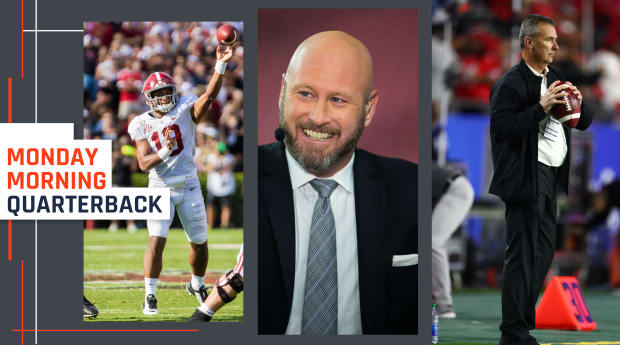
In 2018, Saban handed Tua Tagovailoa the keys to the starting quarterback job. Tagovailoa went 14-0 before losing to Clemson in the championship game. On the year, he passed for 3,996 yards with 43 passing TDs and six INTs while adding some value in the run game (57/190/5). His completion rate (69.0) was elite while gaining 11.2 yards per pass attempt. Last year Tagovailoa was on a higher path after nine games (2,840 passing yards with 33 TDs and three INTs), but his season ended in mid-November with a significant hip injury and a broken nose. In Week 8 of the season, he passed for 418 yards with four TDs and one Int against LSU, but Joe Burrow (393/3) won the game 46-41. In the pros, he’ll need to work harder on scoring drives while not having the luxury of having the edge in offensive talent.
Miami Dolphins Stats To Know:
The Dolphins allowed the most touchdowns (57) while also ranking second in field goals allowed (33). Opponents score 90 times on their 186 possessions (48.4 percent of the time).
Miami’s defense ranked last in passing TDs (39) and touchdowns (27) to the wide receiver position. They also gave up the second-most rushing attempts (482).
Their RBs finished 31st in rushing attempts (297), 32nd in rushing yards (962), and 32nd in yards per carry (3.24).
Ryan Fitzpatrick found the keys to WR DeVante Parker (72/1202/9), helping Parker pick up $21.5 million in guarantees in his $40 million contract signed last December.
The Dolphins have five draft picks over the first 56 selections in the 2020 NFL Draft.
NFL Draft Exclusives: Sign up for Sports Illustrated’s newsletters and get the latest NFL Draft coverage, analysis and highlights - delivered right to your inbox.
according to The MMQB's AFC East Team Needs. The franchise is expected to target former Alabama QB Tua Tagovailoa or possibly Oregon's Justin Herbert to boost its offense. Upgrades to the Dolphins' O-line will also help the team feel more comfortable with its entire playbook. Flores is trying to implement a Patriots-style scheme and needs a true pass rusher opposite Kyle Van Noy to pull it off.
The Dolphins' first-round selections in this year's NFL draft will be broken down with grades from The MMQB's Andy Benoit. A full list of Miami's picks will be updated below as the draft progresses.
Tagovailoa’s workout was on Thursday. By Friday, when ESPN’s Chris Mortensen posted video clips from it, the two-time All-SEC quarterback was driving back to Alabama, his draft process mostly now complete. He remains the first round’s biggest wild card.
That said, the hay’s now in the barn. And teams have a decision to make on him.
***
Fun column this week, and I’m excited for you guys to dive into it. If you scroll down, you’ll find…
• Nuggets from a great Easter morning conversation with ex-Ohio State coach Urban Meyer, who may soon pull a very rare feat, in having coached the top three picks in a single class.
• Ten things about the 2020 draft that I’ve gathered over the last week.
• RIP, XFL.
• The Brandin Cooks oddity.
And, of course, a whole lot more. But we’re starting with the Tagovailoa workout, how it came together, what it proved and what it might mean going forward.
***
Dilfer first met Tagovailoa in the spring of 2016, just before the quarterback’s senior year at Honolulu’s St. Louis High, at an Elite 11 camp. The two saw each other again a month later at the Elite 11 finals, and then again at The Opening in Oregon, and Dilfer estimates now that they were probably together for 11 or 12 days over that time. They casually stayed in touch afterward, through a handful of phone calls over Tua’s three years at Bama.
So even if the relationship was more friendly than familial, Dilfer was well aware of the talent he was entrusted with when Tagovailoa picked him to run the show for these last few months.
But because Tagovailoa was coming off reconstructive hip surgery, this one would have to be different than any pre-draft process that Dilfer had ever been a part of. And while the Rocky analogy encapsulated the idea, the one thing it didn’t capture is the primary goals that were set. The first was to emphasize healing in every facet of the operation. The second was, with that caution, to get Tua ready to throw on Sundays.
“I tried not to be an idiot,” Dilfer said. “I told him early on, I can get you ready for a throwing thing in seven days. So we don’t need months and months and months. I was always the one slowing it up, I never wanted to put his health at risk, knowing that it’s still the underwear Olympics. What I wanted was to give him to his team as a better product than he was before his injuries. To me, that was a different way of thinking about it.
“One, we’re not getting you ready for a pro day, we’re not getting you ready for combine, we’re not getting you ready for workouts, for visits. We’re getting you ready for hopefully a 15-year Hall of Fame career. Well, for that to happen, I gotta hand you over to a team so they can do their work with you, and you’re a better product for them. That’s always been the goal. It was a value add, a bonus, that we were able to do what we did [Thursday].”
And there was a lot of detail in how it was set up. The first piece, while Tagovailoa was still too debilitated to even soft toss, was to get him mentally ready for the league.
To that end, agent Chris Cabott enlisted former Titans and Cardinals coach Ken Whisenhunt to do film work with Tagovailoa a couple times a week ahead of the February combine, which prepared him to go in front of teams, while also meeting Dilfer’s stated goal of preparing him to hit the ground running with his future employer in early May.
In those sessions, the work that Tagovailoa had done coming from a proud high school program, then learning a little from ex-Bama OC Lane Kiffin before arriving in Tuscaloosa, and a lot from Nick Saban, Brian Daboll, Mike Locksley and Steve Sarkisian after he got there, was clear. In particular, Tua’s recall blew Whisenhunt away, as did his ability to diagnose situations and assess an opponent’s personnel.
“It was the recall not just with his players, but the opponent too,” Whisenhunt said. “It’d be, ‘Yeah, I’d say 18 was LSU’s best player, because he could rush, but you see him drop here where he’d get all the way underneath the corner route.’ He has a good feel for what’s going on, like, ‘That’s what I’m seeing.’ And the situational stuff, he’s got recall where, this was the critical play, this what happened, and here’s why.”
As they progressed, Whisenhunt would give Tagovailoa plays to install under what was, to him, foreign terminology, and ask him to know it during their next session. Then, when they’d reconvene, he’d put Tua on the board, and that wasn’t much of a problem either.
But what really stuck out to Whisenhunt wasn’t so much his acumen. Tagovailoa’s reputation preceded him on that. What jumped out, more so, was how, still injured and fighting through a difficult rehabilitation, Tua never complained about the challenges he was faced to those around him, which mirrors what Saban told us about him in March.
“He never felt sorry for himself, which is important,” Whisenhunt said. “He comes from a really good family structure, there’s a good culture of people around him, and Nick did a great job with him. He just has a personality people gravitate to, because you can feel that he cares about you. You notice that quickly. He’s genuine, he cares about you, his teammates, his coaches. I’ll use one of Trent’s terms—He makes them feel important.,
“That’s a great quality for a quarterback. He’s just very aware, very sharp.”
***
March 9 was set as the date for Tagovailoa to be cleared, and it was right around then, maybe a day or two later, that Dilfer got him back out on the field. Tagovailoa had been soft tossing since mid-February, but this was going to be the first time he’d do it with any sort of movement incorporated. As such, Dilfer set up a spreadsheet to sequence Tagovailoa’s return to the field, starting with light drills to test stability.
The quarterback had other ideas.
“And the first day ends up being, Hey, I can do anything. I’m like, What? And he’s like, Yeah, let’s go,” Dilfer said. “And the first workout I think I’d scripted 35 minutes, and we went for an hour and 15 minutes. It was movement and footwork drills and we weren’t gonna throw that much, and next thing you know we’re throwing BBs all over the indoor. And that’s when it hit me, OK, I gotta rethink this. This is about endurance; this isn’t about function. This isn’t about skill development; this is about endurance.
“I could see in one day, he’s twitchy, he’s powerful, he’s ripping it.”
So Dilfer blew up the script. On Mondays and Tuesdays, they’d add new layers of movement and go through harder workouts. Wednesdays were for “Quarterback Olympics,” the kind of games you might see for fun at an NFL facility on a Friday before a game, like throwing balls at uprights or into trash cans. Thursday and Fridays would incorporate receivers into the same movement work that was added on Monday and Tuesday. And Tagovailoa would work out on his own as he saw fit on the weekend.
That would get him ready for the pro day, of course. But, again, that was just a bonus.
“I kept telling everyone this, I don’t care about that,” Dilfer said. “I care about getting him to the Dolphins or the Bengals or the Colts or the Chargers, whoever’s gonna draft him, I have no flipping idea. And that team saying, ‘Wow, thank you, thank you. He’s ready to go, we can now teach him to play NFL football.’ Because that’s not my job, my job is to get him ready to hand him over to someone else, and that team goes, ‘Yes, we have the best Tua possible.’”
But the progress did give Dilfer room to be creative as the workout got closer, and even more creative when circumstances changed.
***
One thing Dilfer did want to be clear on was that precautions were taken ahead of the workout on Thursday, saying, “We had to find a facility that would allow us to do it under full social-distancing policy, which we did. There was never more than 10 people, for the most part we stayed six feet apart. Now, obviously, I’m snapping the ball to Tua, so we couldn’t be six feet apart. But we were clean, we were super careful.”
And as for the workout itself, Dilfer wanted to show endurance to display Tagovailoa’s health, and four specific traits: twitch, movement, power and precision. To accomplish that, he created four blocks of throws, which were slowed only when one of Tagovailoa’s receivers tweaked a hamstring. Each of the four blocks featured 13 consecutive throws without rest, and emphasized multiple movements, where the ball finished, and the ability to catch a snap and throw in an RPO/quick-game scenario.
More challenging, given the bandbox they were throwing in, was to display power. So Dilfer created a drill for the end of the workout where Tagovailoa would take a seven-step drop, make a movement (as if he were avoiding a rusher) and, with his feet planted, in a spot where most would crow hop, throw a ball on a line to a receiver 47 yards away. Four of five such throws he made, Dilfer said, were right where wanted them.
“All he could do was pick up his front foot and move it to the right,” Dilfer said. “Now, we’re talking rare air. There’s a very small group of the population that could make this throw.”
And that was one point that Dilfer felt was important to make.
“What I’ve had to explain to people—Tua doesn’t throw it hard very often,” Dilfer said. “When he needs to throw it long and hard, he can throw it as long and hard as anybody. That’s the thing that’s going to come out when he plays in the NFL, that’ll be the narrative in a couple years, people will go, ‘Whoa, we didn’t know!’ And I’ll say you should’ve known, because I tried to tell you.”
How much will what Tagovailoa did on tape change things? Maybe it won’t, because most of the questions on him center on health and there are questions on Tagovailoa’s future in that regard that are impossible to answer. But walking out of that facility, both Dilfer and Tagovailoa felt like they’d answered for everything else.
***
Really, the idea here wasn’t so much to impress everyone, as it was to confirm that Tagovailoa is still the same guy who won the national title coming off the bench as a true freshman, and lit up the SEC the last two years running. As Dilfer sees it, there was enough there already, on that tape, to know which of Tagovailoa’s elite traits would translate.
“What makes him great is he has multiple,” Dilfer said. “He’s got the best eyes I think I’ve ever seen at this age. At this age, he sees stuff others don’t see. I think Dan Orlovsky’s done a really good job on TV pointing this out; he makes full field reads, he sees stuff as if he has eyes in the back of his head. Some will call it intuition, instincts, some call it eyes. It’s probably both. It’s a feel as well as a clarity of vision when he sees stuff.
“And they’re quick, that’s the other thing. He doesn’t have to go, ‘Hey, my eyes are here, now my eyes are there, I gotta see it, confirm it and throw.’ It’s all one thing for him. His other [trait] would be precision. He just knows where his ball finishes, it finishes more precisely. Those would be the two superpowers. Precision, and the feel/eyes/instincts deal.”
But now? Now, Dilfer hopes the NFL sees what he has. And then they can weigh the talent against the risk, which Dilfer feels will be mitigated as Tagovailoa learns to protect himself better than he has.
Oh, and there was one other seminal moment in all this. A few weeks after they started working, Tagovailoa confessed to Dilfer he’d never seen Rocky IV—the soundtrack of which was playing in football locker rooms all over the country in the 1980s and ’90s. So he asked Dilfer if the training montage was like the desert scene in Creed 2, and they talked it over and, eventually, Tagovailoa got a night free where he could check out the real thing.
After that? “Rocky IV’s the best ever, coach,” he said to Dilfer, and the analogy started to make more sense, too.
“He definitely hunkered down,” Dilfer said. “What he had to come back from was tough, and the work he had to do to come back from it was difficult, monotonous, boring stuff. I wouldn’t say he enjoyed it. I don’t think any of this theme was, This is fun! I don’t think Tua would say, ‘Oh, man, this was the best three months of my life!’ I think he’d say, ‘No, this wasn’t very much fun, but it was worth it.’”
And now, with the metaphorical pullups on the cabin rafters and mountain runs in work boots down, and Tagovailoa having left Nashville, they’re 10 days away from getting to see the value in what they got done come to life.
URBAN MEYER TALKS TOP PROSPECTS
I talked to Urban Meyer on Sunday morning with the intention of discussing the chance—and it’s not all that remote of a chance—that three guys he coached in college could wind up going 1-2-3 in this year’s NFL draft. And we’re going to get to that. But just as we were wrapping up after about a half hour on the phone, I asked Meyer if he had a chance to get a better look at pro football than he had before, given that he didn’t coach in 2019.
He answered that he had, and that he’d actually made a point of studying the league, and talking to over 30 of his former players from Ohio State, Florida and Utah to gather information on what he was looking at. The results, he said, were fascinating.
“I just asked them, ‘Tell me about the culture, tell me about the team meetings, tell me about the expectations, the work ethic, the accountability,’” Meyer told me. “I had an idea, but what’s amazing to me is when I hear the media and the fans, and even others say the reason they’re losing is because they have bad players. That’s one of the most nonsensical things I’ve ever heard in my entire life. I mean, they’re NFL players.
“There’s not a bad player in the NFL. Now, you have superstars, some might not be the right fit, they might have some character flaws, there might be some stuff going on. But to use the term ‘bad player’? And I hear that as an excuse, ‘Hey, he’s a bad quarterback.’ What are you talking about? Because I’ve heard that, and I used to get angry when they’d say that about our players. I’d hear someone say that—Alex Smith is a bad player.
“He was the best thing I’d been around when he came out of Utah. Then I do the homework and find out what it is. It’s certainly not bad players. There are certain organizations that win every year. There are certain organizations that can’t win, yet they have better players on paper than the other organizations, because they draft before them every year. Every year. So I’d challenge everyone, ‘When you say they’re a bad player, what, are you out of your mind?’ They’re not bad players.”
Eventually, Meyer would get his answers—and draw real parallels from alums he had in places like New England, New Orleans, Pittsburgh and San Francisco.
“Culture and criteria,” Meyer said. “There’s two things you have to do. Number one, develop and implement a culture in your organization. And it’s gotta be a culture: This is the way it is, non-negotiable. And then the other thing is talent acquisition. How are you acquiring talent? What’s your criteria? Is everyone on the same page? And what I found out, those who win, that’s it. Those who fail to win, that’s it.
“It’s not whether they run the zone or the stretch play, or the three-level passing vs. the crossing routes. I know people think that’s it. Yeah, that’s fun. That’s intriguing. But that’s not why certain teams win. You walk in the locker room and you know why they win. And you talk to your players who are in those organizations and you know exactly why they win. Because the head coach and GM, and everyone, are aligned with culture and talent acquisition.”
One thing Meyer was clear on—and you could hear his passion for the topic in his voice—was that just like the difference from one program to another wasn’t about bad players, it wasn’t necessarily about a bad GM or bad coach, either. More so, as he sees it, the issues with those that fail are organizational, in the way teams may patch together coaching and scouting staffs that don’t fit, or cycle through coaches like they would swing tackles.
So all that begged the next question, which was whether or not Meyer wanted, through all of this work, to try his hand at the NFL after winning three national titles in college. He laughed and said, “I didn’t say that.” And then, I asked if he was intrigued by the idea.
“Oh, I’m intrigued,” he said. “But I didn’t go that far. There were some conversations, but it never went that far.”
I’m not sure that it ever will. But it sure would be fun for the rest of us to see it.
***
Burrow and Young, teammates at Ohio State before the QB transferred to LSU, could be the top two picks in this year’s draft..
O.K., so I researched all the way back to 1960, and couldn’t find any example of three ex-teammates going 1-2-3 in the NFL draft. Three schools had guys go first and second in one year: Penn State (Courtney Brown, LaVar Arrington in 2000), Nebraska (Irving Fryar, Dean Steinkuhler in 1984) and Michigan State (Bubba Smith, Clint Jones in 1967). But, as far as I can tell, since the advent of the AFL, 1-2-3 has never happened.
And it could this year, with a twist. Joe Burrow is coming into the NFL from LSU, and Chase Young and Jeff Okudah are coming from Ohio State. But the three of them were actually together on the 2017 Buckeyes. Burrow was a banged-up, third-string quarterback, and Young and Okudah were true freshman defenders.
Could anyone have seen it coming? Well, in the case of two of them, Meyer says he knew pretty quickly he had blue-chip recruits that were fully capable of living up to their billing.
“[Strength] coach [Mick] Marotti, he’s almost never wrong when he says, ‘We got one here,’” Meyer said. “Jeff Okudah, the minute he walked on campus, you knew you had one. And same with Chase. Chase plays a little bit of a developmental position, where you gotta grow up in your body and learn technique. But when you put a guy like Chase Young with [DL coach] Larry Johnson, the chance of success, it’s infallible. It will happen.”
Burrow was the outlier, both in his recruitment, and his path to, in all likelihood, going in front of the other two. He first landed on Meyer’s radar the spring before Burrow’s senior year at Athens (Ohio) High. Then-offensive coordinator Tom Herman FaceTimed Meyer from a practice there and told him, “I found your next Alex Smith.” Burrow’s offer list wasn’t the kind that most Ohio State recruits boast, but as the coaches started to dig, Meyer was reminded of a lesson he learned from Kyle Whittingham, a Utah assistant of his.
Whittingham convinced Meyer years earlier to offer a young defensive back who was lightly recruited. At first, Meyer was upset with Whittingham for even recruiting him. But Whittingham told Meyer that he knew the area, and coaches who’d worked against this player said he was the best competitor they’d faced. That player wound up being six-time Pro Bowler Eric Weddle.
Over time, Meyer prioritized that trait. And as he talked to coaches who’d competed against Burrow, they all said the same thing that was once said about Weddle. So Meyer dispatched assistants to Burrow’s basketball games, to see if Burrow would confirm it. Which he did.
“I know what [other schools] missed, and you see a lot of it,” Meyer said. “A lot of these quarterbacks, I call it the spandex quarterback. They’re 8 years old and for the next 10 years all they do is 7-on-7 camps. And they become very good throwers, but a lot of times they miss some of the other parts which, to me, are much more important than being able to throw a football. And that’s leadership, competitiveness, toughness.
“Those are things you learn by playing basketball, by being a multi-sport athlete, by doing other things and competing. Competing is the No. 1 quality of every great athlete or coach.”
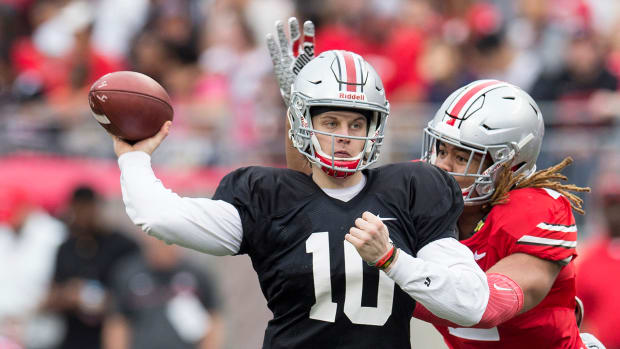
Now, the flip side of that? Burrow came in a little raw, and when he got hurt, he fell behind Dwayne Haskins, who was further along as a passer, despite being a year behind him in class rank. "It’s really intriguing that we had them both there, and one was a little bit behind because he was also an all-state basketball player,” Meyer said. And so he went with Haskins, who threw for 50 touchdowns in Meyer’s final year, and had to let Burrow go.
“It crushed us,” Meyer said. “But we kind of knew, and I could’ve done what a lot of coaches do, and not name a starter until August, because it was that close. But Joe and his mom and his dad, they’re just wonderful people. He earned the right. He graduated, he did everything right. Yeah, that broke our heart. We all loved Joe. We still do.”
In the time since, Burrow kept refining his release and strengthening his arm, and the rest is history. “I don’t know if you’ll ever see a season like that again in a quarterback,” Meyer said, “and there’s been a lot of great seasons. Dwayne had one the year before.” And now, Meyer’s uniquely positioned to watch three guys he believes will grow into team captain types as pros go, maybe, 1-2-3.
“It’d be a feeling of great pride we had, first of all, a staff that went out and found those people,” Meyer said. “Jeff and Chase were top 10 recruits. But Joe Burrow was not. He was a guy that did not have some of the big offers. So that goes to show you that our recruiting staff and coaching staff did their jobs and went out and found the best of the best.”
***
DRAFT BUZZ SEASON
So you’ve come for draft nuggets? Here are 10 for you…
• I’m told the Bengals have maxed out their time with Burrow over the last few weeks, as they work to build a relationship with him. What does that mean? Well, each team is allowed to do three one-hour calls with each prospect per week. So every week, Cincinnati has done, yes, three one-hour calls with Burrow. If you listened to my podcast with Burrow’s trainer, Jordan Palmer, a few weeks back, you heard him say that the training for Burrow has been focused on getting him ready to play in Week 1. The amount of meetings he’s had with the team that’ll likely draft him can’t hurt in that regard either.
• Maybe Washington won’t take Young with the second overall pick. But what I can say is they’ve been aggressive in cross-checking their information on him, and are poised to sit right where they are and take him second overall. Again, the tire-kicking on Tagovailoa made sense for more than one reason. First, you make sure that you’re not passing on, as one person there put it to me, “Michael Jordan.” Second, you might smoke out some offers, so you can better ascertain the value of the pick. My guess would be Young is too sure of a thing for them to pass on, much like his ex-teammate Nick Bosa was last year.
Simmons, who took snaps all over the field for the Tigers, had seven sacks for Clemson last season.
• Word’s been persistent that the Lions want to move the third pick. And it’s not that they don’t like the players there. More so, it’s that they’d like, say, Okudah or Isaiah Simmons at No. 5 or 6 with a few more picks to use down the line. It was pointed out to me that Lions GM Bob Quinn, over 21 NFL seasons, has never been with a team holding a top five pick. So his comfort level with moving down would be understandable, as would his desire to maximize the kind of asset he’s never had.
• We’ve said that Simmons would be great in a Patriots-type of defense, and that makes the run of teams at No. 3, 4 and 5—all of which run New England defenses—a very interesting one. My sense is the Giants are considering him at No. 4 against the offensive tackles, and maybe Louisville’s Mekhi Becton (who has questions about his ability to make weight and his on-field consistency, despite his freakish ability) in particular. GM Dave Gettleman, of course, valued linebackers in Carolina, having paid Luke Kuechly and Thomas Davis and drafted Shaq Thompson while he was there. And I know this about Gettleman: As he said after taking Saquon Barkley second overall, he firmly believes you have to get a generational, All-Pro type talent when you’re picking that high. Both Simmons and Becton have that potential.
• Tagovailoa’s situation is fascinating. If the Lions can’t move the third pick, the Dolphins decide to pass on him in favor of Justin Herbert or even, say, Simmons or a tackle (which I think is wholly possible), and the Chargers don’t take him at 6… then what? Interestingly, it feels to me like Chargers GM Tom Telesco’s scouting report is an awfully important one for the Alabama quarterback right now. Few doubt his playing ability. But, as an old coach once said, the most important ability is availability, and the durability that’ll determine that remains a question mark here.
• A player teams like more than the general public knows: Auburn DT Derrick Brown. He’s a very clean prospect with a high floor, and a lot of teams’ decision-makers would be surprised if he makes it past the Panthers at No. 7. I’d put the Jaguars down as another team that’s been connected to him, so much so that Jacksonville may get aggressive in trying to trade down if he’s gone when they pick at No. 9, to be better position to get a receiver or corner.
• So we’ve got Detroit and Jacksonville as trade-down teams. I’d toss the Niners and Raiders in that mix too. The Raiders don’t have a second-rounder. The Niners, thanks to trades for Dee Ford and Emmanuel Sanders, don’t have a second-, a third- or a fourth-rounder. I’ve heard both teams would like to fill in the holes they have between picks there. And while San Francisco has the bigger gap (no picks between 31 and 156), they do have two first-rounders to work with, thanks to the DeForest Buckner trade. I’d say, at this point, it’s more likely that they move the 31st pick than the 13th.
• The Niners could take a left tackle if one falls to them (I’ve heard they’d like to keep Mike McGlinchey on the right side long-term), but count them with the Raiders as teams that could be in play to pull the first receiver off the board. A couple teams mentioned to me that Jon Gruden is looking for, specifically, a ‘Z’ receiver and Alabama’s Jerry Jeudy is the prototype for that (even if CeeDee Lamb’s a little more of the gritty type that Gruden likes). As for the Niners, Kyle Shanahan values speed, and has gotten a lot out of players like Taylor Gabriel and Marquise Goodwin in the past, and Bama’s Henry Ruggs would qualify as a supercharged version of that.
• O.K., so who is looking at trading up? Three teams that seem to be investigating it pretty pointedly: Tampa, Denver and Atlanta. The Bucs and Broncos, I’ve heard, could be going up for one of the top four linemen (Becton, Jedrick Wills, Tristan Wirfs and Andrew Thomas), making Jacksonville’s slot, at No. 9, a potential hotspot, given the needs the Browns and Jets have at 10 and 11. It’s not as clear what the Falcons would be pursuing, though GM Thomas Dimitroff has always, in the past, been more proactive than most in looking at the option of moving up.
• It’s a relationship business, and there are rumblings that Kyler Murray has given the Arizona brass a glowing review of his former teammate Lamb. Would the Cardinals take one, given that they have DeAndre Hopkins, Larry Fitzgerald, and Christian Kirk on their roster, and drafted three of them last year? I’m skeptical, particularly with how nicely a big-time right tackle like Wills would fit the bill. But it’s worth keeping an eye on anyway.
TEN TAKEAWAYS
More draft details. So here’s the latest on what the NFL draft will look like, as it comes to you in 10 days. The ESPN/NFL Network simulcast will be helmed from the World Wide Leader’s campus in Bristol. And commissioner Roger Goodell will, indeed, be announcing the picks from a camera set up in the basement of his home in Westchester County, just north of New York City. To make sure all this is efficient, there’ll be a mock draft held among teams, with fake trades and everything, early next week to test the technology. And each team will be connected to the league in multiple ways. Primary among them will be a Microsoft Teams conference, with each team allowed to have up to three officials patched in from their homes. As a backup, there’ll also be a league-wide conference call, through which teams can make picks and trades. And to provide another failsafe, each team will be tasked with designating a “decision-maker” (be that the head coach, GM or owner), and that decision-maker will be allowed to have one IT support professional on hand at their house. Obviously, there are a lot of moving parts here. But I can tell you, after the stories I’ve heard the last few weeks, it’ll probably be necessary. Remember, these teams are trying to move technological resources that are supported by palatial facilities with wired, business-grade internet. You don’t just make that all go at someone’s house by pushing a few buttons.
There is an upshot here. Lots of teams I’ve talked to, after some fits and starts at the beginning, have actually really taken to the current setup, believing they’ve become more efficient in cutting out the clutter that working in an office can create. And obviously, owners are seeing savings, especially those that have routinely flown in and housed scouts from all across the country for the two or three weeks leading into the draft. “I could see this changing everything for us,” one NFC exec said. “It allows you to be more efficient, you’re saving money, and honestly our meetings have been better than ever before. There’s not as much bull----.” And you can count new Panthers coach Matt Rhule (who I wrote extensively about last week) among those who are seeing the benefits. “We were utilizing our Microsoft Teams [on Wednesday], [GM] Marty [Hurney] and myself, the entire offensive staff and some of the auxiliary people, just taking turns going through everyone on our draft board,” Rhule told me. “Everybody does that all across the NFL, obviously we’re doing it from our own houses, our own apartments everywhere. But we’re able to do it, just the same way as we would do it back in the facility. What ends up happening is you just have really focused time, where nobody’s walking in and saying, ‘Hey, Matt, I need to talk to you for a second.’ Or, ‘Hey, Marty, I need to talk to you for a second.’ We’re just all locked in on this computer screen for hours at a time.”
The NFL will miss the XFL. And it’s for more than one reason. Some of the ideas were good, to be sure. I wouldn’t be surprised if the kickoff rule gets adopted by the NFL at some point, and their use of the officials was solid. But as much as anything, NFL teams appreciated how well put-together the rosters were. “The rosters were full of fringe, practice squad type guys that, because of the numbers crunch, teams might’ve just cut,” one AFC exec said. “The quality was consistently what you’d want it to be for that league. Philip [P.J.] Walker’s a perfect example of that. The [AAF] had more guys like Johnny Manziel, [Zach] Mettenberger, the renegade types. The XFL felt more like a true minor league.” That, by the way, is a tribute to the scouts and coaches who put those rosters together, and it should be a sign that we could see a whole lot of those guys land on NFL teams in the fall.
Cooks is joining his fourth team since entering the NFL in 2014.
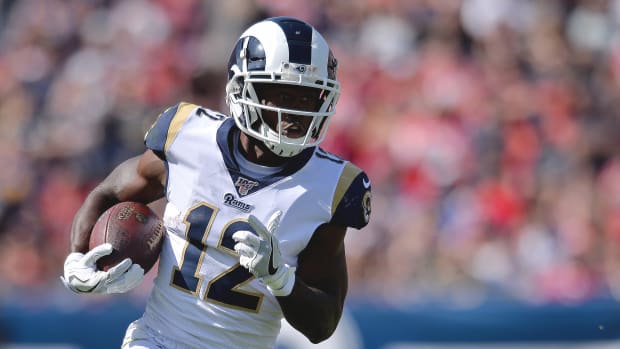
Why was Brandin Cooks dealt again? Because it does seem strange, right? Well, in each case, there was a specific reason. With the Saints, there was friction over how he was being deployed. With the Patriots, his contractual demands would’ve upset the team’s salary structure, given that he was asking for (and eventually got) more than Rob Gronkowski and Julian Edelman were making. With the Rams, the concussion issue made him a guy that they were actually looking to move, as they sought to reorganize what was becoming a very top-heavy cap situation. And in each case, he went for considerable draft capital, reaping first-round picks for the Saints and Patriots, and a second-rounder for the Rams. But there is something overarching here that can contextualize how a 26-year-old with four 1,000-yard seasons, and a guy that all his coaches generally like, could be moved so many times. For an outside receiver, Cooks is, in fact, a smaller player. And for someone as fast as he is, coaches who’ve gotten him have noticed that he’s pretty stiff, which doesn’t allow for the wiggle that you need to separate in short areas as an inside receiver. So that winds up making him a little one-dimensional—he is very good down the field—and limits him on third down and in the red zone. Does it make him a bad player? No. He’s clearly a good player, even when accounting for the injuries. But is he worth $16 million per year, given those limitations? Probably not. That’s the level the Patriots and Saints balked at paying him. It’s also why the Rams traded him. And it’s pretty notable that the Texans are now getting him with four years and $47 million left on his deal, which puts him under $12 million per year. So really, if you add this up, it’s as much about how the money matches the player as anything.
I think more veteran trades could be coming. And they might be coming during draft week. Some teams that got through free agency with holes still on their rosters are mulling the idea of filling them with veterans. Why? Well, because if the offseason program is eliminated as a result of the COVID-19 crisis, which seems a near certainty now, then it’ll become a tougher ask to expect a rookie to come and fill a void in Year 1, particularly with the new CBA cutting the max number of padded practices in camp from 28 to 16, and mandating three-day weekends in the summer. Additionally, I’ve heard that certain teams are holding on to vets they may have otherwise cut in anticipation of that. One example just might be Andy Dalton. The Bengals have maintained that they want to keep their options open with him. And maybe that’s because they believe a new option could emerge right before, during or after the draft.
Count Drew Brees’s NBC deal a win for all players. And an example that players need to capitalize on their names while they’re still playing. Brees did a deal that’ll eventually position him in one of the premier seats in all of sports broadcasting as the color guy on Sunday Night Football, presuming Big Peacock hangs on to the NFL’s premier regular-season time slot. And part of what made Brees so attractive to both NBC and ESPN is that he is still playing, which both makes his name as relevant as can be and gives him the institutional knowledge that Tony Romo has skillfully used over his first three years in the booth. That gives Brees runway to prepare for the job, and it’ll give him an advantage when he gets there. And if I’m a younger star, and I’m interested in TV, Brees is just one of a number of guys I’d look to as examples of why it’s important to get your feet wet early. Ryan Clark, Brandon Marshall and Greg Olsen are other examples of guys who greatly enhanced their value for a second career by getting the ball rolling while they were still in the midst of their first.
Speaking of second careers, Luke Kuechly’s absolutely got one in football, if he wants it. And my understanding is that both his alma maters—the Panthers and Boston College—have left the door wide open for the seven-time All-Pro linebacker to come back and help out in some capacity (be it as a coach, or in a role less involved). And Kuechly sure sounded like a guy who isn’t done with the game altogether, in what he said to Mike Tirico: "I love the game of football. I love everything about it, I love the studying aspect, I love the team aspect.... I'm gonna miss the interaction—the guys, you know, every day. I know when the season comes around I'm going to have that pit in my stomach knowing that, man, I wish I was still out there, but I think you look at it in the sense that you have a long life to live, what's the best thing for right now? You have to make hard decisions in your life. I think this is one of the harder ones I've had to make. Hopefully I can find a way to stay involved in football somehow."
The booth umpire idea should get a good long look. And I know because it wasn’t endorsed by the competition committee that it probably won’t happen this year. But I hope they get creative, and maybe experiment with it in the preseason. I’ve talked to those who helped craft the proposal that the Ravens and Chargers pushed forward, and I can tell you that a lot of thought went into it, and it’s an idea that, on paper, should work. One, the official won’t have the ability to stop the game, meaning the play clock will govern his interventions into game action (which, in practice, should mean he’s only jumping in on obvious misses by the on-field crew). Two, he’s reporting to the head referee, making him a resource to the crew, rather than an adversary. Three, he’s in the stadium, which makes him more accountable, via the on-field guys, to each coaching staff than someone in New York is. Are there kinks that would need to be worked through? Sure. So experiment with it this year. But to me, this would fix one of the craziest things in pro football—which is that the officials don’t get the benefit of all the different angles of HD footage that someone sitting on their couch at home would. And as for what coaches think of this, last year, before the owners meetings, I polled all 25 of them, via text, on whether or not they’d want a sky judge. Nineteen responded. Fifteen said yes, two said no and two said they wanted more info. So that should explain where they stand.
Jimmy Garoppolo is cemented as the Niners’ quarterback for 2020. And good for George Kittle for having his back. "People talk,” Kittle told Pro Football Talk’s podcast. “There's nothing else to talk about. It's nothing that I took seriously. Jimmy G is my quarterback, and he's one hell of a quarterback. We don't get to the Super Bowl without him. So there's no one that I'd replace him with. What he's done for this team leadership-wise and on the field, he's one of a kind." We went over part of this already—that the interest in Tom Brady was coming more from the quarterback to the team than the other way around. So what would have it taken for the Niners to bite? Honestly, I think, really, it would’ve been someone blowing them away with an offer for Garoppolo. Which really no one had to consider, given the weird supply/demand dynamic at the position (for once, supply outweighed demand) this spring.
Mike Gundy is making all football coaches look dumb. And if I were one, I’d probably be pissed at the Oklahoma State coach for it, because he’s perpetuating a stereotype about them—that they feel like their jobs are far more important than they actually are (given Gundy’s comment about the Oklahoma economy). That said, I have way less of a problem with coaches saying they’re preparing as if it’ll be business as usual in the fall. That, in fact, is what they should be saying, because that’s the message everyone else that works for and around them needs to hear. As we learned during the lockout in 2011, some will handle the disruption better than others. And those that are making the most of the time they have, both now and when we get closer to the season, will be rewarded for it if and when there are games.
SIX FROM THE SIDELINE
1. Full disclosure: I loved the idea of the NBA having players playing HORSE and NBA2K. But I haven’t found time to watch a second of it. Maybe I will. But it hasn’t been appointment TV for me.
2. Was interested to see Adrian Wojnarowski’s report that NBA teams are banding together to try to get the draft pushed back, because of the elimination of parts of the pre-draft process. Surely, I’d think Adam Silver and Co. are keeping a close eye on what’s happening in pro football now.
3. My buddy Doug Lesmerises of Cleveland.com has a great Ohio State podcast that I listen to, and on it he raised this really interesting point: Would the NCAA’s model be exposed if college football went on before students return to campuses? I think I agree with him that it would. If you’re denying these guys benefits that the normal students would get because they’re amateurs, you can’t exactly put those guys in danger that you aren’t putting normal students in, for business reasons. Or, at least, you can’t if you’re concerned about looking like a total hypocrite.
4. And for more on that, check out the HBO doc The Scheme, which lays bare the way college basketball really works. The wiretaps they have on Arizona coach Sean Miller and LSU coach Will Wade are worth the two hours you’ll spend watching alone.
5. I’d keep an eye on what happens with the best draft prospects among the 2020 college football season’s elite players. If fall camp starts on time in August, I think they’ll all play. But if the season is disrupted, or preparation for the season is truncated, you’d think the Trevor Lawrences of the world would probably be doing some risk/reward analysis.
6. It’s been a tough few weeks at SI. And while I don’t want to single out any one person over the next, there’s one name in particular of a person no longer working with us that readers of this column will recognize—and this one hit particularly hard for us in the MMQB family. The first time I met Kalyn Kahler, it was early 2016 in California, and Peter King and Dom Bonvissuto had invited me out to talk about a job. I was still at NFL Network at the time, and over the months to come, I got to know Kalyn a lot better. Over time, I saw a ton of talent, and ambition, and eventually that start to manifest in her coverage of the draft, and a slew of deep investigative stories she pulled off. And I’ll say this about Kalyn: She had what most people think they have, but might not truly possess—and that’s a combination of the drive and desire it takes to do the job at a high level. Where a lot of young people would want you to help get them information for a story, she’d be more interested in how you got it (a quality she shared with another former colleague of ours, Emily Kaplan). That’s why, and I’ve told her this, she got better, and will keep getting better. Anyway, if any employer out there is looking at her, and wants to know more, I’m not hard to find.
***
BEST OF THE NFL INTERNET
S/o to Washington for this. And s/o to my wonderful wife, Emily, for following her calling into that line of work. I’m very proud that my kids have someone like that to look up to.
Love the sentiment here from Ravens coach John Harbaugh. Great idea by the team.
That’s arguable. But in a week of uniform redesigns, with the Browns’ new duds coming this week, it’s worth appreciating really good ones. And the Raiders have really good ones.
Social media murder, in the first degree. (Though with those “gradient” uniforms, you kind of did it to yourself, Falcons.)
Pretty good comeback, though.
I’m old enough to remember that the creamsicles weren’t as well thought of back when they were actually being worn as they are now (they were sort of part of the joke in how bad the Bucs were back then). So I can understand why they didn’t go back to them, much as I would’ve liked that, based on the memories they might recall for the fan base. And I’ll give this Gruden Era look a solid B. Much better than Atlanta’s. (And to wrap up our uni watch for the week, here’s hoping the Browns go back to what they should’ve been wearing all along, and you all know exactly what that is.)
But if the Masters happens in November, as it’s now scheduled to, then we’ve got a pretty cool weekend coming before Thanksgiving. It’s also interesting, given that Augusta is in the South and CBS has the SEC on TV, that they put it on the SEC’s annual November “bye week” when conference powers schedule non-conference pushovers for glorified walkthroughs.
Congrats to Jameis Winston and his new wife Breion.
The Colts in-house video folks did a great job with this last year, and it’s been good again so far in 2020.
Florida State center Andrew Boselli, a healthy 22-year-old playing football for a college football blueblood, got the disease from his dad, with a test he took March 21 turning up positive. In a first-person account on the school’s athletic web site, he detailed what it was like.
“A day after my test—an unpleasant process in and of itself—I woke up feeling like I’d been hit by a bus,” Boselli wrote. “I’m thankful to say that my family and I have recovered from our fight with the coronavirus, but I also want everyone to know just how hard it was. I spent days feeling miserable. And my dad, a strong, healthy 47-year-old man with no underlying health conditions, spent three days in the intensive care unit.
“I promise, even if you’re young and healthy, you do not want this virus.”
I’d urge anyone who wants to know more about the disease, or think it’s limited to the sick and elderly, to click through and read about Boselli’s experience. As most of you know, we’re going to have to continue to be very careful for a while.
Lewinger’s 42-year-old husband Joe died from complications with the coronavirus a little over a week ago, and Maura described having to say goodbye over FaceTime, playing him their wedding song as he passed away. She explained how it began with mild symptoms, how Joe’s fever spiked over St. Patrick’s Day, how his breathing kept getting worse, how she “begged him not to leave us and told him we all need him” over the phone.
Burnett broke down on live TV. As she did, the whole thing hit Lurie in a very personal way.
“He was a basketball coach and just a very popular teacher,” the Eagles owner said on Saturday. “She described what it was like the last two weeks with her husband, getting worse and worse, but trying different things, different therapeutics that they were using. And it just wasn't working. And listening to her, dealing with her husband who had this at age 42, it just reminded me of my mom.
“My dad got kidney cancer and died at age 42, with three kids as well. And I was picturing my mother being interviewed on CNN at that age. She was 32 and … oh, my God. That's not the reason to do this. But it's just…”
Lurie paused for a second.
“I think every night you feel the personal tragedy. It's not about me. I can talk about data and numbers. But we're talking about the emotional tragedies, and if you incorporate it and bring that to your heart, then you have no choice but to try to help in any way possible—if you're in a grocery store and somebody seems to need something more than you, or you can help that food delivery person, keep them healthy, whatever.”
Then, he added, “And it's nice to see so many people risk their lives to try to help.”
Being an NFL owner, Lurie can help with resources. And hours before that scene unfolded in his living room, that’s just what he did.
On Friday, Lurie gave $1 million to Penn Medicine to establish the COVID-19 Immunology Defense Fund. And for him, this was about more than just writing a check. Lurie’s been looking for a way to make an impact on this front for longer than most people in this country realized we had a serious problem on our hands.
The donation was personal to Lurie, just like that moment in his living room became.
***
We do have football to discuss in the MMQB this week, and we’re going to get there, because I know there are a lot of you who really, really want that. Among the things you’ll see further down in the column…
• A rundown of draft nuggets to help reset you for the next 17 days.
• An ex-Patriots team doctor explaining the trouble with Tua Tagovailoa and Cam Newton.
• An ex-college scout on running pro days for non-combine invitees.
• The offseason programs that are supposed to start today.
But we’re starting with one of the big contributions from the NFL world to get in front of the worst pandemic to hit the planet in a century.
***
As I’m writing this—at about 6 p.m. ET on Sunday night—the number of confirmed cases of COVID-19 worldwide has climbed past 1.2 million, and the number domestically has passed 330,000. Nearly 70,000 are dead, about 9,500 of them Americans. And by the time you read this, those figures will have changed, probably significantly, again.
For a lot of us, it seems like this has all happened overnight. But Lurie had his concerns pretty early, going back to when he heard where the virus originated, in Wuhan, a Chinese city of 11 million.
“This is not an unknown small place in China,” Lurie said. “This is as if it’s happening in Chicago. And so right away, I thought, ‘Well, there's a lot of flights from China and the Wuhan area to the United States and all over the planet. So why should this be limited to a particular very large metropolitan area in China?’ No one could estimate the extent of it. But to have it leave China certainly was on my mind.”
And then, a few weeks later, it hit home.
Carl Goldman is an old tennis buddy of Lurie’s, a close friend of four decades or so, and he was aboard the Diamond Princess, a cruise ship that was quarantined for two weeks off the coast of Japan in early February. Lurie was texting daily with Goldman at the time, and their wives were texting too. The Goldmans’ trip was to celebrate his completion of chemotherapy, which only made what was unfolding scarier.
About 700 passengers wound up diagnosed with the virus, and Goldman got his bad news as cargo planes took the 300 Americans who were on board back to the U.S. He was quarantined in Nebraska, apart from his wife, who was quarantined in California. And yes, he made it through—he’s back in L.A. healthy. But getting the blow-by-blow gave Lurie a pretty good illustration of what the U.S. would soon be up against.
“What he was telling me was that everybody was quarantined, but they absolutely would have no way of protecting themselves from the food delivery, from having their cabins cleaned or whatever,” Lurie said. “They weren't allowed to really go out and get some fresh air. They were in their room.”
Which sort of explains where America is now: The risk is everywhere, even if you take the precautions that are being recommended.
***
For Lurie, the next obvious step was figuring out what he wanted to do about it. So he started calling around to doctors on the ground and epidemiologists with a pretty simple question in his head: What could I do in my small way?
“I talked to multiple infectious disease experts and epidemiologists around the country and other doctors as well, on the front lines,” Lurie said. “And they mainly were in agreement that we need healthy health personnel, doctors and nurses, because there's no way the hospitals were going to be able to withstand the numbers of people that are going to need urgent care, intensive care. So testing became the crucial aspect, because if you don't know who's healthy, how do you protect the healthcare personnel, and how do you protect patients?
“So it became the crux of the matter. And our level of antibody testing was very, very, very low. We hadn't even identified early on what the antibodies are. And it became really clear to me that immunology is so crucial here.”
That way, as he saw it, he could help in the short-term and the long-term. It would help with the immediate need to get reliable tests to the patients and doctors in the tall grass dealing with this virus, so “we can get them both immune and able to work safely.” And identifying the antibodies would help in the longer term in transferring immunity to others, in creating therapeutics and developing a vaccine.
Eventually, we’ll get there. Lurie’s goal is to speed up the process.
“So this contribution, and what the what they're doing at Penn and some other places around the world, it is for short- and long-term,” Lurie said. “But that's a little misleading because it's to try to shorten the time that we can provide therapeutics and hopefully a vaccine to save an unbelievable number of lives. We're in a race. We're in a race. And we want to win this race.
“And in a way, sometimes you could say having a great offense is our best defense, or having a great defense is our best offense. In this case, we need both simultaneously to be hitting on all cylinders and early. And now, OK, it hasn't been early, and that's a key problem. So we've got to make up for the lack of early testing and early tracing and the lack of early antibody testing to be able to now make up for all that.”
To further the football analogy, Lurie added: “We’re in our own territory, we’re not in the red zone.” And the clock’s working against us, too, as the death toll rises. So as he sees it, the idea was to get the resources in the hands of the people best qualified to drive the field as fast as possible—our smartest scientists, epidemiologists and immunologists.
That, by the way, didn’t have to be in Philadelphia. But it so happened that Lurie had one of the best immunology centers in the country, in Penn Health, right down the street, which allowed him to accomplish two goals (he also wanted to help the healthcare workers in Philly) at once.
That takes us back to Lurie’s living room, what he saw on CNN, the connection to his now-elderly mother and how this pandemic becomes personal for everyone—with so many of us seeing different stories and tying them to things in our own lives. And how that has prompted so many people to do something.
“Whatever the small things you can do,” Lurie said, “I talked about the scientific weapons, but the people weapons, the people's hearts, that's the biggest weaponry of all. … It’s emotional, all this, and you just want to feel like you're doing any little thing that you can do, you know? And I respect the person that's simply bringing bananas to an elderly couple, as much as giving a million dollars for this. It's just whatever one can do.”
Lurie has felt it from inside the Eagles’ building, too. Players and coaches alike have reached out—and were doing so well before his large donation—asking what they could do to help, or where they should give or who they could call to pitch in. “That’s been 100% of [the conversation],” he said. “Nobody's asked us if we're gonna make changes in our offense or defense.”
And his hope is that with his gift, and what other owners are doing too, that the idea of everyone doing something will only spread, using that one kind of weaponry to fuel the other kind.
“In terms of this particular contribution, I hope it does inspire others that can afford to give to focus on the science and the urgency of it right now to test antibodies and create therapeutics and vaccines, and help the health care workers on the frontlines right away,” he said. “I hope it does inspire those who can help to appreciate what the scientists are trying to do.
“Because as I said, besides the people and everyone's hearts, scientists are our best weapons right now, and we've got to listen to them.”
And hopefully, if we do, their actions will soon speak as loud as their words.
***
THE DRAFT IS COMING
Alright, to the football we go. Here are nuggets with the draft now just two and a half weeks away…
• My belief is that, really, 11 players are sort of hovering around the top of the class—three quarterbacks (Joe Burrow, Tua Tagovailoa and Justin Herbert), four defensive players (Chase Young, Jeff Okudah, Derrick Brown and Isaiah Simmons) and four tackles (Mekhi Becton, Tristan Wirfs, Andrew Thomas and Jedrick Wills). South Carolina DL Javon Kinlaw or one of the top two receivers might sneak into that crowd on draft day, based on different teams’ preferences, but that’s what I see as the top group.
• Also, my feeling is that a lot of teams would have Burrow and the four defensive guys as the top five players in the class. Young is the best non-quarterback—and for some, it’s not close. But I did get at least one piece of pushback on that the last couple days, from one college scouting director who sees something pretty cool in Simmons: “He’s dynamic, but he’s also safe. Great character, he’s smart, and does everything and he’s a freak athlete. He’s damn close to Chase Young for me. And I would take him before Okudah. Depending on your scheme, he could be as impactful as anyone on your team. He can do so much. He can cover, rush, run and hit. I love him.” One thing there’s agreement on with Simmons is that he needs to go to a defense that will move him around like the coaches at Clemson did. The interesting thing about that? That would be a Patriot-type of defense, and there are three of those picking in the top five (Lions at 3, Giants at 4, Dolphins at 5). Okudah will probably go somewhere in that range too, and all four could be gone by 7, with the Panthers lurking as a possibility to snap Brown up.
• The tackles could all be gone by 11, with the Jets and Browns both having needs and sitting right there on the fringe of the top 10. What’s interesting is how they’re each bringing something different to the table. Becton’s a freakish left-side type, with what one scout called “Jason Peters potential.” Thomas is solid, and also projects to play on the left, but is unspectacular. Wills is sort of a prototype right tackle, who can swing left. And Wirfs is a very good athlete who everyone sees a little differently (some like him as a guard), and is probably a little more scheme-specific (he’d be best with a zone team) than the others.
• Burrow is clearly the cleanest quarterback. And based on all the Bengals’ actions, I’d expect him to be the pick at No. 1 (which isn’t exactly breaking news). Tagovailoa’s status is more uncertain, and teams are plenty uneasy about his durability (we have more on that lower in the column). Miami’s widely been seen as his landing spot, in part because owner Stephen Ross was at LSU-Alabama to see him play, and went with CEO Tom Garfinkel and GM Chris Grier to Bama’s bowl game, a game Tagovailoa didn’t even play in, to see him. But there’s a flip side to all that due diligence—it didn’t necessarily lead them to the conclusion that Tua’s the right pick. In fact, all the work may have taken them the other way. We’ll find out soon enough.
• Oklahoma’s CeeDee Lamb and Alabama’s Jerry Jeudy have emerged as the top two receivers in the class, in some order. But as we’ve said a bunch the last few weeks, neither guy is Julio Jones, and the depth of the overall group could wind up hurting them on Day 1. Why? Teams will figure they can come back and get a good receiver on Day 2, and the recent history of second-rounders at the position (Michael Thomas, D.J. Chark, D.K. Metcalf, A.J. Brown) may actually be better than what we’ve seen in the first round.
• The corner position is stronger than I thought it was a month ago—and maybe I just needed to catch up on what scouts think. Despite a so-so performance in Indy (and those at Ohio State swear he’s capable of running 4.3), Okudah is easily the top guy at the position. But there are a half dozen good ones after that, in Florida’s C.J. Henderson, LSU’s Kristian Fulton, Clemson’s A.J. Terrell, Ohio State’s Damon Arnette, TCU’s Jeff Gladney and Alabama’s Trevon Diggs. So if you need a good corner, you can get one. But you probably should take one earlier, because there is a drop-off after those seven.
• One player who got more love than I expected when I was calling around this week: Alabama S Xavier McKinney. I actually got an Earl Thomas comp out of one of the NFL’s most respected evaluators, and not a lot of disagreement when I ran that by a couple other veteran evaluators. Another called him “premium…one of the best safeties I’ve ever watched.” Teams love his athleticism and his versatility to play up, back or in the slot. LSU’s Grant Delpit came into the season considered the class’s best safety by a healthy amount, but McKinney has flown by him (part of that, of course, is that Delpit had a shaky final season with the Tigers).
• The COVID-19 affect? One director told me he thinks teams will play it safer this year, and playing it safer, in his mind, means taking big people. That, he continued, should open the door for USC’s Austin Jackson and Houston’s Josh Jones to sneak into the first round. Louisiana’s Robert Hunt is another guy who might go earlier than expected. And it’s possible the top center/guards, LSU’s Lloyd Cushenberry and Michigan’s Cesar Ruiz, merit consideration at the bottom of the round as well.
• Weaknesses? If you’re looking for a traditional middle linebacker, there aren’t a lot of them. Simmons could play there (but you probably wouldn’t be getting the most out of him there), and Oklahoma’s Kenneth Murray and LSU’s Patrick Queen might wind up there too. But after that, the ranks are sparse. And tight end is the other place where there aren’t a lot of answers for teams. Notre Dame’s Cole Kmet is the top guy but has had injury issues.
• It’s no secret that the Lions are open for business with the third pick. And they’re not alone. Early word is this year’s draft is no different than most—with more teams near the top willing to move down than up. The Jaguars are another team that’s kicked around the idea of moving down. The Raiders too, a team that could well be looking to replace the second-rounder they lost this year, with the final pieces in the Khalil Mack trade finally in play.
Thomas Gill can relate to where NFL team doctors are right now with the draft class. Partly because he was one (he served as Patriots team doctor from 1998-2014) and partly because he’s been an MLB team doctor too (he was the Red Sox' doc from 2003-13). And when we talked on Friday, it was the baseball experience that he brought up to explain how a doctor might make the best of a tough situation.
To set the scene, this was Gill’s first assignment with the Sox: The team was asking him how many years it should offer Pedro Martinez on a new deal. And, of course, we’re paraphrasing here:
“Let me examine him,” Gill said.
“His agent won’t let anyone examine him,” the team responded.
“OK, let’s get an updated MRI,” Gill said.
“Agent won’t let anyone get an MRI either,” the team responded.
“So how do you want me to give you a good answer?” Gill asked.
“Well, you just have to give us an answer,” the team said.
Gill then huddled with the pitching coach and the trainer. They broke down his mechanics, and as they were doing that, it came up that Martinez would take a long time to warm up and get loose—a strong sign that there was a rotator cuff problem. Based on that, Gill recommended the Sox offer Martinez no more than a two-year deal. So Martinez went to free agency after the championship 2004 season, the Mets gave him four years, and an iconic figure was gone.
“That does not make me the most popular guy in the Boston,” Gill said. “And if I was wrong, that’s a problem. And I’m not happy I was right, but after two years he tore his rotator cuff and he was never the same again. That’s your job, to take whatever data you have and give the best opinion you can. It’s not up to the coaching staff to figure out if a guy’s medically healthy. So yeah, it’s a tough time to be a team doctor. A really tough time.
“But you gotta take all the data you can, and I think teams will have to understand, we did the best we can with the data we have.”
NFL teams have done what they can this offseason. Some free agents still haven’t had physicals, and none that hit the market in mid-March and switched teams were able to take a physical the conventional way. The combine did give teams the chance to put most of the guys who’ll be drafted in two and a half weeks thorough physicals, but guys who were still hurt at that point won’t have the annual recheck, nor will teams be able to bring guys in, as they normally would, to have their own doctors kick the tires.
That’s left GMs and coaches with minefields of risk to navigate. But, as Gill said, while this may be a new challenge for NFL teams, it’s not unheard of in sports. And that’s why I figured we’d enlist him to go through a few of the facts facing the decision-makers.
It’s harder on banged-up vets than it is on rookies. And that’s for two reasons. One, because, at the very least, the NFL does have physicals on the 337 guys who came through Indy. Two, because older guys, of course, have more miles on their bodies. That means they inherently come with more risk—risk that’s compounded with injury history and price. And that’s where a case like Cam Newton’s gets highlighted.
Newton has had multiple procedures on his throwing shoulder and is coming off surgery on his left foot. Add to that the magnitude of making him your starting quarterback, and there’d be enough to make Gill, a shoulder specialist himself, uneasy.
“There’s no way I could trust a shoulder exam [from someone else], based on strength, stability, motion, because of what might be important to me,” Gill said. “And I know just based on my track record, knowing how I evaluate people, what’s worked well versus someone else maybe saying that’s not as big a deal. … There’s no way I could sign off on a guy like that if I didn’t examine him personally.”’
And given Jadeveon Clowney’s previous knee troubles (and microfracture surgery), the free agent pass rusher would be another player that Gill would need more info on. “Clowney’s a guy you absolutely have to examine, see how much swelling he’s had, see what his updated X-ray looks like, see what his stability looks like. Guys like that, it’d be really important to see them.” Which makes it easy to see why Clowney and Newton are still unsigned.
Risk on rookies is on a sliding scale. Tagovailoa is obviously the big one here, and part of his situation, Gill and others have told me, made him a risk even before the coronavirus changed so many things about our offseason.
One, while it is true that he’s in about as good a spot as he could be six months out from surgery, he wouldn’t be out of the woods on AVN (Bo Jackson’s old condition that causes death of bone tissue due to lack of blood supply) until 9-12 months post-op at the earliest, and it really takes two years to be completely in the clear. Two, the tightrope surgeries he had on his ankles are new procedures, leaving questions as to how they’ll hold up over time.
“He would be a guy, as a team physician, that I would absolutely wanna examine myself,” Gill said. “That’s definitely a guy you want to see progress, because those surgeries, especially a hip surgery, the problems, if they’re gonna come up, they come up six months, nine months, two years down the line. … And so I think if you’re gonna invest that much in him, you’d sure like to have as late a data point as possible.
“And I’m sure that’s a guy that even if you had an MRI in February, if you were able to see him again in April, you’d want an MRI, if you’re talking about that kind of investment.”
The scoring system is the same. This is something I didn’t know, and I’ve been covering the NFL for 15 years: There’s a universal scoring system among NFL doctors. Gill detailed that for me.
1: “Someone who’s never had a medical problem. They’re clean as can be, it’s usually just kickers basically.”
2: “Somebody who had maybe some torn cartilage in their knee, a sprain, some soft tissue injuries that are never gonna be a problem again. They’re fine.”
3: “Maybe they had an ACL reconstruction, a shoulder stabilization, so they had a significant problem but it ended up healing well, and they examined well at the combine. They’re playing well, so we expect they’ll be fine.”
4: “Somebody that maybe has some arthritis. Their knee is still unstable, their shoulder’s still unstable, they’re probably not gonna be able to play very long. Maybe they’ll only be able to last a year or two before they start breaking down.”
5: “A black ball. It’s basically, ‘Do not draft,’ they have severe problems.”
Gill added that many players in his Patriot days landed in a subcategory: “3/discuss.” That’s where Rob Gronkowski was, and he’d suspect teams will have Tagovailoa there too. In many cases, those would be the players teams would want to bring to their facilities on top-30 visits so their doctors could get a second look at them. So those guys are hurt this year, as are players who weren’t in Indy and thus lack a score from team doctors.
Relationships matter. Because of the number of players being processed, it’s impossible for any one team to get its own doctor’s hands-on assessment with everyone. So physicians help one another. They share scores at the combine. They pull on relationships at the college level. And so, for example, a team looking at Tagovailoa would be well-served to have a team doctor with connections at Alabama.
“A lot of teams will share their rank list,” Gill said. “And I’ll look at the rank list of a guy I like and respect, and someone we’ve given a 4, someone else had given a 2, because maybe there’s stuff that I had thought, as a team physician, was a bigger deal for the longevity of that player than someone else did. You don’t always grade people the same way. But we’re always complete with the data itself. What you do with the data is up to each team.”
Is having the same score as another team's doctor the same as putting a guy through a full exam? Of course not. But it’s a lot better than nothing. And it can help doctors put checks and balances on their own process with players.
***
Gill’s most memorable draft case came in 2010. Arizona tight end Rob Gronkowski had missed his junior year due to back surgery, but was seen by the Patriots as a high-end prospect who absolutely merited more examination. New England had him as a “3/discuss” coming out of the combine, and brought him in for a visit. Unlike some other coaches, Bill Belichick wouldn’t ask Gill what round he’d be comfortable drafting an injured player in. Instead, it was yes or no, and the visit was vital to Gill formulating his answer.
“He’s a guy you’d want to take a deeper dive on, get a really close exam, talk to him for a period of time. He’d have to spend a lot of time in the training room: How’d you do with strengthening? Your squatting? Did you miss many practices?” Gill said he’d ask. “And also on a psychological level, is this a guy that can follow your team’s workout plans and guidelines? So is [losing the rest of the spring evaluation] a problem? Yeah, it can be a problem.”
And it may lead, again, to more risk aversion from teams in a couple weeks.
***
A MAKESHIFT PRO DAY IN NASHVILLE
The coronavirus pandemic has made for some weird scenes across the country—and there were a couple of those in the Nashville area at the end of March. Ex-Titans college scouting director Blake Beddingfield, who lives in the area, was thrust into the middle of them after the NFL canceled all remaining pro days on March 13.
“I just had a number of agents calling wanting me to time their kids,” Beddingfield said on Friday. “A lot of the workout facilities here in Tennessee are shut down. Park access is gone, and there’s almost nowhere else to do them. But they’re necessary. NFL teams need times. Some were combine guys—the D-end from Ole Miss [Qaadir Sheppard], [Purdue TE Brycen] Hopkins—that needed to finish up, whether it was the vertical, the broad jump. Others weren’t. So they were trying to figure it out.”
Beddingfield was given one large group of 26, sent to him by trainer Jordan Luallen from Boost Performance, and then had a list of five others that needed help. They came from programs as big as Notre Dame and Michigan State, and small as Ferris State and Missouri S&T, and all with the same goal of making the best of a bad situation. And the truth is, if they wanted teams to trust the results, they needed an NFL scouting type to run the show as a way of verifying them, which is where Beddingfield came in. Finding a place to stage them, though, wasn’t easy.
As such, much of the first pro day, held on March 25, actually took place in the outfield of Belmont University’s baseball facility—Rose Park. It took about six hours, but the 26 players from Boost got through all the combine testing and measurements they needed (height, weight, wingspan, hand, 40-yard dash, vertical, broad jump, short shuttle, bench, etc.)
The second group, which happened to be made up completely of receivers and DBs (SMU WR C.J. Sanders and Louisville CB Cornelius Stughill among them), worked out on March 26 at a local high school, Montgomery Bell Academy. They did the testing and also got field work in (largely because it was easy to do with the position groups matching up), with a college quarterback who lives in the area coming over to throw for them.
“It went really smooth,” Beddingfield said. “There were some fast times. These guys have been training, and some in that second workout ran really well, we had some fast guys out there. It was good to give them the opportunity to get a legit 40, that’s good for them. It shows they’re in shape and that they’re healthy. That’s a big key—whether they had injuries or not, it shows they’re healthy enough to run, jump and do drills.”
And obviously, there was great benefit for NFL teams too. Beddingfield sent the results to scouting directors with all 32 teams, and probably had a couple dozen teams call him to follow up. Also, both workouts were taped and the film is available for teams, and all of this reminded the ex-scouting director—who was helping run the XFL’s Houston Roughnecks—of a couple cases where these sorts of things were game-changers with the Titans.
One was in the drafting of Kevin Byard, who blazed 4.41 and 4.40 in the 40 at his pro day, after not being invited to the combine. Beddingfield said he may have been a sixth-rounder before that. But that time sent teams back to the tape, and added to a mountain of college production. Tennessee took him with the first pick of the third round, and he’s now one of the NFL’s best safeties.
Another was in the evaluation of Jason McCourty. His 4.30 at Rutgers’ pro day factored in the Titans' decision to take a flier on him in the sixth round in 2009. The corner wound up spending eight years, seven as a starter, in Tennessee and, now with the Patriots, is heading into his 12th NFL season. And stories like his made what Beddingfield was able to pull off pretty rewarding.
“It really is,” he said. “You feel almost obligated to do it. So many kids trained so hard for this. They’ve been training since their seasons ended at these facilities for pro days that’ll never happen. There are hundreds of kids like these, that would love to set it up anywhere, even in someone’s back yard. I felt bad for the trainers, the kids, the agents, so I was very happy to do it. I wish we could do more, but I’m not sure how that’ll happen now.”
Beddingfield, by the way, wasn’t the only ex-scout doing this. Ex-Raiders scout Raleigh McKenzie ran one in the D.C. area, ex-Browns scout Bob Morris held one in Dallas and ex-Titans scout Richard Shelton put one together in South Florida. Good on each of those guys for making these things happen, and fighting through complications to get these kids a fair shot at their dreams.
***
TEN TAKEAWAYS
1) Give a ton of credit to the Kraft family for what they’ve done over the last few weeks to fund and expedite the delivery of 1.2 million N95 masks from China. Patriots president Jonathan Kraft went on 98.5 The Sports Hub in Boston with my buddies Toucher & Rich on Friday to explain a process that sounded like it’d take James Bond to complete. It started with Massachusetts governor Charlie Baker reaching out to Kraft, a close friend of his, and explaining he’d secured the masks through a third party (a guy named Brian Danza brokered the deal) but had no way of getting them home from Asia, because supply chains had been shut down, as had most air travel. Baker was way ahead of other governors in seeking reinforcements independently, so Kraft wanted to help him but figured it didn’t make sense to send smaller private planes over. And after some thought about his connections to people with cargo planes, it dawned on him that they could just send one of the 767s the Patriots bought as team planes last year. From there, it took the help of a D.C. law firm (Hogan Lovells), an ex-Goldman Sachs Asia exec (Mark Schwartz), the former president of the World Bank (Jim Yong Kim), the Chinese tech conglomerate Tencent and the FAA to get clearance take the plane to China and take the masks where they needed to be. And it took a layover for the 11-man crew in Alaska, on both sides of the trip, to work around a pretty unique circumstance: The plane could only be on the ground for three hours, just about all of which it took to load the masks into the cargo. So the plane flew to Ohio to get the software it needed for the trip, then seven hours to Alaska, then another 12 to China after a night’s sleep, spent three hours on the ground in Shenzhen, flew nine hours back to Alaska, and then back to Massachusetts from there after another night’s sleep.
All the way around, this was an absolutely remarkable effort to protect the heroes in our healthcare system. And in that audio, you’ll hear a lot of interesting detail. This one was pretty great too—300,000 of the 1.2 million masks went to New York, because Robert Kraft was watching Governor Andrew Cuomo, and asked Jonathan if they could help, at which point Jonathan set up a three-way call with Baker (who had question for Robert himself that he needed to ask) to get it done. The Krafts wound up spending $2 million on the masks, splitting a $3 million bill with the state of Massachusetts, and adding $500,000 for the ones that went to New York; and there are still a half million more masks coming. Anyway, this went well beyond some billionaires writing a check, and I can tell you, having healthcare professionals in my own family (including my wife), that it’s going to make a big, big difference. And it was also personal for Jonathan Kraft, who serves as chairman of the board at Mass. General Hospital (Schwartz is on the board too), a hospital with a very prestigious reputation globally.
2) While we’re there, all our best to the family of longtime NFL agent Buddy Baker. I think I can speak for a lot of people in my generation when I say that my biggest concern in these trying weeks goes back to the health of my parents. And so what Baker went through the last few weeks represents a worst case scenario—his parents died within six minutes of one another on March 29. Be sure to check out our Greg Bishop’s column on it on the site today. Here’s an excerpt that really hit home with me: The Bakers were healthy when March started. No fevers. No coughing. No colds, even. Eventually, both felt ill enough to visit their doctor, and they received matching diagnoses, slight cases of pneumonia, nothing to worry about, or so they thought. Stuart, though, continued to feel worse, until on March 19th he checked into the local hospital, with a high fever and a pre-existing asthma condition. Doctors affixed a breathing mask to his face immediately. Forty-eight hours later, they placed him in intensive care. Even then, they lowered the amount of oxygen that he required, signaling that his health was improving. “We were concerned, but my dad was a tough guy, we figured he’d get through it,” Buddy says. “We never imagined this was going to be life-threatening.”
3) Today would otherwise be the first day teams with new coaches could start offseason programs, so, for Carolina, Washington, Dallas, Cleveland and the Giants, work is officially being lost now. I was told, as of Sunday afternoon, that the NFL Management Council and the NFLPA were still working through rules for virtual offseason programs. So everyone remains in a holding pattern. As it is, all teams are allowed to distribute playbooks to their players, and coaches can send teaching tapes (video with instructions voiced over) along too. Under normal circumstances, we’d be entering Phase I (which lasts three weeks for teams with new coaches, two for those without) for the new coaches. During that time, players can meet with coaches and do strength-and-conditioning work with strength coaches on the field (for up to 90 minutes) but balls are only allowed out there out of the JUGS machine (for catching the ball and fielding kicks). The team can only specify two hours for players to be at the facility, and the players can spend up to four hours there, with a limit of four days per week for that work. Which is to say, at this point, the work they’d be getting done would be fairly limited anyway. So what’s the holdup with the rules? Triggers for workout bonuses would be one. The thought I’ve heard is that while taking attendance for meetings would be fairly simple, doing full-scale workouts under supervision would not—and so maybe, for this year only, players would only need to attend meetings to get their bonus money, which is triggered in most deals (under the new CBA) by attendance just under 90%. The most affected guys here? Well, Packers OLBs Za’Darius Smith ($750K) and Preston Smith ($650K), and QB Aaron Rodgers and S Adrian Amos ($500K each) are all among the top six, joining 49ers QB Jimmy Garoppolo and Panthers S Juston Burris ($500K apiece). The reason for so many Packers? Pretty simple. An enticement to spend the spring in Green Bay.
4) The memo that went out last week informing teams that the league would either allow teams to use their facilities for the draft, or make everyone work from home was, I’m told, suggested by teams in states that are currently under stricter restrictions. And it makes sense, in leveling the playing field for everyone—being at your facility when others couldn’t would constitute a pretty sizable competitive advantage for a team. And this edict probably means that the teams will be working from home on draft weekend. It’s pretty difficult to see stay-at-home orders being lifted in every state where there’s a team. As far as I can tell, the Chiefs are the only ones that are not under one right now.
5) This was raised to me on Sunday, and I think it’s another illustration of the new complexity in trying to run the football world like business-as-usual in the fall: What happens to the road scouts? A few handfuls of guys working for every team spend a good part of football season on the road, visiting schools and going to practices and games, as part of the college scouting process. Area scouts, national scouts, college scouting directors, and in some organizations directors of player personnel, assistant GMs and the GMs themselves get involved in the process. If things are back to normal come September, those guys will be crisscrossing the country again, and coming into contact with a wide cross-section of people who all run in different circles. So, the point was raised to me, does it seem possible, even if we make great progress between now and then, that it’ll be a good idea five or six months from now to be conducting business that way? A lot of different industries that require travel will be facing that reality at some point down the line, and pro football’s no different.
6) Here was Texans coach Bill O’Brien, from a town hall with season ticket holders, on the trade of DeAndre Hopkins: “He had three years left on his deal and he wanted a raise. And we weren't going to be able to go in that direction. We felt like we had a great offer from Arizona that involved picks. That involved an excellent three-down running back who is hungry and humble and just can't wait to get started. David Johnson is going to be a great addition to our football team. There's a lot of things that go into trades. Lot of thoughts that go in. How much are you going to take on contractually? How much does it take to buy that second-round pick, that No. 40 pick? What type of player are you bringing in? What type of player are you losing and what is in the best interest of the team?” O’Brien covered a lot of it there. We covered more in the March 23 MMQB. And I’d bring that all together by asking people to take a hard look at the idea of not extending Hopkins, but ripping up his contract and giving him more than $20 million per year. The Falcons did something like that for Julio Jones. Why’d they feel comfortable with it? A big part was that Jones embodied what Atlanta wanted in a player. And as we’ve been over, Hopkins didn’t do that for Houston. Which is to say it’s one thing to keep a guy like that around. It’s another to go extraordinary lengths to reward him.
7) It’ll be interesting to see what happens with Patriots corner Stephon Gilmore. New England needs cap space—and Gilmore has an $18.67 million cap hit for this year and a $19.67 million cap hit for next year, after a 2019 restructure. But he’s only taking home $11 million in cash this year, $12 million next year, and, after that, he’s up. Gilmore’s deal, at $13 million per year, was near the top of the corner market when he signed it. Since then, he’s gotten better, and the market for defensive players has exploded. He’s now around $10 million per year short of fellow DPOYs Khalil Mack and Aaron Donald. And it stands to reason that if the Pats went to him looking for cap relief, he’d want something in return—and he might want a correction anyway. He’s New England’s best player. He turns 30 in September. The Patriots are retooling. If you’re a corner-needy team, you might want to give them a call just to check in.
8) The Chiefs started to wiggle out of their own cap crunch this week by getting Sammy Watkins to agree to a pretty significant pay cut. His base gets knocked down from $14 million to $9 million, though he has the chance to get himself all the way to $16 million if he hits on all his incentives. So why was Watkins willing to do this? Well, for one, the receiver market’s been tough—plenty of teams are eyeing a draft class that might go three rounds deep with starting-level talent at the position, and balking at paying veterans as a result. Guys like Nelson Agholor and Breshad Perriman did one-year deals as a result of that. And then, there’s the discount the Chiefs might now get that teams like the Patriots and Saints have enjoyed for years, where a great coach and quarterback can make a player willing to come in (or, in this case, back) at a discounted rate. For Watkins, it makes sense, too. He’ll hit the market next year at 27, and it stands to reason that another year with Andy Reid and Patrick Mahomes gives him the best shot at hitting big then.
9) Another trend to keep an eye on? Teams now looking at, potentially, bringing back veteran free agents of theirs who might be lingering out there on the market. A couple personnel chiefs mentioned it to me, with pretty solid logic backing the idea up. It’s now becoming clear the offseason program will be canceled. Add to that the fact that training camp restrictions are going to be more stringent under the new CBA (16 padded practices, down from 28), and you can see why there might be value for teams in having players who wouldn’t come in with a huge learning curve. There also might be benefit for those players, in that doing a one-year prove-it deal (Clowney could be one case of this) in a place you know would be appealing as a way of maximizing what you can get in 2021.
10) And as an addendum to that point, experience with past coaches will help too. That was part of the motivation for the Bears to deal for Nick Foles—he played for Matt Nagy in Kansas City and QBs coach John DeFilippo in Philly—even if the move wasn’t for pandemic reasons at the time (it was more getting him up to speed quickly, while splitting reps with Mitch Trubisky). Buffalo adding defensive linemen Mario Addison and Vernon Butler makes for another example. One I thought could come that hasn’t gotten a ton of traction? Andy Dalton to Jacksonville. I figured it might happen because of the Jay Gruden connection (the Jags’ new OC was Dalton’s first NFL coordinator). But my sense is the Jags haven’t moved much to make that happen, even if Dalton would make a lot of sense as a Gardner Minshew insurance policy. So Dalton’s still a Bengal, and the Bengals are keeping their options open with him.
***
SIX FROM THE SIDELINE
1) As we consider where all sports are going, this came up in conversation: If college football has a truncated season (say, 6-8 games), and you’re someone like Trevor Lawrence, do you play? I think it’s a fair question. You might not have the normal ramp up to the season that you otherwise would, which could expose you injury-wise. And in that particular case, you’d be that much closer to a life-changing pay day.
2) Good story from my buddy Chris Mannix on the site over the weekend, on the NBA giving thought to the idea of finishing its season with everyone in one place—that place being Las Vegas. That’d be fun, of course, and I hope it happens. It’s just hard to see it right now, based on where we are in early April.
3) If you’d asked me what sports league worldwide would be hit with a scandal involving a party with sex workers during the COVID-19 pandemic, I don’t know that would have answered English Premier League.
4) I’m halfway through The Scandal on HBO, and it’s fantastic and not the least bit surprising. It also made me wonder if all the lost revenue in college sports over these months will be what finally pushes some measures for fundamental change over the goal line.
5) Good to see Sabres star Jack Eichel, the son of a nurse, making a sizable contribution of personal protective equipment to our health-care workers.
6) My heart sank when I saw this:
***
BEST OF THE NFL INTERNET
Well said.
Good video of Gov. Baker thanking the Krafts here—where the emotion is pretty visible.
Having snacks in close proximity 24/7 definitely tests your willpower.
It seems impossible that it was five weeks ago that we got back from the combine. And how we were all thinking back then.
I think Irsay’s heart’s always been in the right place—and this is all proof of it.
So this is chilling for all of us. But it’s also the sort of attitude that’ll get us through it faster, and healthier.
And this is why. Giving people false hope will only work to make those who don’t understand the problem ignore warnings and blow through stop signs. Which is, ultimately, the last thing we need right now.
Follow Jane’s story here.
Nor would I.
Good on Rams COO Kevin Demoff for using the shots everyone’s taken at his team’s new marks to support a really good cause in its time of need.
I have no idea what the WWE 24/7 title is, but Gronk holds it now. Which gives him four championships as a pro athlete.
God bless the niece of ex-Giants QB Danny Kanell.
Click through for the story of ex-Jaguars LT Tony Boselli.
***
WHAT YOU NEED TO KNOW
Hate to finish the column on a downer, but really tough news hearing about the death of Tom Dempsey, the most prominent NFL-connected person felled by the pandemic thus far. The Saints announced his passing on Sunday morning. He was 73 and had been battling dementia and Alzheimer’s for nearly a decade.
And if you didn’t know—for a generation of football fans, he was a pretty memorable figure in the sport. He was born without toes on his right foot or fingers on his right hand, and overcame that to kick what stood alone as the longest field goal in NFL history for 28 years, a 63-yarder at the buzzer to beat the Lions 19-17 in 1970. For decades, we’d all see the grainy footage of Dempsey on NFL broadcasts, as kickers lined up for 60-something yard kicks.
Jason Elam matched his record in 1998, and Matt Prater bested it in 2013, but its iconic nature—the booming kick coming off the square-toed shoe—will always stand.
Best to his family, and those with the Saints that knew him.