Archivists are uploading hundreds of random VHS tapes to the internet
16 by happy-go-lucky | 1 comments on Hacker News.
Friday, 28 February 2020


Tuesday, 25 February 2020

Monday, 24 February 2020
Sunday, 23 February 2020
Saturday, 22 February 2020
Thursday, 20 February 2020
When You Click Buy on Amazon, It May Be Sweating the Supply

By BY KAREN WEISE AND MICHAEL CORKERY from NYT Business https://ift.tt/3bSKSP0
When You Click Buy on Amazon, It May Be Sweating the Supply
By BY KAREN WEISE AND MICHAEL CORKERY from NYT Automobiles https://ift.tt/2SJfuv6
Wednesday, 19 February 2020
Monday, 17 February 2020
New on SI: Nick Saban Discusses Tua Tagovailoa’s Injury, Rehab and Special Makeup
Nick Saban discusses his relationship with Tua Tagovailoa throughout the rehab process, and the special makeup of the former star Alabama quarterback.

The start of this story, you’ve heard before.
Nick Saban had this freshman quarterback that he knew he might need at some point. So here and there, in 2017, he’d try and get him extended playing time—against Fresno State and Vandy, and then for the whole second half against Tennessee, even after this 19-year-old’s first possession ended in a pick-six. Then, in the team’s regular season finale, Auburn held the Tide to 112 yards passing and out of the end zone for the game’s final 27 minutes.
Alabama lost its place in the SEC title game. Saban made a decision.
“The thought after that game in my mind was, ‘If this is an issue for us moving forward, there may be a time when we have to put him in, so we can take advantage of some of the skill players we have,’” Saban says now. “So we go into the Georgia game, the national championship game, with the idea, ‘Hey, these guys have a really good run defense, they’ve got really good players, it’s gonna be hard for us to not throw the ball effectively and win.’”
The idea was prescient. Georgia went up 13–0 at the half, holding starter Jalen Hurts to 21 yards on 3-of-8 passing. Bama needed a spark. And Saban thought to himself, This is the situation when you said you’d put the other guy in and give him a chance.
The other guy went in and
the rest is history.Tua Tagovailoa wasn’t perfect the rest of the way. He threw a pick to DeAndre Baker on a call that, per Saban, wasn’t even supposed to be a pass play. Then, there’s the sack he took in overtime, losing 16 yards on the Tide’s first offensive snap of the extra period, prompting Kirk Herbstreit to say on the broadcast, “Throw it away, nobody’s open, you gotta give up on the play.” But as we know now, all of that was just a set-up to what was coming.
On second-and-26, Tagovailoa uncorked a moonshot to fellow freshman Devonta Smith, streaking down the sideline for a 41-yard touchdown. Saban won his sixth national title, and fifth in Tuscaloosa. The young Hawaiian was etched in Tide lore forever.
Now, for the part you don’t know.
Saban found Tagovailoa in the locker room postgame and, in a quiet moment, approached him in a way only this particular coach could.
“Tua, man, you can never take a sack in overtime. Especially when it’s a three-point game—the game is already tied,” Saban said to his quarterback. “But when we get sacked, we’re out of field goal range. I don’t know what you were thinking about. But you can’t do that.”
“No, coach,” Tagovailoa responded, “we just needed more room to throw the ball.”
Saban laughs now, “Just to show you what kind of personality he has, and how he’s affected by the game, or the way you said it, the size of the game, the impact, the consequences.”
The point in Saban telling the story—25 months later, with Tagovailoa’s collegiate journey having become much more complicated in the interim—isn’t hard to figure out. One, it shows how Tua changed Alabama’s program as much as any single player has in Saban’s 13 years there. Two, it shows how his star has been ready for what’s next for quite some time.
***
It’s hard to believe, but we’re now just one week from the combine. And so we’re in the last real lull between now and the draft. This week, we’ll cover…
- Free agents who’ll get paid more than you might expect
- Why I think Philip Rivers might have something left
- A CBA update
- How Nick Caserio wound up staying in New England
- Why Eric Bieniemy wouldn’t be nuts to consider Colorado
- Lots of fun stuff in the All-32
But we’re starting with the complex case of Tagovailoa, and why his college coach still sees an elite player and person, worth rolling the dice on.
***
By now, you know the end of Tagovailoa’s Alabama story isn’t nearly as happy as storybook beginning two years ago in Atlanta. That’d be Tua’s only national title at Bama, and the two seasons to follow would alternate from on-field brilliance to bad medical luck and back around again. He had two ankle surgeries over his last 13 months in the program, and that was just the prelude to something much worse.
On Nov. 16, with three minutes left in the first half against Mississippi State, Tagovailoa rolled left and, as he threw the ball away, was yanked to the ground. He stayed down. The cart came out. Screams of pain were audible on the sideline as doctors popped his dislocated hip back into place. The damage was done. He suffered the hip injury, a fracture of the posterior wall, and was at risk for AVN. That’s the condition—which leads to the death of bone tissue due to the interruption of blood supply—that ended Bo Jackson’s football career.
Dire enough was the situation that Tua was taken by helicopter from rural Mississippi to a hospital in Birmingham. Two days later, he had season-ending surgery in Houston.
“It was probably one of the most difficult things for me ever as a coach,” Saban said. “You never like to see anybody get hurt, first of all. I know it’s a part of the game, but as hard as these guys work, the goals and aspirations they have, you hate to ever see anybody get hurt. But a guy of his caliber, the future that the injury could impact in some way, the impact that it has on future, our team. It was really, really difficult.”
Saban then paused, and repeated himself, “Really difficult for me as a coach.”
The Tide wound up falling to Auburn two weeks later, effectively ending any shot Bama had of a sixth consecutive playoff berth. And thus, a lot of eyes were trained on Tagovailoa’s next move. He had to decide whether he’d stay for his senior year or declare for the draft, despite an injury that would shelve him for, at best, the great majority of the pre-draft process and rob him of a real shot to prove to teams he’d be OK coming back.
The decision was agonizing, as Tagovailoa said himself. And on a lot of days, Saban, for good reason, prepared himself to talk to a depressed kid. That wasn’t what he got.
“I would call him every day when he first got hurt. I’d called him that Saturday night, and I was down and out about him getting hurt. And he would be positive and upbeat,” Saban said. “I was calling him to lift his spirits, and he would lift mine. And I’d call him the next day, and say, ‘I’m gonna lift Tua, support him in every way.’ Again, calling him to lift his spirits and he would lift mine. All through that process, he was so positive.
“He just had a great outlook about the whole thing and was just looking forward to what he had to do to try to get better. He wanted to go to the games and support his teammates. He did more to help me through it than I helped him. And it was my job to help him.”
Saban’s not a doctor, and he wasn’t going to get into the specifics of the injury. I’m not either. All anyone knows at this point is that, thus far, Tagovailoa’s checked all the boxes he’s needed to check, roughly two months out from surgery.
There’s also some not-so-great history here among prior first-round quarterbacks. Every situation is different, but almost uniformly, the guys who’ve come into the league with serious injury histories this decade (Sam Bradford, Jake Locker, Robert Griffin III, Marcus Mariota, Carson Wentz and Deshaun Watson) have gotten hurt again in the pros.
So here’s what Saban does know: The guys he’s had in the past who have overcome injuries and gone on to long and prosperous NFL careers have had similar makeup to Tagovailoa. And he knows specifically about Tua’s because he saw him come back from the two ankle surgeries.
“He’s a very positive person,” Saban said. “I think when it comes to injuries, guys that have a real positive attitude about it, look at their rehab as a positive thing, they always seem to bounce back and do better physically and emotionally than guys who get down and out about it, get depressed about it and think about what they’re missing, rather than what they need to do to get back—worried they’re not gonna be the same as they were before.
“He was always really positive about whatever he had to do to approach getting back and being able to go back out and play and compete and help his team.”
And some team will gamble that Tagovailoa can do it again, because he was good enough as a player at Bama to justify it.
***
Saban won five national titles, four at Alabama, before Tagovailoa arrived in early 2017. As such, it’d be hard for any player to be considered a program-changer—but that’s what the coach soon found out he’d be getting in the product of Honolulu prep powerhouse St. Louis.
The teenage quarterback arrived with a trio of future NFL receivers—Jerry Jeudy, Henry Ruggs and Devonta Smith—joining a roster that already had 2018 first-round pick Calvin Ridley on it. Saban had started the move from his old pro-style offense to a spread three years earlier. And it didn’t take long for Saban and his new OC, Brian Daboll, to recognize they were getting the triggerman and the burners to supercharge it.
“Football’s a great team game, except for one position, and that’s quarterback,” Saban said. “That guy can impact the game more than anyone else. We won a lot of games here where we had really good quarterbacks, but never a really dynamic guy you build things around and change what you’re doing to accommodate his skill set. And it really accommodated the other players that we had because we had such good skill players at wide receiver.
“We changed the culture a little bit, to be a little bit more wide open, because that’s what our players on offense could do. He certainly was capable of making it work—and he did.”
The production speaks for itself. Tagovailoa threw 25 touchdown passes before throwing his first pick of 2018. He tossed 26 touchdown passes before his first pick of 2019. He was a Heisman finalist as a sophomore and was neck-and-neck with Joe Burrow for the award going into November of this year. He had the injuries, sure. But he kept winning (23–2 as a starter) and kept showing exactly what you’d want an NFL quarterback to show.
Through Saban’s eyes, all of that went well beyond the field, and into a dynamic personality that paired nicely with his playing ability. “He’s so well-liked by not just his teammates and the people internally in this program, but I think externally. Fans love him, everybody loves him. He’s just that kind of kid.” And that wound up rubbing off on everyone.
“Because he’s not a selfish guy, none of our players on offense were,” Saban said. “We had four really good receivers. They all rooted for each other, he rooted for all of them. They all made plays. None of them ever looked over their shoulder and said, ‘Why aren’t I getting more balls?’ And I think that probably started with him being such a positive guy that was team-first, that they all followed the same lead.”
It’s paid off for everyone. Jeudy’s a sure-fire first-rounder going into next week’s scouting combine, Ruggs might sneak into Round 1, too, and Smith went back to Bama and will be one of the best receivers in America, along with the fourth guy Saban referenced, rising junior Jaylen Waddle.
Tagovailoa’s wait won’t be long either.
***
As a player, physically, there’s not a whole lot about Tagovailoa that jumps out. He stands 6-feet tall and his arm is good but not great. Everything else made him different than any quarterback Saban’s ever had.
“Really can rid of the ball quickly, and his accuracy is unbelievable, which, to me, is the most compelling thing a quarterback can have,” Saban said. “It’s good judgment about where you throw the ball, get it out of your hand when you need to get it out of your hand, and be accurate with it so the people that are catching it can catch it and run with it. That’s what he is. He makes a lot of really, really good throws in tight windows, which is the biggest difference between college quarterbacks and pro quarterbacks.
“Pro quarterbacks have to do that because there’s a lot more man-to-man. I think he’s proven that he can do that in his college career here.”
Then, I presented Saban with what I’ve heard: That scouts who’d gone through Tuscaloosa the last few years were getting Drew Brees as a comp from guys on Saban’s staff.
“I think he’s a lot like Drew Brees. I always thought Aaron Rodgers was a lot like that as a player too,” said Saban. “Not overly big, accurate with the ball, really good judgment, decision-making. Those guys are the style of player. I would never say the expectation should be he would accomplish what those guys have, I’d never wanna put that on a guy. But that’s the style of player he is.”
Which explains a lot.
It explains why Saban was comfortable putting a 19-year-old kid in that spot against Georgia in the national championship game in January 2018. It explains why Saban went with Tagovailoa the following season, and why he’s still seen as such a viable NFL commodity, even after all the injuries.
And there’s still room for growth there, too, something that was proven out back during that freshman year of 2017. Earlier that season, months before his big-stage heroics, Saban and Daboll saw a quarterback who was letting mistakes compound themselves in practice. He was a perfectionist, and he’d get down on himself when things went wrong.
Per Saban, they’d tell him, You can’t do this, man. You gotta be able to overcome adversity, bounce back. Everybody has bad plays, the best thing you can do is learn from your mistakes.
The proof they got through to him? Instead of letting the 16-yard sack in Atlanta turn into another bad play, it led to a championship—because he had more room to sling it.
“He’s a pretty simple, this-is-the-play, this-is-my-read, this-is-what-I’m-supposed-to-do kind of guy,” Saban said. “He’s not thinking about winning a championship, he’s thinking about, ‘What do I have to do to give us a chance to win a championship?’ He stays pretty much focused on that.… He’s not one of these guys that gets overwhelmed with things.”
Considering the circumstances in front of him now, that’s a pretty good trait to have. And good reason to think, with an uncertain situation ahead, he’ll ready for whatever’s next.
***
FREE AGENTS READY TO CASH IN
Every year there are a few free agents off the radar who wind up making headlines: That guy got what?!? So to get you ready for what’s ahead in free agency, since we sort of exhausted the quarterback topic in the Mailbag and GamePlan last week, I figured I’d give you a list of guys who teams expect to get rich—even if you might not expect it.
Robby Anderson, WR, Jets: He’s still just 26, and went for 779 yards and five touchdowns on 52 catches last year, despite the team, and its quarterback situation, being uneven early in the season. Anderson’s red flags are well-documented, but he’s got size, and he can run, and so someone will roll the dice on the belief they can unlock the world of talent that’s here.
De’Vondre Campbell, LB, Falcons: The 26-year-old was an integral part of a Super Bowl defense in 2016, playing the K.J. Wright role in Atlanta’s Seattle scheme. Campbell’s been overshadowed by draft classmate Deion Jones over the last four years, but he’s been steady, and he finished 2019 with a career-high 129 tackles. The Falcons’ cap situation will make it impossible for them to bring him back, which could be someone else’s gain.
Graham Glasgow, G/C, Lions: He’s started 47 of 48 games the last three years, and has extensive experience at both center and guard. Is he Maurkice Pouncey or Zach Martin? No. But guys like that don’t make it to the market, and someone with money allocated for Joe Thuney or Brandon Schreff will strike out, and Glasgow will make a good fallback option. Remember this, too: Free-agent offensive linemen always get paid.
Javon Hargrave, NT, Steelers: A starter since going in the third round in 2016, Hargrave has steadily improved and was a big part of Pittsburgh’s rebirth on defense this year. He’s registered 10.5 sacks over the last two years, a big number given his role in the Steelers’ 3–4, and he should be well-positioned to hit the market, with teams thinking he’ll grow with increased opportunity after playing in the shadow of Cam Heyward and Stephon Tuitt.
Shelby Harris, DT, Broncos: A seventh-round pick in 2014, Harris spent his first three seasons on the fringes of the league—on and off active rosters and practice squads. He found a home in Denver in 2017 and has flourished since. He won’t get what Hargrave or David Onyemata will. But he won’t be far off.
Nick Kwiatkoski, LB, Bears: Here’s the guy who’d never really gotten the chance to be a full-time starter, then did… at just the right time. The fourth-year former fourth-round pick started Chicago’s final seven games and showed that he can play the middle for someone, and he could get paid after guys like Cory Littleton and Joe Schobert come off the board. And maybe that someone will be his old coordinator, Vic Fangio in Denver.
Cory Littleton, LB, Rams: You need to protect him a little bit—he’s not the most stout inside linebacker—but Littleton is a playmaker through and through. Last year, he had 134 tackles, 3.5 sacks, two forced fumbles, nine passes defensed and two picks. In 2018, he had four sacks, 13 passes defensed and three picks, plus a touchdown and a safety. And Littleton’s been one of the NFL’s best special teamers to boot.
David Onyemata, DT, Saints: New Orleans took a fourth-round flier on Onyemata, a product of the University of Manitoba, in 2016—and it has paid off handsomely. A favorite of the coaches, the 6'4", 300-pounder has developed into an all-around force and became a full-time starter this year. He’s still got plenty of room to grow, and the Saints’ cap situation dictates that he’ll probably have to cash in somewhere else.
D.J. Reader, DT, Texans: Lots of defensive tackles here? Lots of defensive tackles here. Reader was a fifth-round pick in 2016 and is awfully athletic for a 327-pounder, and the thought could be that he’s still got upside left as a pass-rusher. The Texans would love to keep him, and we’ll see if they can.
***
REASONS TO BELIEVE IN PHILIP RIVERS
Mike McCoy was Philip Rivers’s head coach from 2013–16. He remained his neighbor in San Diego since then. Until Rivers packed his family up and left for the Florida panhandle in January, the two shared a neighborhood outside the city. And so when it became clear that Rivers was done with the Chargers, even if the Chargers aren’t in San Diego anymore, it hit McCoy on a couple different fronts.
“How fortunate you are as an organization to have someone like that for as long as they did,” McCoy said, over the phone from San Diego on Sunday. “He’s the ultimate professional, does everything the right way, he’s just the best. But he’s also such a good person. That’s the one thing I hope isn’t lost. Everyone sees Philip Rivers on Sunday, but to see the way he prepared, the way he did things, how he treated the other players, he’s fantastic.”
A lot of nice things have been said about Rivers over the last week, and it’s justified.
He’s sixth all-time in passing touchdowns, sixth all-time in passing yards, 10th all-time in passer rating, and there are few Charger records pertaining to a quarterback that he doesn’t hold. But the reason why I think there may still be a little gas left in the tank comes down to what McCoy was saying, in describing his old neighbor as a person.
McCoy, you might remember, was Peyton Manning’s offensive coordinator, as the then-Bronco was coming back from four neck surgeries. Manning’s arm wasn’t what it had been, but by the time he was healthy enough to play, that didn’t matter. He could outthink everyone, which allowed him to anticipate throws—which more than made up for a couple fewer RPMs on the ball.
As we talked, McCoy basically painted the same picture for me on Rivers. I didn’t realize it until after we talked and was looking over my notes. So I called McCoy back. He didn’t want to compare one all-timer with another, specifically. But he didn’t disagree with the notion.
“I have no doubt in my mind, wherever goes next, Philip’s going to be very successful,” McCoy said when I circled back. “He’s still got it. He can still play the game. The mental part is what’s the key, his knowledge of the game. Some of these guys may not have the arm they had—and I don’t think Philip’s lost much, if anything—but they can make up for it with anticipation. The great ones have that. And they know their own strengths and weaknesses, their own limitations, better than anyone.
“So maybe you gotta anticipate more. Well, go back and watch some of the in-cuts Philip threw this year and tell me what you see.”
To illustrate that dynamic during our earlier conversation, McCoy raised how Rivers attended his introductory press conference—and immediately wanted to go to work on putting the offense in. The two melded the offense Norv Turner ran over the six years prior and what McCoy brought schematically, and, per McCoy, there wasn’t so much as a hiccup in making it work. “Really from that first day,” McCoy said, “I knew this guy was special.”
“His football intelligence is off the charts—off the charts,” McCoy said. “His knowledge of the game, you’re lucky when you’re around a guy like this. A defense says the same code word twice, he’ll expose it. You’re not gonna fool him often. And the chess match we had in practice, him and [Eric] Weddle, they went at it every day.”
Which was one more way, McCoy said, “You could see he truly loves the game of football. It shows all the time. Every Sunday was a gem to him. Didn’t matter what our record was, how many injuries we had, what time of year it was, he played the game like he was a little kid.”
So all that—his passion for and knowledge of the game—won’t be everything in determining what becomes of Rivers in 2020, wherever he lands. But I happen to think it’s a pretty decent starting point for a guy who’ll turn 39 later this year.
***
ALL-32
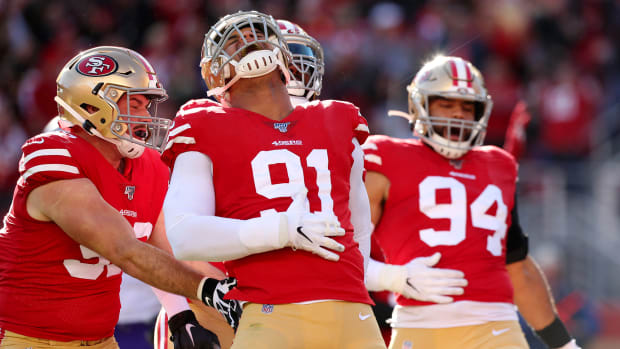
I don’t know why it took me this long to think of it, but I think the 49ers should look into tagging Arik Armstead with the purpose of trading him. Last year, it worked for both the Chiefs (Dee Ford) and Seahawks (Frank Clark) and brought home a significantly stronger return than the comp-pick system would’ve. Now the gamble here would be that Armstead could sign the tender, and then you have trouble finding a suitor, and your cap room (the Niners are expected to have around $20 million in breathing room) would effectively be gone if you couldn’t arrange a deal to offload him before the start of the league year. But the Niners should be able to investigate the trade market sufficiently at the combine to determine whether or not it’s a good idea to franchise him. So… this makes sense to me.
Interesting hearing that new Bears OC Bill Lazor said on the Coaches Show on WBBM in Chicago that he actually recruited Mitchell Trubisky when Trubisky was an underclassman at Mentor (Ohio) High and Lazor was a Virginia assistant. Lazor’s job will be an important one, in organizing all the voices helping the quarterback, with QBs coach John DeFilippo, pass-game coordinator Dave Ragone, along with head coach Matt Nagy, among those that’ll be trying to help kickstart Trubisky’s development. Interestingly enough, all four of those coaches were Division I college quarterbacks.
One win for Bengals coach Zac Taylor: He’s been able to come through the ups and downs of last season with a respectful relationship with Andy Dalton in place. It makes sense that Dalton wants to find a place where he can start next year, with the presumption that Cincinnati is going quarterback with the first pick. Similarly, as Taylor tried to build a strong rapport with his players, it makes sense for the team to do right by Dalton and work with him on that.
The Bills are flush with cap space. They project to have around $80 million to spend, and that’s before they make moves ahead of the league year (releasing Trent Murphy, for example, would create another $7 million or so). And they’ve drafted very, very well the last three years, which puts them in position to take full advantage of having their quarterback on a rookie deal. Now, they just need that quarterback, Josh Allen, to come through for them.
Should free agents Chris Harris and Derek Wolfe depart, then Von Miller will be the only member of the 2015 Broncos defense, the one that won Super Bowl 50, left. Which tells you all you need to know about the shelf life of teams built that way. In this era, with a team like that, you only get so many shots at it.
We’ve mentioned here that Browns GM Andrew Berry plans to structure his front office like the Eagles do theirs—with a VP of player personnel (heading up scouting) and a VP of football operations (heading up the rest of the football side) reporting to him. Berry already has two trusted confidants at his side, in Ken Kovash and Ryan Grigson. It certainly is possible that we see Kovash wind up as VP of football ops and Grigson as VP of player personnel when the reorg happens, probably after the draft.
Maybe it’s posturing, but it’s at least interesting that Buccaneers coach Bruce Arians said this (via ESPN, from the NFL Coaches Academy): “I don’t care who’s my quarterback. We’ve gotta have a defense.” He was referencing the need to keep a defense that improved and has a boatload of free agents—Shaq Barrett, Jason Pierre-Paul, Carl Nassib and Ndamukong Suh among them—together. That said, given the chance to back Jameis Winston, he’s been lukewarm over the last few weeks. And this is another example of it.
The Cardinals’ inability to cut David Johnson is another cautionary tale on paying running backs. Half his $10.2 million salary for 2020 was guaranteed at signing in 2018. The other half vested during the 2019 offseason. To get out of that, Arizona would have had to cut him just months after signing him to that deal in August 2018, with over $13 million gone for the single year, and $9 million in dead money to account for. For not doing that? The team is tied to him this year. They can trade him, but another team would have to be willing to pay a guy who’s been under 4 yards per carry two years running over $11 million this year. The Cardinals could eat some of that, but that, of course, would cut into the $8.25 million they’d save on the cap by dealing him. So yeah, not a great spot for Arizona to be in.
I do think Tyrod Taylor is an ideal placeholder for the Chargers. He knows Anthony Lynn’s system, having run it in Buffalo. And he’s worked with a young quarterback before—he opened 2018 as the Browns starter before giving way to Baker Mayfield—so he’d probably be good for a first-round quarterback, should that be where team brass finds the next guy.
The Chiefs have some decisions to make on players (Sammy Watkins would be one), but one they’ve already made their mind up on is Chris Jones. One way or another, I expect him to be a Chief in 2020. They’ll try to work out a deal first, and if that doesn’t work, they’ll tag him. One thing that complicates his situation a little is what the Chiefs paid an outside acquisition, Clark, last offseason. You’d think Jones would want at least what Clark got.
One sneaky important free agent: Colts LT Anthony Castonzo. GM Chris Ballard’s done a great job rebuilding his offensive line. Losing a left tackle would be a serious blow, because as good as the young pieces (Quenton Nelson, Ryan Kelly, Braden Smith) are, none of them have any experience playing that position. For his part, Ballard said on Indy sports radio this week that believes Castonzo has three or four good years left.
With the likelihood that the Cowboys lose Byron Jones in free agency, the continued development of young corners Chidobe Awuzie and Jourdan Lewis will be in focus with the new coaching staff. Both guys will be in contract years in 2020, and will be working with DBs coaches Maurice Linguist and Al Harris. Harris was a pretty good NFL corner himself.
Soon, it’ll be time for the Dolphins to start spending the capital they built last year. An overview: Miami has around $95 million in cap space and is likely to have 15 draft picks, after the comp picks are doled out, with five in the first two rounds. That’s an amazing position for GM Chris Grier to operate from. But he knows as well as anyone, turning that into a cadre of great players is tougher than just amassing it.
Another name I considered for last week’s cut list was Eagles WR Alshon Jeffery. The reasons they’d get rid of him are there—health, his place in the locker room, his price tag, and his age. The trouble is there would be major cap implications to walking away, and Philly’s already thin at the position. This is a tricky one for Howie Roseman.
There’s good news on the back end of the Falcons’ likely divorce from running back Devonta Freeman—there will be options for them in the draft. Atlanta has four of the first 80 picks, and the second and third rounds should be where a lot of the top backs (Georgia’s D’Andre Swift, Ohio State’s J.K. Dobbins, Wisconsin’s Jonathan Taylor, LSU’s Clyde Edwards-Helaire) come off the board. So the hole there will likely be temporary.
This week, Leonard Williams pushed back on the notion that he’s asking for $15 million from the Giants. But maybe he shouldn’t? Given that the team forked over a third-round pick and a conditional fifth-rounder to get him, and his franchise tag number would be around $16 million (not happening), Williams has considerable leverage here.
It didn’t go unnoticed among people connected to Tom Coughlin that the Jaguars hired his replacement in New York, Ben McAdoo, as quarterbacks coach. Funny coincidence, given all that’s happened over the last two months.
The Jets’ signing of CFL safety Anthony Cioffi is another example of how the NFL could really use a developmental league. Cioffi finished a very solid four-year career at Rutgers in early 2017, and went undrafted that spring. He signed with the Raiders, washed out and landed in Canada. There, he grew as a hybrid safety/linebacker (he actually started his college career as a corner) and played his way into another shot at the NFL. We’ll see how this one goes, but as it is, this is a good example of a post-college guy who probably wasn’t quite ready buying himself some time by playing somewhere other than the NFL.
I touched base with Lions coach Matt Patricia via text on Friday on the Matthew Stafford trade report. Here’s what he said: “Not in any trade talks whatsoever for Matthew.” I think some of this may stem from Detroit kicking the tires on some quarterbacks before last year’s draft. Whatever it is, as far as I can tell, there’s nothing there right now.
The likely release of Packers tight end Jimmy Graham will free up $8 million in cap space and bring the team to around $30 million in breathing room. The flip side is that it’ll also eliminate a playmaker—and put a little more on GM Brian Gutekunst to get playmakers for Aaron Rodgers, and on the coaches to get more out of underachieving younger guys like Marquez Valdes-Scantling.
The Panthers’ continued caution on committing to Cam Newton is fine for now, but the new league year is a month away—and the game of musical chairs at quarterback probably won’t last long thereafter. Now, they’d probably be OK going forward with Kyle Allen and Will Grier and a potential draft pick in 2020, especially considering Year 1 under Matt Rhule promises to be something of a rebuild. The issue would come if the Panthers want to get something for Newton, trade-wise. That’ll be tougher to do on, say, April 1, because so many of the quarterbacking seats will be taken by then.
One win for the Patriots—their 2017 contract with Dont’a Hightower. It looked like there was zero chance he would see the four-year deal he signed with the team through. He had a partially torn pec, and looked like he was breaking down physically, and that was reflected in a deal that protected the team at every turn ($875,000 per year in per-game roster bonuses, $2 million per year in play-time and performance incentives). Yet, here we are, going into the final year of that deal. The pec wound up going in October 2017, ending that season after five games, but he’s started 30 of 32 games the last two years, which is a big-time credit to him.
A.J. Green would make a lot of sense for the Raiders. And regardless of the quarterback situation (it’s safe to say the team sees the floor as sticking with Derek Carr, and the ceiling obviously may be somewhere else), the Raiders would probably be a good fit for Green.
The Rams introduced their new coordinators last week, and one thing I like about the hires is pretty simple: There’s strong reasoning behind them. Defensive coordinator Brandon Staley had connections to Sean McVay through Chris Shula, Staley drew interest from multiple teams, and a big part McVay’s motivation in pursuing him was how hard a time he had coaching against defenses led by Vic Fangio, Staley’s boss last year in Denver. As for offensive coordinator Kevin O’Connell, McVay saw the need for more hands-on coaching with Jared Goff, given the losses of Matt LaFleur, Greg Olson and Zac Taylor over the last three years, and few would be better suited to fill that role than O’Connell, who filled the role (Jay Gruden’s OC) that McVay once did in Washington.
We mentioned this with the Niners a few weeks back, and it goes for the Ravens too—huge win for the team keeping its coaching staff intact. That coordinators Greg Roman and Wink Martindale will return is huge for the young guys, as will be having Roman and QBs coach James Urban back for Lamar Jackson.
In the wake of the Redskins shedding Josh Norman and Paul Richardson, many anticipated something happening with tight end Jordan Reed on Friday. I’m told that situation has to be handled differently because of Reed’s injury situation—concussion issues landed him on IR last October. He last played in a game in 2018.
Interesting aspect of the Saints’ situation with Drew Brees: His contract is up. The last time we were here, a two-year, $50 million deal got done without incident, and I don’t think there’ll be one this time if Brees to decides to play in 2021. But an already tight-to-the-cap New Orleans team will have to be creative cap-wise, because Brees has $15.9 million in dead money to deal with, which means he’d have the second highest cap number on the team if he decided not to play. And then, there’s the fact that Brees’s deal could well be a market setter for Philip Rivers and Tom Brady.
I personally think it’d be tough for the Seahawks to bring Michael Bennett back. Too much history for both sides to wade through there.
Big Steelers news that slid slightly under the radar this week. And GM Kevin Colbert was the one to say it for himself: “I’m not looking to ever go anywhere else again as long as the Rooneys and Steelers are interested in me.” Assuming Colbert’s being forthright, that means he’s open to sticking around a few more years, and also that he’d resist anyone trying to poach him. Rumors have swirled for over a year that Panthers owner David Tepper, a former Steelers minority owner, might make a run at adding Colbert to his front office.
Should CB A.J. Bouye wind up a cap casualty in Jacksonville, his return to the Texans almost makes too much sense. When Houston let him go, Rick Smith was still the GM. The coaches loved him. So with a long-standing need at that position, Bradley Roby a free agent and Vernon Hargreaves cut, bringing back an old friend might make sense for Houston.
Titans GM Jon Robinson has pulled together a really solid roster over the last four years, so it’ll be interesting to see how he handles the first draft pick of his tenure. Right tackle Jack Conklin is a free agent, and good offensive linemen always get paid in free agency. So whether it’s Tennessee or someone else paying that freight, you can bet Robinson will be wishing, at the end, that he’d be picked up Conklin’s $12.87 million option for 2020. The Titans declined it, largely due to Conklin’s injury problems.
A lot’s been made over the Vikings defensive coordinator situation, with Andre Patterson and Adam Zimmer sharing the role in 2020. I’d say it’s probably not worth spending much time worrying about. Mike Zimmer was one of the best defensive play-callers in the league for over a decade as a coordinator, so he’ll be more than able to make up for an experience deficit the two new guys bring.
***
TOP FIVE
CBA talks are entering a critical stretch. The NFLPA held a meeting of its exec board and player reps on Jan. 30 in Miami and again on Feb. 6 in L.A. Another Thursday meeting is set for this week in D.C. Coming out of the L.A. meeting, the NFLPA gave the league a list of its issues with its proposal, and the league countered with another proposal. The union and league will continue dialogue this week, so tweaks could come to the most recent proposal, and the players will decide in D.C. whether to vote on what they have in front of them or counter. The good news? A lot of the economic issues have been worked out. The biggest divide, at this point, concerns minimum salaries. The bad news is that the idea of a 17-game season still remains an issue, and Cardinals owner Michael Bidwill’s comments last week didn’t help. The league and union are trying to grind through new work rules—offseason, training camp, and in-season—that would lighten the physical and mental load on the players, should there be a 17th game. And the NFL’s given the players its word that the new schedule won’t come until 2021, at the absolute earliest. I was told on Friday that a vote this week remains unlikely. But things are moving in the right direction. The NFLPA has its annual rep meeting from March 7–10, during which they’ll elect a new president. Given Eric Winston’s role over the last few years, finding common ground before then seems like it’d be critical for both sides.
Nick Caserio’s staying in New England. The Patriots are keeping their director of player personnel, and I think this is a situation where you have to give ownership credit. As was the case with Josh McDaniels a couple years ago, the Krafts recognized that, given the age of the coach (67 now, 68 on opening day) and quarterback (42 now, 43 on opening day, and a free agent), stacking young guys who could continue to ascend in different parts of football operations would be vital. So maybe Caserio will get the GM title eventually—no one’s had that in New England over Kraft’s 26 seasons of ownership—or maybe McDaniels will be the head coach. The key is the team has created in-house options for itself. Two other aspects of Caserio’s imminent new deal are worth noting, as well. First, as it’s structured now, the Patriots have three guys atop their scouting department—Caserio, pro director Dave Ziegler and college director Monti Ossenfort. Both Caserio and Ossenfort’s deals were set to expire in May, leaving Ziegler as the only one signed for this season (he’s up after the 2021 draft). So a potentially destabilizing circumstance loomed, and now that’s been addressed. Second, Caserio’s role as quasi-coach (he’s in McDaniels’s headset from the booth on gameday) and jack-of-all-trades made it so it probably would’ve taken multiple guys to cover the difference he makes for the organization. All of which means, all the way around, this is a great development for the Patriots.
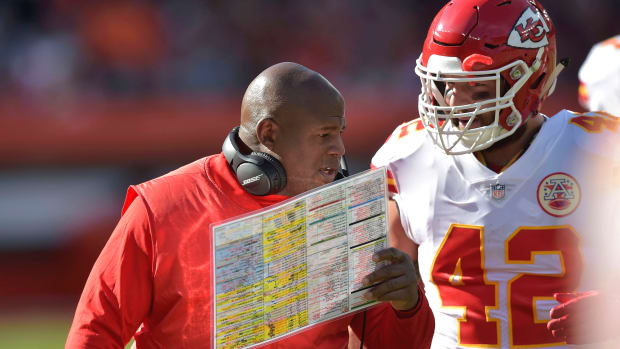
Kicking tires on Colorado wouldn’t be crazy for Eric Bieniemy. And I get the logic people are pushing that the Chiefs’ OC should stay in the NFL and take his shot at a head coaching job next year. But I’d use Bill O’Brien and Matt Rhule as examples of what going into a difficult situation at the college level can do for a guy’s NFL stock. In 2012, after three years as the Patriots’ offensive play-caller, O’Brien was considered a wild-card candidate for the Jaguars’ opening, and had been connected to many other jobs. He went to post-Sandusky Penn State. He did a great job. By 2014, he was the hottest candidate on the NFL market, and went to a pretty stable franchise in Houston. Likewise, Rhule could’ve bailed for the NFL a year ago, and into a broken situation with the Jets. He stayed an extra year as Baylor’s fireman, completed the rebuild there and wound up commanding an unheard-of seven-year deal to be new Panthers owner David Tepper’s first coaching hire. Point is, there is benefit in doing it that way. Bieniemy will almost certainly be in the mix again next year for jobs. Coaching Patrick Mahomes protects his stock the way coaching Brady once protected O’Brien’s. But a great couple years at his alma mater could wind up giving him his pick of jobs. And I’m not saying that’s what he should do. I am saying the move would be understandable.
The Myles Garrett/Mason Rudolph situation will only get uglier. I’ve felt this way from the moment Garrett’s accusation that a racial slur from Rudolph ignited the November fracas in Cleveland (which ended with Garrett swinging a helmet at Rudolph)—one way or the other, something awful happened. If Rudolph is guilty of what Garrett says he is, then it’s self-explanatory how bad that is. If Rudolph’s not guilty, then Garrett’s handling of this, after he doubled down with ESPN’s Mina Kimes this week, is even worse. Barring Garrett retracting what he said, the accusation is something Rudolph will have to wear for the rest of his career, which is wildly unfair if he’s innocent. If you want an idea of the impact here, just turn on the TV. It wasn’t hard to find segments the other day breaking down the “if he’d done this” scenario. Which, if someone is just tuning in mid-stream, might cause people to assume he’s guilty. In that sense, a lot of damage has already been done.
XFL’s got its work cut out for it. Through six games (going into Sunday’s action), five unders had hit, and no game had been decided by fewer than 6 points. The Tampa Bay Vipers, coached by a noted offensive guru in Marc Trestman, haven’t scored a touchdown on offense yet. And the reasons why, I think, are pretty simple. The NFL has a depth issue at quarterback and along the offensive line, so naturally the XFL was always going to have problems filling out those positions. The AAF addressed that with rules severely limiting blitzing. The XFL hasn’t, and defensive coaches are starting to catch on to the fact that linemen are having trouble identifying and blocking pressure. So they’re sending guys. It’s led to offenses having problems moving the ball, and quarterbacks getting hit. And the tough thing is, if they want to be a developmental league, those are the two positions I believe the NFL would be most interested in them working on. Maybe there could be rules tweaks in-season?
***
SIX FROM THE SIDELINES
1) Since the Astros either hired the wrong crisis management people, or didn’t listen to the ones they had, I’d like to offer this statement for owner Jim Crane: “I own the team and the buck stops with me. As a result, even if I wasn’t directly involved, I’m accountable for everything that happened over the last few years, and this has been an embarrassing episode for all of us. From this point forward, I promise to do my best to uphold a higher standard of integrity, and hire people who’ll do the same, within this organization. I sincerely apologize for our actions.” Bottom line, they didn’t have to make things so hard on themselves.”
2) As I type this, I have no idea who won the dunk contest. And now I’ll go look it up… Derrick Jones Jr. Not sure who that is. But I’m pretty sure this is another sign that all-star games in professional sports are sort of outdated. The Pro Bowl sucks. I don’t think the other ones are very good either. Or necessary anymore. (Update: I guess the actual NBA All-Star Game was pretty good last night, according to what was on Twitter.)
3) Kobe Bryant, Kevin Garnett and Tim Duncan make up one heck of a Hall of Fame class.
4) Billy Donovan had the court at the Univ. of Florida named after him this week, and I’m not sure he gets the credit he deserves for what he accomplished there. To do what he did at a dyed-in-the-wool football school—capturing back-to-back national titles in hoops—remains absolutely incredible.
5) The Michigan State coaching search ended with Mel Tucker landing a deal worth $5.5 million per year, and illustrated why, again, the SEC and Big 10 have separated themselves from the rest of the country. Remember, it was a Pac-12 school with a national title in the last 30 years that couldn’t keep up with the fourth program in the Big 10 East.
6) Obviously, the rape case at my alma mater, Ohio State, is unspeakably awful. I’m glad that Ryan Day didn’t waste any time taking action.
***
BEST OF THE NFL INTERNET
It’s impossible not to root for Teddy Bridgewater.
Or Ron Rivera, for that matter. The new Redskins coach held a Bud Grant-style yard sale of his old Panthers gear, and he and wife Stephanie raised $30,000 for the Humane Society of Charlotte. Awesome way for them to say goodbye.
Very fair take from Bobby Carpenter. And I love that: Bad things happen when good people choose to do nothing.
And this would be a fair question.
Just when you thought the ol’ Gatorade bath had gotten stale.
God bless Scott Simpson.
You guys know where I fall on this. S/o to Dianna for asking the question too, and getting the correct answer.
What’s really tough for Mason Rudolph is it’s almost impossible to prove a negative.
Matt Rhule’s first tweet as Panthers coach… Live from Daytona.
This is a fun watch.
***
WHAT YOU NEED TO KNOW
And maybe this is more looking forward than looking back, but I figured it’d be fun to go back to my review from this summer of Joe Burrow, who was coming off a good-not-great redshirt junior season, his first at LSU.
Every year, during our draft week in July, I do full once-over of the quarterback class to come, to give you guys a picture of how those in the know see the best prospects at the most important position. The hope is to give you stuff to pay attention to, from an NFL perspective, during the college season. Here’s how we looked at Burrow:
Burrow was in the thick of a position battle with [Dwayne] Haskins in 2018 at Ohio State, then transferred to LSU and caught fire at the end of last year. And he’s got some physical ability, and size—and a pretty decent situation around him to boot.
“LSU’s one of those teams, when you play them, you see it’s built on good play at every other position but quarterback,” [Jordan] Palmer said. “But the last five games, he went off, and they’re bringing back pass-rushers, corners, three good running backs. It’s all there. He has a chance to have special year, and you can see it’s not too big for him.”
And he sure did have a special year. But when I wrote that, the thought was maybe he plays his way into the second round, after being seen as a third- or fourth-rounder. I’m not sure anyone saw what was coming.
So what do you need to know? I think Burrow’s case is another example that shows we shouldn’t draw sweeping conclusions on college players before their eligibility is up. Similar to Burrow, Baker Mayfield was seen as a middle-round prospect going into his final year at Oklahoma. Kyler Murray was seen as a baseball player. Both went first overall the following April, as Burrow is expected to.
Right now, Clemson’s Trevor Lawrence and Ohio State’s Justin Fields look like the cream of the 2021 crop. But a lot can happen between now and next April.
Question or comment? Email us at talkback@themmqb.com.
Sunday, 16 February 2020
Saturday, 15 February 2020
New on SI: Could Mason Rudolph-Myles Garrett Dispute End Up in Court?
Cleveland Browns DE Myles Garrett again has accused Steelers QB Mason Rudolph of directing a racial slur at him during their Nov. 14 fight.
Three months ago, Cleveland Browns defensive end Myles Garrett told NFL officials that Pittsburgh Steelers quarterback Mason Rudolph had directed a racial slur at him during the Nov. 14 Steelers-Browns game in Cleveland’s FirstEnergy Stadium. The alleged slur—which Rudolph categorically denies saying and which the NFL says available evidence doesn’t substantiate—would have occurred during an on-field skirmish between
Browns and Steelers players. The skirmish was highlighted by Garrett striking Rudolph in the skull with Rudolph’s helmet.Garrett, who apologized for the strike and who didn’t mention the alleged slur during a post-game press conference, was one of several players suspended by the NFL. Garrett was suspended indefinitely, a term that cost him the final six games of the 2019 season. The suspension could have extended into the 2020 season but NFL commissioner Roger Goodell reinstated Garrett earlier this week.
Latest developments indicate the dispute might be headed for court
The controversy over what Garrett claims Rudolph said had faded until two days ago. During an interview with ESPN’s Mina Kimes, Garrett reiterated his accusation, telling Kimes that Rudolph “called me the N-word . . . he called me a 'stupid N-word.”
On Saturday, the Garrett-Rudolph dispute inched toward potential litigation.
First, Steelers head coach Mike Tomlin rejected the possibility that his quarterback would utter such an offensive remark. Tomlin stressed that he has spoken with numerous Browns players and coaches. None, according to Tomlin, mentioned or even intimated that Rudolph had said “anything racial or anything of that nature.”
Tomlin taking time in the offseason to issue a statement about a controversy from last season highlights the controversy’s unresolved state. Tomlin’s statement also serves as a reminder to Garrett and his representatives that, based on what is presently known, no players on either team corroborate the accusation. Rudolph’s potential case against Garrett would be strengthened if only Garrett claims to have heard the remark.
Second, Rudolph tweeted a statement that hinted at him bringing a defamation lawsuit against Garrett. Rudolph dismissed Garrett’s accusation as “a bold-faced lie” that constitutes “a disgusting and reckless attempt to assassinate my character.” The reference to character assassination is noteworthy. A defamation lawsuit would include an assertion by Rudolph that Garrett has damaged his reputation, perhaps irreparably.
Third, Rudolph’s agency and law firm, Younger and Associates, tweeted a declaration that warns Garrett “is now exposed to legal liability.” The statement ridicules Garrett for claiming that “Mr. Rudolph uttered the slur simultaneously with being taken down” and prior to Garrett committing “a battery by striking Rudolph on the head with a 6 lb helmet.” The agency goes on to assert that Garrett is lying in order to “coax sympathy” and distract from his “inexcusable behavior.”
A possible lawsuit . . .
Whether Rudolph “could” and “will” sue Garrett are two different considerations.
Rudolph certainly could sue Garrett for slander. Slander constitutes a spoken statement that is untrue, factual sounding (as opposed to constituting an opinion), told to others and damages a person’s reputation. Slander is the spoken version of defamation, while libel contemplates defamation in writing. Rudolph would need to prove slander by a preponderance of the evidence, meaning “more likely than not.”
Rudolph could insist that Garrett has falsely accused him of making a specific and derogatory statement and the accusation has harmed Rudolph’s reputation. To that point, Rudolph could introduce expert testimony to show that his potential for signing lucrative endorsement deals has been derailed. Obviously, companies are less likely to pay athletes to endorse their products if those athletes are accused of making racist remarks.
One might question Rudolph’s marketability even without the current controversy. Filling in for an injured Ben Roethlisberger last season, Rudolph threw 13 touchdowns against 9 interceptions before suffering a sternoclavicular joint dislocation in his left shoulder in December. The Steelers hope that Roethlisberger, who is recovering from surgery on his right elbow, will return in 2020. If that happens, Rudolph would probably be back on the bench. As a back-up QB, Rudolph is unlikely to attract top endorsement offers. However, he’s only 24 years old. It could just be a matter of time before Rudolph starts in Pittsburgh or elsewhere. Consequently, if the public believes Garrett, Rudolph’s actual and potential opportunities for endorsements would be hurt.
Rudolph might also be able to establish that a false accusation he called Garrett the “N-word” constitutes slander per se. Such a statement is so outrageous on its face that the plaintiff—here Rudolph—is relieved of the obligation to prove damages. Statements that are likely to cause a person to be hated or shunned can constitute slander per se, though courts are very scrutinizing in recognizing remarks as slander per se.
Rudolph’s lawsuit would be advanced by the apparent absence of evidence in support of Garrett. To date, no coach or player—including those who were within inches of Garrett and Rudolph—has publicly come forward to vouch for Garrett’s accusation. Rudolph would also stress that Garrett notably declined to mention the accusation during his postgame press conference. Garrett also appears to have waited six days to share it and only did so during a hearing that would impact the length of his NFL suspension. In addition, the NFL has not found evidence supporting the accusation. Those factors all favor Rudolph.
. . . but an unlikely lawsuit
There are a number of reasons why Rudolph might decline to pursue a case.
For starters, if Garrett is telling the truth, Rudolph would be ill-advised to sue him. A lawsuit in that circumstance could lead to Rudolph lying under oath. That would present a far more serious risk to Rudolph than protecting his brand: he could be criminally charged with perjury.
Assuming for the moment that Rudolph is telling the truth, he’d still face obstacles in a case.
First, Rudolph almost certainly qualifies as a public figure. This means he’d need to establish “actual malice” in order to advance a slander claim. To that end, Rudolph would need to convince the jury that Garrett knowingly expressed false and defaming information about him or had reckless disregard for the information’s truth or falsity. Therefore, if Garrett genuinely believes that Rudolph made the racist comment, even if Garrett is mistaken—assume Garrett misheard what Rudolph said—Rudolph wouldn’t be able to prove that Garrett knowingly lied. Reckless disregard for the truth would also be hard to show, though Rudolph could question why Garrett didn’t contact him to clarify what he heard.
Second, Rudolph would be subject to pretrial discovery. He would have to answer questions under oath that are related to whether he would say the N-word. Rudolph would be required to share emails, texts and social media posts. If Rudolph has made insensitive remarks about any group of people, he ought to be concerned about the possibility of those remarks damaging his case and going public, too.
Third, Rudolph might struggle to meet the burden of persuasion. If, at the end of a trial, the jury is undecided on whether Rudolph or Garrett is telling the truth, Rudolph would lose. Remember, as the plaintiff, Rudolph would have the burden of convincing the jury. A jump ball, if you will, would result in a loss for Rudolph.
The NFL and NFLPA don’t want litigation
Although it isn’t their call, neither the NFL nor the NFLPA want Rudolph to sue. A lawsuit would likely lead to attempts by Garrett to subpoena recordings and related evidence from the NFL and NFL Films. Subject to various rules and restrictions, NFL Films records the audio of players during games. If Garrett is skeptical of the NFL’s findings, he might suspect the evidence would prove he is telling the truth.
As to the NFLPA, it doesn’t want to see two members of its bargaining unit become the plaintiff and defendant in a lawsuit. Likewise, the NFLPA knows that teammates of Rudolph and Garrett would rather not have to testify, especially if what they say under oath undermines their teammate.
Chances are we won’t see a lawsuit. The dispute will probably end with both men publicly contradicting each other. Rudolph can try to restore his reputation by hinting at a lawsuit but not actually going forward with it. Rudolph wants to signal to the football community—and the companies that might one day want to sign him to endorsement deals—that he is a good person. Garrett, meanwhile, wants to signal that he is telling the truth. Both can accomplish their goals that without facing off in court.
Michael McCann is SI’s Legal Analyst. He is also an attorney and the Director of the Sports and Entertainment Law Institute at the University of New Hampshire Franklin Pierce School of Law.
More From All Steelers:
Javon Hargrave Signs With Drew Rosenhaus
Druin Mailbag: XFL Thoughts, Big Ben, Biggest Misconceptions for Steelers and More
Tuesday, 11 February 2020
Monday, 10 February 2020
New on SI: Philip Rivers to Enter Free Agency, Won't Return to Chargers
Philip Rivers has spent his entire career with the Chargers, who drafted him in 2004.
Quarterback Philip Rivers will not return to the
Los Angeles Chargers for the 2020 season.The team and Rivers mutually decided the veteran quarterback will enter free agency.
"After stepping back a bit from last season, we reconnected with Philip and his representatives to look at how 2019 played out, assess our future goals, evaluate the current state of the roster and see if there was a path forward that made sense for both parties," Chargers general manager Tom Telesco said in a statement. "As we talked through various scenarios, it became apparent that it would be best for Philip and the Chargers to turn the page on what has truly been a remarkable run."
The fourth pick in the 2004 NFL draft, Rivers has played his entire career with the Chargers. In his time with the team, he made eight Pro Bowls, threw for more than 4,500 yards five times and as a starter went 123-101 in the regular season and 5-6 in the playoffs. He sits at No. 6 on the NFL's all-time touchdowns list with 397, ahead of John Elway, Joe Montana and Johnny Unitas.
"I am very grateful to the Spanos family and the Chargers organization for the last 16 years," Rivers said in a statement. "In anything you do, it's the people you do it with that make it special. There are so many relationships and memories with coaches, support staff and teammates that will last forever, and for that I am so thankful.
"I never took for granted the opportunity to lead this team out on to the field for 235 games. We had a lot of great moments, beginning in San Diego and then finishing in L.A. I wish my teammates and coaches nothing but the best moving forward."
Los Angeles finished the 2019 season 5-11.
More From ChargerReport:
Former Chargers A.J. Hendy, Dexter McCoil Come Up Big in XFL Debuts
New on SI: How the Chiefs’ Defense Turned the Tide in Super Bowl LIV in Three Plays
Patrick Mahomes got all the attention for Kansas City’s comeback, but without some stellar defensive work, the Chiefs would have never been in position to win.
It was Thursday morning, and just about all of the Chiefs’ defensive work ahead of Super Bowl LIV was done. But for one reason or another, defensive line coach Brendan Daly—the former Patriots assistant set to coach on the biggest stage for the fourth time in six years—still felt the need to reinforce the emphasis he and the staff had given his guys.
So on the 11th day of game prep, Daly held the defensive linemen in the meeting room a while longer than the team schedule prescribed, and spent a solid 15 minutes showing the guys 49ers screen pass after 49ers screen pass. His obsession was going to get driven home.
“He made us watch all the screens,” said 17-year vet Terrell Suggs on Sunday afternoon, a week after the Chiefs’ 31–20 Super Bowl win. “He just knew it.”
Suggs wound up being he beneficiary of that particular point of emphasis. We’ll get to that one.
But if you really want to know where a defense that would’ve struggled to make a stop in the Big 12 in 2018 became one that made handful of big ones in the Super Bowl, you can start with the overarching idea in that meeting room. It’s in there that you’d find how defensive coordinator Steve Spagnuolo and a bunch of imported players and position coaches pulled it off.
Spagnuolo calls it My Job Plus. The idea? You take care of your job first. Then, you can do a little extra.
“I know Bill [Belichick’s] big thing is do your job and all that,” Spagnuolo said late last week. “We believe in doing our job. And then if you can do a little bit more, that’s the plus part of it. And throughout the [Super Bowl], guys did that.”
Patrick Mahomes will, rightfully, forever be
the hero of Super Bowl LIV. His performance in the game’s final seven minutes would’ve been impressive no matter what led up to it. But given how he’d played over the first 53, the stakes and his age, what the 24-year-old made happen will be remembered as historic.That said, without a maligned defense doing My Job Plus last Sunday night, there’s a pretty good chance things would’ve gotten out of hand well before Mahomes ever had the chance to stage his Houdini act of a fourth-quarter show. And that it happened just a year after the KC defense couldn’t buy a stop in the AFC title game, as Mahomes went blow-for-blow with Belichick’s defense, makes it even more remarkable.
***
The offseason is here! And we’re going nowhere. There’s a lot to get to this week, even with the season over and the combine still two weeks away. Among those things, we’ll discuss …
• Eric Weddle’s retirement, and the impact he made.
• Potential cap casualties across the NFL.
• Some college coaches who were pursued by NFL teams.
• The trouble with XFL’s structure.
• The London Jaguars?
• A key time in the CBA negotiations.
But we’re starting with one last look back at the Chiefs, their championship and the less-discussed reason why the Lombardi Trophy is back in KC after a half-decade.
***
A few days after the Chiefs’ win, Kansas City’s offensive line coach, Andy Heck, happened by Spagnuolo’s office. He’d just buzzed through the defensive tape and was about to deliver the highest compliment he could give Spagnuolo.
“Steve,” Heck said, “those guys were flying around.”
That was more than a confirmation of the effort Spagnuolo saw on Super Bowl Sunday. It was one more nugget of affirmation that all the work he and his coaches had done over 12 months had achieved its purpose.
“That was a huge compliment, because when I’m watching the tape, I’m dissecting everybody’s job—what they did, what they didn’t do, where were the mistakes—because I’ve still got the coach in me and I’m going to use it for next year,” he said. “But to hear him say that, I was very proud of that. Now, you would expect that in the Super Bowl, that everybody would fly around. But Andy’s point was, guys made so many plays just on effort.
“And I think that’s a true statement. And even in a big game like the Super Bowl, on defense, it still comes back to relentless effort. And there’s a lot of examples of that from our guys that made it possible for us to limit [the Niners] to 20. And I’m glad they did.”
In other words, the game, against an intricate Niners offense helmed by one of the sport’s best play-callers, became the definition of My Job Plus.
I asked Spagnuolo to pick three plays from the game that best encapsulated the win on defense, and he produced three that fell right along those lines. The first one, you could argue, may have ended with extra effort on the play, but it started with that extra 30 minutes on Thursday.
Play 1
Line of scrimmage: Chiefs’ 25.
Down-and-distance: 1st-and-10.
Time: 9:38 left in the first quarter.
Score: 49ers 0, Chiefs 0.
Had it gone as it was drawn up, this play should’ve been the game’s first touchdown. Spagnuolo called a zero blitz—sending the house and leaving his back-end guys on islands. Kyle Shanahan called a middle screen and, at first, the middle of field looked like the seas parting, with Raheem Mostert eyeing a clear path to end zone. (He may have had to beat safety Dan Sorensen, but there was no one else in front of Mostert with a shot at him.)
But at the snap, Suggs remembered what Daly told him and then noticed how left tackle Joe Staley “was inviting me upfield and inside. It was very unusual.” So Suggs backed off a step. Garoppolo dumped the ball to Mostert as he was getting hit and, as he let the ball go, Suggs went into a back pedal. Now, instead of Mostert being behind him, he was right in front of him. And fellow defensive lineman Mike Pennel, who’d struggled to get past his blocker, was right there with Suggs to get Mostert to the ground.
“He did his job by being a contain rusher,” Spagnuolo said, explaining that Suggs’s job initially was to rush, but to do it in a way in which Garoppolo couldn’t get outside of him. “But then he did more than that. He felt the tackle, he just felt the whole O-line, that it wasn’t a true pass play, that it was a screen. He came off, and made a play on the screen.”
Bottom line: If Suggs and Pennel just do their jobs on that play, Mostert probably scores. The plus part wound up saving the Chiefs four points. The Niners ended up kicking a field goal three plays later.
Play 2
Line of scrimmage: Chiefs 27.
Down-and-distance: 3rd-and-5.
Time: 10:28 left in the third quarter.
Score: 49ers 10, Chiefs 10.
San Francisco came out in a trips-right formation, with Tevin Coleman outside and Emmanuel Sanders and George Kittle side-by-side in the slot. And what was coming was something the Chiefs had drilled all week to their guys: In spots like this, the Niners would run what’s called a “China” route, a short in-cut, off a pick. The corners, as such, were told to play tight to the receiver to minimize the chance that they’d get cut off.
At the snap, Bashaud Breeland was way up on Coleman and played him with hard inside leverage. As Coleman cut in, Sanders went to the flag, and shook his shoulders to try to get in Breeland’s way. But Breeland was too close to Coleman for Sanders to do anything about it without running into his teammate. Garoppolo put the ball to right of Coleman, but because Breeland followed his coaching he was right there with him.
Now, the plus? Linebacker Damien Wilson was in the middle of the field to clean the play up, but he had slipped on the turf. So Breeland had to make the tackle himself—and he did, dragging Coleman down two yards short of the sticks when there was room to dive for the first down. That forced another field goal, preventing seven the first possession of the second half.
There was also a secondary focus that was adhered to.
“This team we were dealing with was huge on yards after catch,” Spagnuolo said. “We preached all week long that if they were going to complete them, we had to tackle where the completion was made. And he did that on that play. It was well executed by Breeland.”
So with the first two plays, the Chiefs kept it 20–10 early in the fourth quarter when it probably should’ve been 28–10. And that set up the third play.
Play 3
Line of scrimmage: 49ers’ 34.
Down-and-distance: 3rd-and-14.
Time: 9:47 left in the fourth quarter.
Score: 49ers 20, Chiefs 10.
The magnitude of the situation was intense. On the previous possession, Mahomes was picked off. The deficit was 10. Realistically, the Niners were probably a touchdown, or maybe even a few first downs, away from putting KC away.
So losing on this third-and-long would be a back-breaker.
Before the snap, safety Tyrann Mathieu creeps up to the line and, because he’s a proficient blitzer, the Niners have to treat the threat as real. He and linebacker Ben Niemann crowd over the A-gaps at the snap, then both fall off into coverage. Defensive end Frank Clark is getting around San Fran tackle Joe Staley. But just as he’s closing, Garoppolo sees Mathieu right in front of his target, Kendrick Bourne, notices that Suggs has lost contain on his right, and bails from the pocket.
From there, Clark keeps coming, Suggs recovers, and both, with that second effort, get Garoppolo out of bounds. The Niners have to punt. The Chiefs would score on their next three possessions. San Francisco wouldn’t be able to muster another first down until seven more minutes had come off the game clock. And all because Mathieu did a little extra to get Garoppolo mentally—and because Clark’s effort was enough to make up for Suggs’s false steps.
“The point is, we took away his first read, Frank flushed him out, and then the rest of the guys plastered their coverage. That’s what we do when they scramble,” Spagnuolo said. “And then [Rashad Fenton], our nickel, was there to take him out of bounds.”
***
There were other little things that helped too.
One was a cutup of Niners play-action plays, shot from the end zone with the offense coming at the camera. By watching that, the coaches figured, they’d get a better look at any noticeable tells the defense could use to figure out if the play was ultimately a run or a pass—and they found one. They noticed the San Francisco linemen had “high hats” early on play-action pass plays, meaning their helmets were popping up.
That revelation almost led to a pass breakup on Garoppolo’s first throw of the game, with linebacker Anthony Hitchens quickly identifying the boot off a run action.
Another was the presence of defensive assistant Connor Embree, whose father, Jon, and brother Taylor are offensive coaches for the Niners. Embree, as a result, wound up being a valuable resource during the week.
And another yet was what each individual coach brought to the table. Linebackers coach Matt House, a college coordinator at Kentucky the last five years, stood in front of the group at halftime and gave them an adjustment to defend RPOs the Niners were throwing at them, which related back to his experience in the SEC. The Super Bowl experience of Daly and secondary coaches Dave Merritt and Sam Madison didn’t hurt, either.
After the Cardinals waived him in December, Suggs initially had trepidation about going to Kansas City, and he told head coach Andy Reid as much. Suggs’ personality is big, and he “learned the hard way” in Arizona that he wouldn’t be a fit just anywhere. He didn’t want to go through an experience like that again. Reid assured him, If you’ll fit anywhere, it’s here.
It was sort of a funny thing to say, Suggs thought, given all the turnover they’d had. Eight defensive players played at lest 80 percent of the snaps for the Chiefs in last year’s AFC title game. Five of them were gone. Mathieu was new. Clark was new. Spagnuolo was new, That, to Suggs, seemed like a lot of moving parts. But he trusted Reid, and he showed up at 6 a.m. the next day.
After cramming that morning, he walked to the locker room and bumped into a bunch of the guys playing three-on-three basketball. “It was like I was back on the South Side of Chicago,” Suggs joked. And soon, he saw that feeling was real.
“The group is different, it was the chemistry,” Suggs said. “They hadn’t played with each other, and usually, it takes time to jell, it can take two or three years to become really good. They had a brief amount of time to make it work. And they did it. You bring up the Baltimore defense I played on, those were guys who played their whole careers together. The chemistry was built. It was there.
“Here, we’d only been playing with each other for a short time. For me, it was the last month of the season and into the playoffs.… To reach football immortality that way, it’s special.”
And as the guys there saw it, it was the little extra in an era when everything is won on the margins. It’s Daly keeping the guys a little longer, it’s Breeland following through on his responsibility, then making the tackle, it’s Suggs acting on what he’d been drilled on and applying it to make a play, it’s noticing the high hats, and it’s House’s halftime message.
That’s where, as Spagnuolo saw it, the Chiefs set the table for Mahomes to do his magic, and where they put everything that happened in 2018 behind them, once and for all.
“It's contagious,” Spagnuolo said. “And where it begins is in practice, because if your leaders are doing it, and both 32 and 55 do it, then the other guys have no other choice but to join the crowd and start running all over the place. And when a guy like Terrell Suggs, 17 years in the league, is practicing like that during the weeks of the playoffs, you can't help but look at him as another teammate and player, and say, ‘I better pick my stuff up, too.’…
“That showed up. They were gritty right down to the end, they kept fighting. It was like a damn heavyweight bout where you kind of get staggered a little bit, but just keep on swinging and eventually turn the tide and end up knocking the guy out.”
That, over the rest of it, was the real plus in Spagnuolo’s championship equation eight days ago. And the result? Well, the result was that his group wound up being a lot more than along for the ride.
***
ERIC WEDDLE FINDS THE RIGHT TIME TO LEAVE
Eric Weddle isn’t hanging ’em up now because, after 13 seasons, the 35-year-old can’t play anymore. The Rams safety is doing it because it’s always been his goal to never let it get to that point. And last year, he got a little taste of what it might feel like to be there.
In his first game with the team, at Carolina in September, Weddle broke off cartilage in his knee—after going a dozen NFL seasons without a significant lower leg injury. He thought it might get better; it didn’t. By the end of the year, four pieces of cartilage the size of dimes were floating around in his knee. His meniscus, he says, was fine, which kept the problem from being worse. But it was hard to walk, and there was swelling. So he started thinking.
“It was a long season last year,” Weddle said from his home in San Diego last Friday. “To have the mental fortitude to get through every week, and be at my best, it took a lot out of me. There were times after wins, after losses, where I was by myself at my apartment, and it was tough.”
And that had Weddle thinking about his kids—he has a sixth-grader, a fourth-grader, a second-grader and a kindergartner—and his wife, Chanel. He’d moved them back to San Diego after the 2018 season, having made the decision that wherever he went, he’d go on his own so they could get re-established back where he’d spent most of his career. When the Rams came calling, it seemed perfect, about a two-and-a-half hour drive away (without traffic, at least).
But after the injury, all of it started to wear on him. If the Rams played at home on a Sunday afternoon, he’d go home Sunday night and return, via Uber or car service, on Tuesday night. Other weeks, when the Rams played at night or on the road, he’d be in the studio he rented five minutes from facility, with all the time in the world to think about all of his—and his knee adding an element to it he didn’t expect.
“I thought, ‘What’s one more year?’” Weddle said. “I know I can still play, and play at a high level, even with the knee. But thinking about going through a whole season, going through the pain, honestly, it made me sick to my stomach. And I realized if my heart’s not in it, my mind’s not in it, then it’s time to go. I always follow my gut and that’s what I’m feeling right now.”
So in a roundabout way, this is amazing news: Weddle gets to accomplish one of his most important goals, one that few NFL players reach, and leave the game on his own terms.
And he leaves quite a legacy behind. A late-bloomer picked in the second round, Weddle didn’t make his first Pro Bowl or All-Pro team until his fifth NFL season. But from there, came loads of accolades. He retires a six-time Pro Bowler and five-time All-Pro, and he served as a team captain for three different franchises.
That last one is central to his reputation going out, according to those who’ve coached him. Redskins coach Ron Rivera, who was with Weddle during his first four NFL seasons with the Chargers, has stories of his star safety playing mind games with Peyton Manning on Sunday Night Football (and winning them), and apologizing on the field for even the smallest slip-ups. But his most representative story came from the Pro Bowl.
By then, Rivera was Carolina and was coaching the game. During the week, all seven Panthers in the game accompanied Rivera to Salute to Service event, as did Weddle, who was still a Bolt.
“He made such an impression on our guys, they all kept saying to me—We should trade for that guy, or, If he’s a free agent, we should sign him,” Rivera said Saturday. “Every one of them, I mean, Greg Olsen, (Matt) Kalil, (Luke) Kuechly, Thomas Davis, all those guys kept saying, ‘Man, if that guy’s available, Coach, we gotta get that guy.’ That’s how much of an impression he made on our guys. And remember, it was 2013. We’d just won the division.”
A couple years after that, the Ravens saw the same thing those Panthers players did, signed Weddle. After one year with him, John Harbaugh and defensive coordinator Wink Martindale agreed to overhaul their system around the veteran safety, Suggs and CJ Mosley. The idea was to put the power to adjust in the players’ hands with concepts they called AFCs (automatic front and coverage) and BTFs (blitz the formation), in an effort to play defense like other teams play offense.
It was different, and daring, and hinged largely on the knowhow of Weddle and the other two. “He knew it like a coach back there,” Martindale says now.
“He came from the AFC West like I did, and I always liked the way he played,” said Martindale. “And I knew through his career he’d been like a point guard back there. But for our defense, he was like Magic Johnson. He set up everyone up for success. There were times in two-minute, hurry-up, where I’d just let him call it. His experience was invaluable to everyone.”
And it was, again, in his final stop. As a guy who’s always looked to make others around him better (“The thing he’d have frustration with was guys who didn’t have the passion he did,” Martindale said), and was always working to bring young guys along, one of his final acts as a pro football player was fitting.
Weddle went over to Sean McVay’s house for the college football championship game on Jan. 13. McVay wanted to use his 35-year-old captain as a sounding board that night, and for hours the two went over ways the Rams could improve their program and McVay and his staff could improve as coaches. Weddle wasn’t 100 percent sure he was done then, but he knew he had something to give, and McVay had the humility to take the help from a player.
Three weeks later that Weddle called McVay to give him the news that he was retiring.
His plan, for now, is to take at least a year off and spend as much time as he can going to his kids’ games and driving them to school and doing all the things he hasn’t been able to. After that, he’ll consider getting into coaching (maybe, but not necessarily at the pro level) or media or team management. Maybe he’ll dive into something, maybe he won’t.
Figuring that part out, he thinks, will come naturally with some time. When we talked, he sounded pretty content and ready for whatever comes next.
“You try to do something as good as you can, and leave an imprint,” Weddle said. “I tell guys, try and stand for what you want your last name to stand for. For me, that was being accountable, a guy everyone could count on, who loved the game, respected the game, and would do anything for those around him.… I’m excited for what’s next, and I feel like I left the game better than I found it. You do that, and you can leave the game proud and happy.”
***
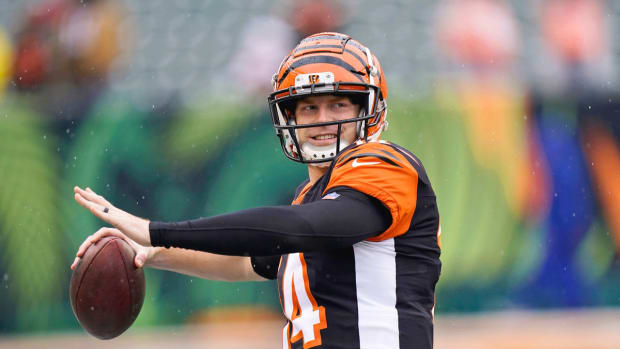
THE CHOPPING BLOCK
The next phase of the NFL offseason is one that can get a little ugly: It’s time for teams to look at the bottom line and decide which players aren’t worth the freight anymore.
Some cuts could come as early as this week. More will land during the combine, and some won’t happen until free agency starts. But they’re coming and, to prepare, teams are compiling watch lists of guys that could be on the chopping block. And I went to some of those teams to collect names. So here, then, is our own Watch List.
Bengals QB Andy Dalton (cap savings if cut: $17.7 million): Zac Taylor’s plan is to be upfront and honest with Dalton, and the truth is that the team has to weigh the idea of having the outgoing franchise quarterback as the bridge to the next one. The Giants made it work last year, so the idea of it isn’t exactly unprecedented.
Broncos QB Joe Flacco (cap savings: $12.25 million): The expectation, as of right now, is that Drew Lock will enter the spring as the team’s starter, making Flacco, due $20.25 million in cash in 2020, way too expensive to keep around as a backup.
Panthers QB Cam Newton (cap savings: $17.1 million): Carolina has been steadfast in saying that any decision on Newton will have to wait until there’s a clearer picture of his health. And the Panthers probably won’t have that until he’s recovered from his January surgery—probably sometime in March.
Falcons RB Devonta Freeman (cap savings: $3.5 million): Freeman’s issues since signing his deal in 2017 (he hasn’t posted a 1,000-yard season since and averaged 3.6 yards per carry in 2019) are another cautionary tale on paying backs. Atlanta will have to carry $6 million in dead money. But given their cap situation, every dollar counts.
Titans RB Dion Lewis (cap savings: $4.04 million): The emergence of Derrick Henry marginalized Lewis’ role and made his 2020 cap charge of $5.16 million a non-starter. Lewis turns 30 in September and might have his best chance to latch on with another Patriot-connected coach (Detroit? Giants?).
49ers RB Jerrick McKinnon (cap savings: $4.8 million): Thanks to a 2018 ACL injury and resulting complications, McKinnon still has yet to make his Niners debut, and the team has paid him more than $15 million over those two years. It’s not hard to see the writing on the wall here.
Cardinals RB David Johnson (cap savings: n/a): And I say not available based on the fact that Johnson’s $10.2 million base salary for 2020 has already vested. That makes it pretty unlikely the team would cut him, even though he’s disappointed since signing his deal. If they could trade him? That’s a different story, and I’d guess they would consider that.
Chiefs WR Sammy Watkins (cap savings: $14 million): This feels like a cost-of-doing-business thing for the Chiefs. They overpaid on Watkins because he was a good fit for their young quarterback in 2018, and that young QB was on a rookie deal. Now, Mahomes is about to get paid, they need room—and they have Watkins’ younger, cheaper replacement (Mecole Hardman) on hand.
Dolphins WR Albert Wilson (cap savings: $9.5 million): Wilson had 351 yards and a single touchdown last year, so this is a relatively simple decision. Could Wilson go back to KC and take Watkins’s roster spot?
Jaguars WR Marqise Lee (cap savings: $5.25 million): Lee finished the season with three catches and on IR, and he has been a massive disappointment since signing a four-year, $34 million deal prior to the 2018 season.
Buccaneers TE Cameron Brate (cap savings: $6 million): The Bucs have worked hard to develop OJ Howard, and Bruce Arians’s offense just isn’t that tight end–friendly. That makes paying Brate starters’ money a little difficult, even if he remains a good player.
Bears TE Trey Burton (cap savings: $5.05 million): Chicago has a tight cap situation, and Burton’s coming off a rough year that ended on IR. It wouldn’t be surprising to see the Bears conduct a complete overhaul at his position.
Packers TE Jimmy Graham (cap savings: $8 million): It’s not like Graham can’t play anymore; his production just no longer matches his financials. As a sidebar: It’d be fun to see him back in New Orleans.
Bengals OL Cordy Glenn (cap savings: $6.3 million): This one’s fairly easy. Glenn doesn’t want to be there. Jonah Williams is coming back. Glenn is gone.
Broncos G Ron Leary (cap savings: $8.5 million): Leary has missed 19 games in three years as a Bronco. That, and his big number, exposes him—though he should be able to find work quickly in a lineman-needy NFL.
Browns DE Olivier Vernon (cap savings: $11.5 million): Sacks aren’t everything, but it’s tough to carry a pass-rusher about to turn 30 at over $15 million coming off a season in which he had just 3.5 of them.
Jaguars DL Marcell Dareus (cap savings: $13.2 million): The former third overall pick finished the season on IR, turns 30 in March, and plays for a team working through cap issues. Dareus can still play. He just probably won’t be doing it for the Jags.
Panthers DL Dontari Poe (cap savings: $10 million): This is pretty straightforward. Barring a pay cut, it’s hard to see Poe back for Matt Rhule’s first year in charge.
Vikings DE Everson Griffen (cap savings: $13.8 million): Griffen’s been a great Viking, but he has endured a tough couple years and is 32 years old. He has gas left in the tank—he had eight sacks last year—but Minnesota’s troublesome cap situation would make it tough to bring him back even with a pay cut.
Giants LB Alec Ogletree (cap savings: $10.4 million): It may be tough for a new coach to walk away from a team captain, but Ogletree is paid like a top-five off-ball linebacker despite not playing like one. OT Nate Solder is another name that came up when I asked around, but my sense is that he’ll make it to 2020 on roster, based on the logistics of his contract, the team’s depth at his position and his background with new coach Joe Judge.
Browns LB Christian Kirksey (cap savings: $7.45 million): Kirksey played in nine games the last two years. So that should be that.
Steelers LB Vince Williams (cap savings: $969K): Yeah, it’s not much savings. But Pittsburgh is not paying $4 million in cash for some they just turned into a part-timer.
Bears LB Leonard Floyd: The Bears thought a breakout season was coming from Floyd in 2019. Instead, he finished with three sacks. I’m sure GM Ryan Pace and coach Matt Nagy would like to give the former top-10 pick another year. The trouble, for the cap-strapped Bears, is that his $13.2 million lump-sum option for 2020 would be an easy place to yield a significant amount of financial breathing room.
Vikings CB Xavier Rhodes (cap savings: $8.1 million): Maybe Rhodes can turn it around in his 30s. But he’s been trending downward for a couple years now, and he was the subject of trade discussions last spring. He’s due $10.5 million in 2020. He won’t be making that much in Minnesota, no matter how shaky their corner situation is.
Jets CB Trumaine Johnson (cap savings: $3 million): His contract was perhaps the biggest misstep of the Mike Maccagnan era in New York. How big? Cutting him means taking on $12 million in dead money. And it remains a no-brainer.
Redskins CB Josh Norman (cap savings: $12.5 million): Norman had his best years playing for Rivera, and the two have a good relationship. Whether they can work out a deal for him to stay at a lower number remains to be seen.
Saints CB Janoris Jenkins (cap saving: $11.25 million): With a lot of moving pieces at corner, I wouldn’t be surprised if the Saints make a play to keep Jenkins. But I can’t imagine it will be at $11.25 million. In fact, when New Orleans claimed him in December it was under the premise that it was, at most, a two-month rental, because of his big 2020 number.
Dolphins S Reshad Jones (cap savings: $7.495 million): Injuries limited Jones to four games last year. It’s not the first time he’s been banged up, making his number (nearly $16 million) just too high.
***
ALL-32
The 49ers’ toughest decisions will come on the defensive side. In particular, it’s with two guys they developed and were very patient with: defensive lineman Arik Armstead and safety Jimmie Ward. Both are former first-round picks, there had been questions about whether either would be around in 2019, and both responded with career years for a top-of-the-league defense. Now, each is position to cash in, and the Niners, with limited cap space for 2020, will have a hard time keeping both.
One thing I haven’t heard many people mention: The Bears will have to make their feelings clear on Mitch Trubisky in the spring, one way or the other, with their decision on his fifth-year option coming. Trubisky’s option number for 2021 projects to about $25 million, and it won’t be fully guaranteed until March of next year. But it will be guaranteed for injury, and that puts Chicago in a similar spot to where the Redskins were with Robert Griffin in 2015. Washington would up picking up the option on Griffin, then Griffin got beat out in camp, leaving the team forced to make him a gameday inactive on a weekly basis so as not to risk triggering the injury guarantee.
With a lot of questions swirling around the Bengals and Joe Burrow—and we’ll get to that (again)—it’s worth mentioning that the team is really happy with how left tackle-to-be Jonah Williams spent his first NFL season after a torn labrum kept him off the field for the year. He was in meetings and at practices, and he did everything he was physically able to so he’d be able to hit the ground running in 2020. Cincinnati was smitten with Williams through last year’s pre-draft run-up, when the Bengals got him with the 11th pick. So as they see it, they’ll be injecting two top 10–level picks into the team at OTAs.
The Bills know they need to get more explosive on offense this offseason—and their tire-kicking on Antonio Brown was evidence they knew it last year. The bottom line is that Buffalo’s got a lot of nice complementary pieces but could use a focal point, and that makes me wonder whether this cap-rich team should make a real run at AJ Green, who stylistically would be perfect for Josh Allen.
It should come as no surprise that Broncos coach Vic Fangio would say he wants the offense to be more “aggressive” under new coordinator Pat Shurmur. I’m told Fangio repeatedly went to since-departed OC Rich Scangarello last year asking that the offense take more shots to generate chunk plays. It’s not like Scangarello ignored him, but he felt like he had to balance the desire for big plays with protecting rookie Drew Lock as he adjusted to life as a starter. In the end, that was a big part of the friction that led to Scangarello getting fired.
The arrival of Joe Woods as Browns defensive coordinator should be good news for Myles Garrett—assuming he finds himself eligible to play. Woods is steeped in the Monte Kiffin/Pete Carroll system, which is very pass-rusher friendly. He spent a couple years coaching for Wade Phillips too, and we know what Phillips has done for edge guys over the years. Woods was with Von Miller from 2015–18, and Nick Bosa last year.
The Buccaneers have a lot to take care of as far as their veteran quarterback situation goes. But it’s hard not to look at Oregon’s Justin Herbert and see a Bruce Arians quarterback. He has the size to stand tall and take hits in that downfield passing game and the arm to put the ball wherever he wants it. The question is whether Tampa’s picking high enough (14th overall) to get him.
The Chiefs’ title is a good example of what can be done when you’re in the spot the Cardinals are now. The Eagles and Rams are two more teams that, over the last couple years, have reinforced the point that having a quarterback you believe in on a rookie contract is a very big deal. So it’ll be interesting to see what Arizona does with its cap space (more than $50 million at this point) over the next two months.
For what it’s worth, Chargers QB Philip Rivers and now-full-time OC Shane Steichen are very close. When I talked to Rivers in November about Steichen being promoted to interim OC, he told me that, because Steichen had grown up as a coach around him, the 34-year-old felt like an extension of him as a playcaller. “I felt that way with Norv [Turner], too, over the years,” he said. So Steichen signing his deal to stay on in LA would be a plus for Rivers—whose future is very up in the air.
One thing that’ll be interesting: The Chiefs really had to manage the interior of their offensive line this year, particularly after losing center Mitch Morse in free agency last year. So that would be one area to watch, where perhaps you’ll see some draft capital spent. KC has three picks in the first two rounds in April.
Credit to Colts coach Frank Reich for being creative with his staff adjustments. He had to find a home for Mike Groh, an assistant he likes and respects from his Philly days. Reich put Groh where he is best, coaching receivers. He then took receivers coach Kevin Patullo and gave him a promotion, to pass-game specialist. That’s a good way of generating solutions to put the best group around you.
Lots of conjecture around what Cowboys quarterback Dak Prescott should seek in a new contract. Know this: Players in his situation rarely take discounts, and for good reason. If a player gets a new deal with a year or two left on his remaining contract, the team is basically buying back those years, and taking the injury risk on for the player. That, of course, positions a team to ask the player to take a little less. But if a player makes it to the end of his contract, then he’s assumed all of the risk already, which is why that’s usually not the time for a team to try and get a player to be magnanimous about his money.
I understand why there’s hysteria over the Dolphins’ year-long study of Tua Tagovailoa and speculation over how they can make sure they get him. I can also tell you that until the team’s doctors get to Indy at the end of the month, even the team’s brass can’t be sure of its position on the Alabama quarterback.
USC OC Graham Harrell was one college coach the Eagles looked at hiring in January. Here’s another: Ohio State receivers coach Brian Hartline. Philly pursued the ex-NFL receiver to help with the team’s passing game and coach its wideouts, which is another sign of how the Eagles looked at trying to add some outside-the-NFL influence to their mix. Hartline wound up deciding to remain in Columbus in 2020, but Philly wasn’t the only team to show interest in this rising coaching star, and this isn’t the first year it’s happened. The Colts, for one, looked hard at Hartline a couple years ago, too.
I saw free-agent Dante Fowler’s name connected to the Falcons this week, and that makes sense. That defensive scheme always needs pass-rushers, Fowler’s from the Southeast, and Dan Quinn helped recruit Fowler to Florida in 2012 (and was his defensive coordinator for a year in Gainesville). I just don’t know how Atlanta would make it work cap-wise.
One thing I love about Joe Judge’s staff with the Giants: There are four former head coaches on the list— Jason Garrett, Freddie Kitchens, Bret Bielema and Derek Dooley (five if you count QBs coach Jerry Schuplinski’s time as a high school coach). Those guys should be valuable sounding boards for Judge as he adjusts to being in charge. And those moves show a certain level of self-awareness from Judge, not unlike what Sean McVay showed in hiring Wade Phillips when he got to L.A.
The Jaguars’ moves over the last month have very much laid the blame at the feet of Tom Coughlin. It hardly seems to be a mistake that the next two highest-ranking guys to go, OC John DeFilippo and director of player personnel Chris Polian, have family ties to Coughlin. One interesting tell here will be how the team handles Yannick Ngaukoe going forward. Coughlin’s tactics ruffled feathers with Ngaukoe’s camp last July, so the Jags’ reorganized brass making an aggressive play to lock him up, should it happen, could certainly be read as another way of curing the alleged ills of Coughlin’s tenure.
One way the Jets could work on their offensive line issue is to take advantage of a quirk in the franchise tag system. Because there’s one tag number for all O-linemen, the figure (expected to exceed $16 million) is based on what tackles get paid, making it tough for teams to use it on interior linemen. That means top-shelf guards like Washington’s Brandon Scherff and New England’s Joe Thuney will probably make it to market. And thus, Joe Douglas could have a roadmap to fixing the Jets’ long-maligned front, getting his left tackle in the draft rich with those and a stalwart on the veteran market.
The Lions could really be operating from a position of strength in the draft. The presumption has been that Joe Burrow will go first and Chase Young second. And if Herbert and Tagovailoa get hot, that would make the Lions’ position at three the spot for QB-hungry teams to look at. Either that, or the Redskins trade to a team that picks a QB and the Lions get Young. Either way, there are good scenarios here if the non-Burrow signal-callers do their jobs in the pre-draft process.
If the Packers are looking for receiver help, like most expect they will be, sitting there with the 30th pick is a pretty good place to be. They won’t have to overdraft someone there, but will be in front of teams that might be waiting until Day 2 to get one, given the outrageous depth of the position group in this year’s class.
Since this is a quiet time in the calendar, it’s a good chance to point things like this out: Great job by the Panthers, with the decision to help a place in need. North Central High, in Camden, S.C., was destroyed by a tornado in January. David Tepper and Co. will charter students from an hour-and-a-half away and host their prom at the team’s indoor practice facility, donate weight room equipment and practice jerseys to the school and give a $5,000 funding grant to fix the scoreboard at the town’s football stadium.
Ex-Patriots TE Rob Gronkowski messed with fans this week by commenting on a Tom Brady Instagram post, hinting again at a potential return to the field. Three things here. One, those around Gronkowski have maintained he’s very happy in retirement. Two, his last two seasons were, physically and mentally, very, very tough on him. Three, Gronk knows that keeping the light on for a return is good for Gronk Inc. He remains in the news cycle and is more relevant the more people speculate on it.
I don’t know if the Raiders will be able to even make Tom Brady consider Vegas. That said, the idea of it sheds light on the the team’s quarterback situation—one that, to me, is pretty enviable. Derek Carr’s a good-but-not-great player at the position, as it stands now. You can win with him. But he’s not carrying a team. The key? He doesn’t have another dollar guaranteed coming to him, and the Raiders have him under contract for another three years. Cutting him now would mean just $5 million in dead money hitting the cap. Next year, that number would drop to $2.5 million. So that allows the team to tread water with a pretty good player for now, while maintaining their flexibility for the future.
The Rams hope to have Andrew Whitworth back at left tackle. But he’s weighing testing his value on the market—he gave up just one sack last year, despite the fact that L.A. had the third-most pass attempts per game in the NFL and a stagnant run game. Yes, Whitworth is 38. But he remains a top-shelf left tackle and could be an ideal bridge for someone looking to rework that position.
The removal of Joe Flacco from the books, and addition of a quarterback starting (and starring) while on a rookie deal, has given the Ravens their healthiest cap situation going into an offseason in a long, long time. And that means that they have a good amount of wiggle room to re-sign someone (Matt Judon?) or pursue an outside free agent (AJ Green?) in March.
I like where the Redskins are organizationally—able to give Kyle Smith at shot at running the scouting operation, giving Ron Rivera a major voice in personnel and reserving the right to shuffle things around in May. Also, I’m not sure why it didn’t dawn on me until now, but Rivera worked with Smith’s dad, former Chargers GM AJ Smith, for four years in San Diego. So there’s some background there.
The Saints’ love for Taysom Hill probably leaves Teddy Bridgewater’s fate tied to Drew Brees’s decision. If Brees isn’t back, Bridgewater returning to New Orleans for another run might make sense, given that the bet on Hill all along has been based on his potential. If Brees is back? Then, if you’re Bridgewater, the call comes down to opportunity—and not just opportunity to start, but opportunity to get reps in practice and continue developing.
The Seahawks made a smart short-term move in trading for safety Quandre Diggs during the season. Diggs would’ve qualified as a distressed asset, given how his broken relationships in Detroit made him available for a discount. And the long-term benefit should be good for the team too. The Seahawks have him for $10.75 million over the next two years. If they hadn’t landed him, they’d have gone into this offseason with a need at the position. My guess is that Minnesota’s Anthony Harris and Denver’s Justin Simmons get way more than $5 million per in free agency. And at the top of the safety market (Mathieu, Kevin Byard, Landon Collins, Earl Thomas), by the way, prices out at nearly triple where Diggs is.
Again, how did Steelers coach Mike Tomlin keep Antonio Brown in line for as long as he did? If you don’t see Tomlin’s value in Pittsburgh now, you never will.
This year’s tackle class is good, and I’m still not sure there’s a prospect that projects to be what Laremy Tunsil is now at 25 years old. And even if there was, it would’ve cost the Texans a lot to move up from the 26th pick to go get him (I think two or three go in the Top 10). Which colors why Houston gave up what it did in August, which seemed crazy at the time.
The Titans did work to upgrade their staff when defensive coordinator Dean Pees retired. The inside linebackers job vacated by Tyrone McKenzie was actually offered to, and almost accepted by, Univeristy of Cincinnati DC Marcus Freeman. Ultimately, Freeman decided to stay at UC, which may have to do with the chance he’ll have take over for Luke Fickell there if Fickell decides to go to Michigan State. Regardless of that, it’s another example of Mike Vrabel thinking outside the box with his assistants—even if the guy he wound up hiring for the inside linebackers job, ex-Saints coach Jim Haslett, was decidedly inside the box. The other thing Vrabel did was leave the defensive coordinator spot open. I wouldn’t be surprised if outside linebackers coach Shane Bowen eventually earns the title.
A lot of folks should benefit from the Vikings installing Gary Kubiak as offensive coordinator. If you want an early fantasy-football guy to watch for 2020, Dalvin Cook is most certainly one of them. Among those who’ve had career years with Kubiak calling plays in recent years: CJ Anderson, Ronnie Hillman, Justin Forsett and Ben Tate. And the last time he had a real franchise back, that player, Arian Foster, won a rushing title and ran for 4,264 yards and 41 touchdowns in a three-year stretch. Add to it that 2020 is a contract year for Cook, and if I were the 24-year-old, I’d be over the moon with Kubiak becoming OC.
***
TOP FIVE
1. Key date coming in the CBA negotiations. It’s not a hard deadline, but the NFLPA’s election in mid-March is being treated as an important checkpoint in the ongoing CBA negotiations. President Eric Winston isn’t eligible for re-election because he didn’t play this year, so his six-year term will come to an end. The union has good candidates—Chargers OT Russell Okung and 49ers CB Richard Sherman are two guys on the executive committee who would certainly qualify, and Cardinals player rep Corey Peters is another who’s considered an intriguing name. If things were to take a wrong turn in the coming weeks, Winston’s departure could further complicate things, since the trust he’s established with those negotiating on the league side has been an important part of getting negotiations to this point. While nothing’s done, a deal does seem to be on the horizon. The players have some leverage here—the owners’ really want to get this done so they can start work on the impending media deals and gambling.
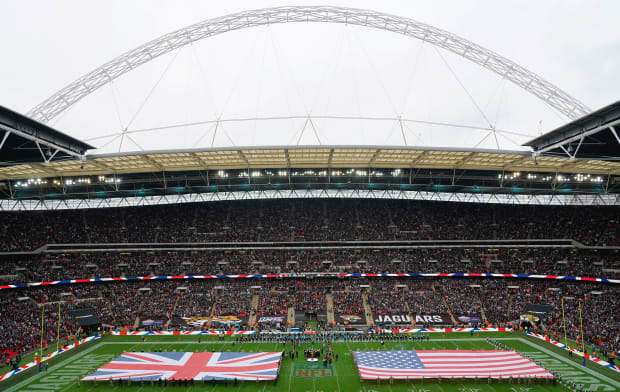
2. Jacksonville’s home slate down to six games. Maybe the Jaguars’ announcement that they’re going to play two home games at Wembley Stadium doesn’t make it panic time in North Florida. But there’s certainly reason for concern, because, at the very least, what the Jacksonville brass is telling its fanbase is that the market simply can’t be profitable enough to satisfy ownership. My understanding is that the idea of moving another home game to London—they’ve had single games there the last seven years running—has been talked about inside the building in Jacksonville for a couple years now, so few people working there are at all surprised that it came to this. And the less naïve fan in Jacksonville probably isn’t shocked by it either. The city simply hasn’t grown the way it hoped it would (like Charlotte or Nashville have) when it was granted a franchise in 1995.
So where does this go next? Well, there are a few things I can say definitively here. One, the league officials running the International Series (Mark Waller before, Chris Halpin now) have long felt like they have the fan support in London that would be needed to put a team there. Two, when the series was launched in 2007, owners set a rough goal of putting a franchise there full-time within 15 years—that’d be 2022—and it was important enough an initiative that some power brokers saw the idea of being the first stateside league to put a team there as a legacy piece. Three, other owners see Jaguars owner Shad Khan as an ideal figure to lead a franchise over there. And four, enormous logistical issues remain. My guess would be that, for now, the league’s hope is that fans in the UK will take to the Jaguars more than they have in the past, and then everyone will work from there. We’ll see.
3. Brady rumors won’t stop. My buddy Tom Curran over at NBC Sports Boston has pointed this out repeatedly, and he’s right: A lot of what happens in the Tom Brady Sweepstakes will boil down to timing. If Brady is resolute in testing the market, the Patriots’ handling of that will be interesting, because we’ve seen it both ways in the recent past. In 2013, Wes Welker went to the market and it didn’t develop as quickly as he would’ve liked. And by the time he had good offers on the table from the Titans and Broncos, the Patriots had already signed Danny Amendola to replace him. Conversely, last year, the Patriots pursued free-agent tight end Jared Cook, but there was a limit to how far they’d go with Rob Gronkowski’s future still uncertain. Cook signed in New Orleans, Gronk retired a couple weeks later, and the team was up a creek. So let’s say Brady wants to go on a tour, a la Peyton Manning in 2012. If he does that, with so many moving parts at quarterback this offseason (Drew Brees, Philip Rivers, Ryan Tannehill, Jameis Winston, etc.), can the Patriots afford to wait? For that matter, can other teams? The cautionary tale there would be what happened to the Cardinals post-Manning pursuit in 2012. They were left with Ryan Lindley and John Skelton, were picking too low to get even Ryan Tannehill, and a lot of people got fired in the aftermath. So all of that plays into what’ll be a tricky dance for everyone if Brady does make it to the market.
4. The good and bad of the XFL. First, the positives. The broadcasts looked professional, the teams appeared to be well-coached, the games were relatively fast-paced and entertaining, and the access given to the networks differentiated the product from the NFL or anything else we generally see in the sport. Also, the modified kickoff rules are brilliant, and I think provide the NFL with a blueprint for making an inherently dangerous play safer without eliminating the spirit of it all together.
Now, there will be some things to watch going forward—beyond the inevitable viewership drop after the Week 1 novelty wears off. The first one involves player salaries. Non-quarterbacks are making a base of $27,040 for the season, or $2,704 per game. In addition, they get a $1,685 bonus for being active on game day (46 of 52 players on every roster will be) and a $2,222 bonus for each win, a bonus you have to be active to collect. That means if your team wins but you’re inactive for the game, you’re out $3,907, which is significantly more than your base. In a league full of guys on the fringes of pro football, you think that might cause some locker-room issues for coaches to work through? AAF coaches had a difficult enough time last year keeping their teams together, and they weren’t dealing with this.
Another issue will be protecting quarterbacks. The AAF instituted no-blitzing rules last year, which was a tacit acknowledgement that there’s an offensive-line shortage across the sport. Without that, it’ll be interesting to see if the XFL, which is paying its quarterbacks more (journeyman Josh Johnson got a $200,000 signing bonus), runs into a problem with the beating those guys take. The one thing we can all agree on is that the NFL could use a developmental league. But without the backing of the Shield, it’s just as easy to conclude that the odds are against the XFL making it.
5. Zac Taylor’s edge with Joe Burrow.It’s certainly fair to wonder where things will go next with Burrow and the Bengals. And there’s a key relationship that Cincinnati would be smart to cultivate here, given some of the talk out there on Burrow weighing his options. Back in Mobile at the Senior Bowl, Cincy coach Zac Taylor mentioned to me that he and Jimmy Burrow, Joe’s dad, became familiar with each other when they were both on the recruiting trail—the elder Burrow as Ohio University’s defensive coordinator and Taylor as the University of Cincinnati’s offensive coordinator. They had a natural connection too, that ran through Nebraska. Jimmy Burrow played there, coached there and had two sons who played there. Taylor, meanwhile, was the quarterback in Lincoln a couple years after Burrow left. So if I’m Taylor, I work that relationship, especially if he likes Burrow as much as I think he does. “He’s a winner,” Taylor said of Burrow during our talk. “You can tell that he leads the guys around him, you can tell the effect he’s had on the whole state. Those are intangibles that you can’t coach. He set all the accuracy records, all the great things he did in the SEC this year—this didn’t happen by accident. He’s always in great body position to throw the ball, and he can extend plays when necessary. There are certainly a lot of traits that translate well to the NFL.”
***
SIX FROM THE SIDELINES
1. The Michigan State opening touched the NFL this week. San Francisco defensive coordinator Robert Saleh received overtures from a school he’s very connected to (he grew up in Detroit, coached at MSU and has an uncle who played there). Ultimately, he chose to pull his name out of the search, and he’s not the only one—Pitt coach Pat Narduzzi and Iowa State coach Matt Campbell did as well. And my understanding is part of the reason for this, outside of the prospect of sanctions, is a belief that the Spartans already have a candidate in mind and could pull the trigger quickly. I don’t think anybody would be stunned if that candidate was Luke Fickell.
2. I thought this was a fascinating post-Signing Day note: 47 of the Top 100 high school recruits in the country, as ranked in the 247 Sports composite ranking, are going to a total of five schools. Those five schools (Alabama, Clemson, Georgia, LSU and Ohio State) also landed nine of the top 10 in America. Unsurprisingly, those five schools have 54 of the 337 players invited to the combine this year.
3. If it’s true that the Red Sox considered backing out of the deal that sent Mookie Betts to LA because ownership was influenced by media backlash, which is what Ken Rosenthal reported, then that’s worse than dealing a top-five player at 27 years old in the first place. I didn’t like the premise of dealing Betts from the start. But if you’re gonna do something like that, you should act with just a little more conviction.
4. The Warriors move to deal off D’Angelo Russell for Andrew Wiggins (Golden State’s also getting a protected first-rounder in the deal) is fascinating. They’re one of the best franchises in pro sports, they should have a top-five pick in June, and they will get Steph Curry and Klay Thompson back in 2020–21. I can’t wait to see what the endgame is here.
5. Great finish to Duke-North Carolina. But those were horrific uniforms, and I don’t care what the reason for wearing them is. In college rivalry games, schools should go with their classic look, without exception. It was hard not to look at the TV and think, “Is this a practice in September?”
6. I don’t want to go too deep into politics in this space (mostly because I’m not that qualified to do it). But it sure looks like the election is going to get very, very ugly.
***
BEST OF THE NFL INTERNET
This question from the Super Bowl LIV MVP pretty much sums up the Chiefs parade. But we won’t just leave it at that.
Great answer from Mahomes.
And here’s an action shot that set up that question.
My guess is Travis Kelce probably had a few, too. And the shot at Dee Ford there was pretty vicious. So much so, that the first thing I did was check to see if the Chiefs and Niners play again next year. (They don’t, unfortunately.)
This man, apparently, brought his own horse for the festivities, then decided to surf on said horse.
There was not a happy ending to his story.
The Chiefs parade truly had it all. (One unfortunate twist: The video of the guy falling out of a tree with his pants down appears to have been deleted from the internet. Gone now, but not forgotten.)
This is phenomenal and really did the job in detailing a lot of cool aspects of the third-and-15 play we highlighted in last week’s MMQB. So if you haven’t yet, click on that link and read up on the play, then watch the NFL Films explanation, and you’ll have pretty good perspective in how much goes into a single snap in pro football.
Really nice tribute by Chiefs CEO Clark Hunt to his dad Lamar.
Here’s an illustration of the XFL kickoff rules we referenced, and reaction from one of the leaders in concussion research in football.
I definitely tried to be judicious with my XFL tweets, given how some AAF tweets probably wound up looking when that production turned into Fyre Fest.
Good start to the offseason for me.
***
WHAT YOU NEED TO KNOW
The XFL’s Dallas Renegades have advertising on their helmets—on the back, a small and subtle Bud Light Seltzer ad is there for everyone to see. (Pro Football Talk was the place I saw this one reported.)
So why does it matter to you? Because the NFL will be studying everything the XFL experiments with, and uniform advertising has been kicked around by owners in the past. And this could be another XFL idea they consider adopting.
The league, always overly protective of their on-field look (see: rules governing socks and sleeves) has been reluctant to join the NBA and international soccer leagues in selling space on game jerseys. But we have seen it on practice jerseys, which is proof of the amount of thought they put into introducing it. The helmet idea, at least on paper, would seem to be a little less intrusive on the team and league brands plastered all over unis.
And honestly, if the NFL allowed what the XFL did with the Renegades, I’m not sure anyone would really care anyway. So stay tuned.
Question or comment? Email us at talkback@themmqb.com.
Subscribe to:
Comments (Atom)