Would the Internet Be Healthier Without 'Like' Counts? (2019)
9 by headalgorithm | 1 comments on Hacker News.
Saturday, 12 September 2020


Thursday, 10 September 2020
New on SI: What the Mahomes Contract Really Means
What is the truth behind the historic contract? With insights from the deal’s architects, interviews with two quarterbacks who signed similar agreements, and a look across the sports landscape, we tried to find out.
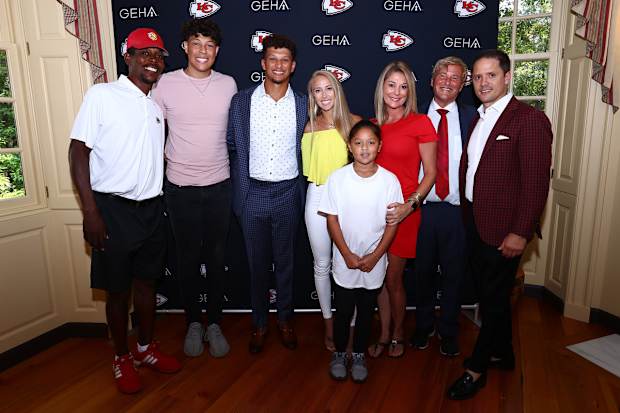
The Contract just sat there, on a table at Andy Reid’s house, near platters offering cold cuts, hummus dip and vegetable medleys. A bucket of Dom chilled on ice, next to the banner standing close by, the one emblazoned with Chiefs logos to properly announce The Contract to the world. In heft, The Contract resembled an old phone book, clocking in at over 100 pages. And, as signing hour approached on an early-July afternoon, everyone in the inner circle of Patrick Mahomes looked both backward and forward, hoping to contain news of the historic extension for another few hours.
Then, as lawyers for the NFL Players Association scoured the final details in an agreement that had taken 18 months to complete, the story broke like a dam overwhelmed—and from the most unlikely insider, a beer manager/die-hard Chiefs supporter at a downtown Kansas City liquor store. Mahomes and his closest confidants—agents Chris Cabott and Leigh Steinberg; his father, mother, two siblings and girlfriend; plus top members of the Chiefs brass (minus Reid, who could not have any contact with his players)—could only laugh. They knew exactly what would happen next.
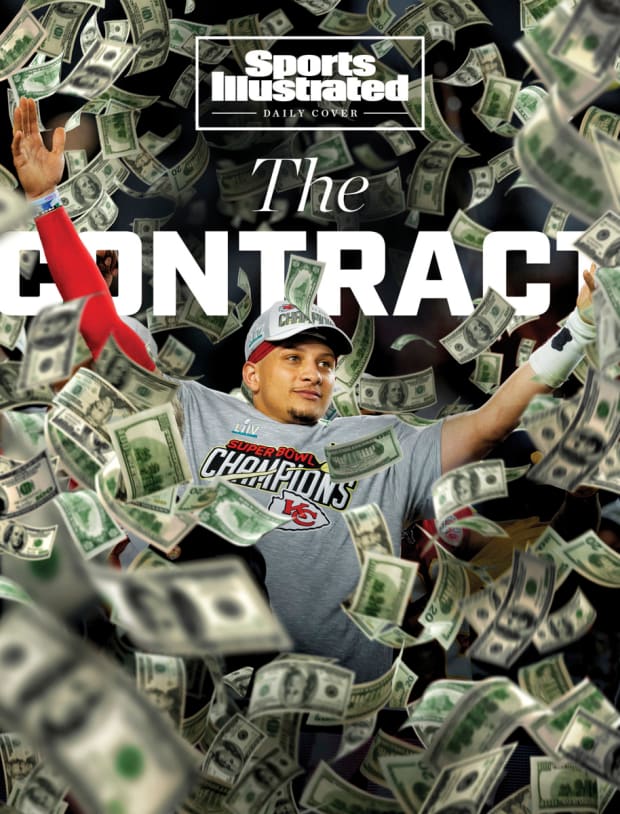
The Contract instantly became a historical sports document, its parameters criticized by other agents, praised by Mahomes and celebrated by the beer manager and others throughout Chiefs Kingdom. The Contract could* be worth half a billion dollars and should* tie Mahomes to KC for the rest of his career. And, in a broader sense, The Contract would also be shown to embody both how NFL deals differ from agreements in other sports, and how they rarely deliver exactly as laid out.
Mahomes scribbled his name onto the white pages, making the document legal, securing mind-boggling, generational wealth. The whole group posed for pictures, cracking open the bubbly as general manager Brett Veach toasted to a future of Super Bowl championships like
the one they nabbed back in February. Cabott thanked his counterparts from the negotiating table. Social distancing measures were taken because of COVID-19. Someone even saved the pen that Mahomes used as a memento. The only thing missing was one of those giant game-show checks.Finally, just as they had done after Mahomes agreed to his rookie contract in 2017, the quarterback, his agents and Veach looped signatures onto a Chiefs helmet. Almost three years to the day, exactly. As Cabott would note later, the people in the original pictures and the current ones were also exactly the same.
Patrick Mahomes, budding NFL icon, had made history once again. The headline: 10 years, $503 million, largest deal in the history of sports. The truth, while no less groundbreaking, is quite a bit more complicated.
* * *
Representatives for Mahomes first examined the basic parameters for an extension in January 2019. They wanted to lay out for the superstar what they considered the two most important factors in any deal: whether he would reset the quarterback market in a short-term sense or a long-term one, and how either option would work in tandem with the Chiefs’ salary-cap dynamics, both for overall philosophy and available cash.
In terms of fit, the answer could not have been simpler. Mahomes loved the small-town feel of Kansas City, how he could dine out uninhibited; he loved his owners, the Hunt family; his boss (Reid), his offensive coordinator (Eric Bieniemy) and his position coach (Mike Kafka). Steinberg’s relationship with the franchise dates all the way back to 1977, and he has represented some Kansas City legends, from the late Derrick Thomas to Christian Okoye to Tony Gonzalez to one Patrick Mahomes.
As the Super Bowl season unfolded, the quarterback’s reps continued to drill deeper on short- versus long-term options. A three- or four-year guaranteed deal held great appeal and fit with recent trends throughout sports. Foremost, it would allow the agents to renegotiate again while Mahomes remained in his prime and the salary cap continued to rise like an elevator that would never stop. But Cabott saw one prominent hang-up with a shorter agreement: Unlike in baseball and basketball, when an NFL star signs a deal, the team must immediately fund all of the guaranteed cash to the NFL, and he believed it would be more difficult to maximize the money for that reason. The agents looked into taking out an insurance policy to offset the unlikely but not impossible event that Mahomes wouldn’t be able to negotiate for a third time (like, if for any reason, he never played again). But none of the policies, combined with a shorter, all-guaranteed contract could net as much total as the longer-term options.
Steinberg had long sought out contract innovations. He helped Steve Young push cash to later years in one deal while accurately predicting that then President Ronald Reagan would drop tax rates. He helped create the concept of “voidable” years so that top players could reach free agency earlier if they hit basic incentives.
Now, Team Mahomes sought to find a permissible route around that cash-up-front rule. They settled on a clunky term: guarantee mechanisms. Both Cabott and Steinberg describe it as the latest innovation in the evolution of pro football contracts. The first five years—and roughly $140 million—of Mahomes’s deal are guaranteed against injury. But for each year that he remains on the Chiefs’ roster, significant, eight-figure chunks—at least $21.7 million (’21) and as much as $49.4 million (’27)—become guaranteed. There are buyout opportunities, but those very guarantees make releasing Mahomes in any one season prohibitively expensive, which to his reps means that Mahomes basically signed a guaranteed contract, without the Chiefs needing to lay out over $400 million up front. In the improbable event he is let go, he would then hit the open market.
Mahomes did not take the same route as Kirk Cousins, who played out two franchise-tag seasons with the football team in Washington, then signed for three years in Minnesota for $84 million guaranteed, then renegotiated this spring to add two seasons but help the Vikings increase their 2020 cap space. Mahomes chose the opposite path to the same place.
The structure, Cabott says, borrowed from basketball in the guarantee mechanisms and from baseball in the no-trade clause the Chiefs agreed to, making it unlike any agreement in NFL history. Mahomes came to like the longer, more creative option best. “This way,” Cabott says, “he reset the market at the position and for the sport and for all of sports.”
* * *
Given the remarkable nature of The Contract, the Mahomes deal includes a game of sorts. Call it Fun With Numbers. It’s like Mad Libs, except instead of “insert adverb” it’s “insert detail that supports your take.” The basics: Mahomes signed a 10-year extension, on top of the two years that remained on his rookie deal. The extension is worth $450 million, plus incentives, and could tether Mahomes to KC through at least 2031, when he’ll turn 36. According to ESPN’s stats crew, Mahomes will earn $1.60 a second, $96 a minute and $137,808 a day for the duration of the agreement, which, were it a country, would compare favorably to the GDP of Tonga, the 196th richest nation in the world.
The baseline: Mahomes will bank some 19,000 times more than the fee Lamar Hunt paid ($25,000) to create the Chiefs franchise in 1960 because he is Patrick Mahomes. Because he is an NFL and Super Bowl MVP; young, charismatic, healthy and, despite not yet being in his prime, the biggest star of the most popular league in America. He’s worth multiples of every dollar anyone could pay.
And yet, examining any NFL contract, let alone one of the longest and largest ever, is like exploring numbers through funhouse mirrors after partaking in cannabis. Nothing is exactly as it appears, beyond the guaranteed cash. Here, there’s the big number—$502.6 million—that Mahomes could collect over the next 12 years. But in order to collect in full, he’d need to reach the Super Bowl and win league MVP every season.
There are averages involved in assessing the agreement—like the $10 million-plus bump over Russell Wilson’s previous average-per-year record—a nice break for the team in the first two seasons and essentially two deals merged into one contract, with the second half of the extension averaging over $11 million more than the first. Studying these numbers can make for a dense, dizzying exercise, like reading an NFL math class textbook cover to cover, hence the number of pages. But the most relevant notions are 1) Mahomes will become really, really rich, 2) the chance that he realizes max value is close to zero, 3) the chance he plays out the entire duration is lower than 100%, and 4) the contract is likely to change to suit the Chiefs’ needs in any given year.
Whatever numbers are chosen, of course, represent the kind of grand sum that a bank would envy, let alone the guy hawking beer in the nosebleeds at the stadium where Mahomes stars. No one is saying he’ll ever want for cash, or was ripped off by the Chiefs. But the deal is also instructive, especially in its potentially confusing impact on the market for quarterbacks like Dak Prescott and Lamar Jackson, or the recently signed Deshaun Watson (four years, $156 million and $73.7 million guaranteed at signing).
In fact, as wild as it might seem, many see The Contract as a team-friendly bargain given the inevitable salary cap increases between now and 2031, and the leverage that Mahomes “lost” by not being able to renegotiate for up to three presidential terms. “I thought it was a great deal for the Chiefs,” says Jason Fitzgerald, the contract expert at overthecap.com. “I was shocked. It’s unlike any contract in the last 15 years.”
Unsurprisingly, the deal’s most fervent critics are agents who do not represent Mahomes, and they lob their length-and-leverage criticisms anonymously. They point out that only 15 other active NFL players have signed six-year contracts and none for more than eight seasons. That’s because, like with the NBA, the trend toward shorter contracts means they can renegotiate more often. “If he signed for one-trillion for one year, we still would have heard all that,” Steinberg quips.
Given those factors, Mahomes could be leaving money on the table, even if his table is filled with bundles of cash stacked to the ceiling, the leftovers piling up in adjacent rooms. Cabott disagrees. He argues that they did realize full value. Either way, the pertinent questions are why? And for what?

* * *
Back around the turn of the century, several high-profile QBs inked deals similar (relatively speaking) to the one that Mahomes just signed. In 2001, Brett Favre agreed to a “lifetime” pact with the Packers for $101.5 million, followed by Drew Bledsoe’s $103-million deal. Donovan McNabb went for $115 million in ‘02, over 12 years, the longest-ever contract at the time. Then Michael Vick ($130 million) and Daunte Culpepper ($102 million) joined the nine-figure-check club with contracts that ran long in years. “I thought those days were pretty much done,” Fitzgerald says.
To Steinberg, the length of those agreements highlighted how pro football had evolved from a run-the-ball-and-play-great-defense league into a passing juggernaut. Only the rare team could win Super Bowls without a truly elite quarterback. Which is why, combined with billions in television revenue, previous record-setting deals he had negotiated—around $640,000 for Steve Bartkowski from the Falcons in 1975 and $45 million for Steve Young from the 49ers in 1997—pale in comparison to Mahomes’s now fully stocked bank vault.
Steinberg also came to realize that skyrocketing quarterback salaries could come at a substantial price for teams that desired to maximize talent around their salary-cap-eating stars. Hence the rash of longer-term, more flexible agreements. Mahomes settled on similar reasoning, choosing to bake both long-term stability for himself and cap-flexibility for his team into The Contract. “We achieved all our goals for a mega-deal and gave him the best chance to chase a dynasty,” Cabott says.
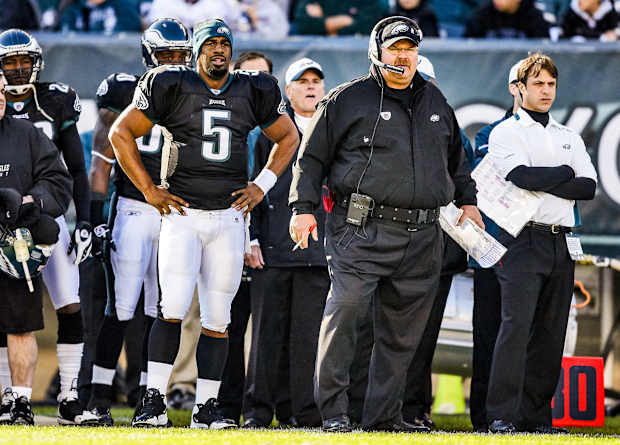
McNabb used that same logic, while playing for the same coach, almost two decades ago. The rationality still resonates, soundly, in that players of their stature care about both money and winning, and taking the absolute most means taking from someone else who might help them win. In the eight seasons that McNabb played for Reid under the long-term deal, the Eagles made the playoffs six times, advancing to four conference title games and one Super Bowl, giving themselves numerous chances to triumph, a best-case scenario in a league with vast parity.
Because those contracts are long and can be adjusted, if Kansas City is strapped for cash, it can rework the deal in any one season to funnel money earmarked for Mahomes to key teammates or prized free agents. If the Chiefs are flush with dollars in another campaign, they could dump more into Mahomes’s coffers with similar but opposite tweaks, an exercise in balancing two enormous scales. Where pro baseball teams can spend over luxury tax thresholds to horde talent, NFL franchises are capped in total dollars ($198.2 million in 2020), making this exact kind of flexibility more important for any team to consistently contend. It’s not like Mahomes needs every single dollar, anyway. McNabb, asked if he saved any mementos from his famous signing, laughs and says, “a whole lot of money, more or less.”
The Contract allows Mahomes to assist Veach with more than his arm. Just like Tom Brady, who in 20 seasons with the Patriots often took below-market deals to help New England reach Super Bowl after Super Bowl but still ranked among the most handsomely compensated players in the league. It helped, of course, that Brady’s wife commanded higher earnings as a supermodel than he ever could in football. Still, the Mahomes extension is as friendly, if not more so, than anything Brady signed, and that’s because of the total years. Brady never agreed to more than six seasons in one deal ('05), and even then, he renegotiated after three years.
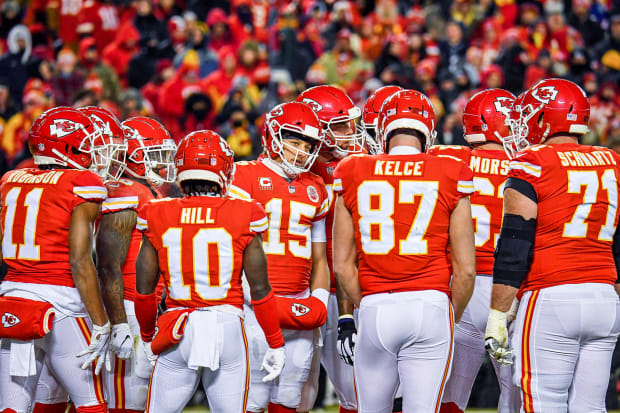
Already, Mahomes helped Veach reach extensions with two Pro Bowlers—defensive tackle Chris Jones and tight end Travis Kelce. If the Chiefs can lock in safety Tyrann Mathieu (up after ’21) and speedster Tyreek Hill (’22), they will have all their cornerstones signed for an extended playoff run. Without The Contract and its malleable nature, that would be impossible.
When Mahomes completed his agreement, McNabb sent him a text message. He congratulated the young star, but also implored Mahomes to not play with any added pressure in the years ahead. McNabb had found that living up to The Contract becomes its own sort of beast. “At the time you get paid, you feel like you have to be Superman,” McNabb says. “And we didn’t even have social media. He’s going to hear rumblings. He’ll be an extension of the GM and some guys who don’t get contracts are going to try to blame Patrick, say he didn’t stick up for them. There will be people in the locker room who will be pissed off he gets to do whatever he wants.”
The possibility of change—in locker-room dynamics, with The Contract’s parameters—will linger over the agreement. All the nine-figure-check-club quarterbacks learned that a decade is a long time, a lifetime, in the NFL—a lesson they absorbed through personal experience.
* * *
Anyone assuming that Mahomes will enjoy a perfect and perfectly long career in Kansas City has ignored or missed the shifting, uneven history of most long NFL contracts. Things happen in a league with a 100% injury rate; bad things, usually. Injuries. Roster overhauls. New regimes. Tough years. Great backups.
Of the five quarterbacks who, before Mahomes, signed those game-show-check deals, none finished their respective careers with their original team. Favre volleyed between retirements and comebacks. McNabb, Vick and Culpepper each played for three or more franchises. And then there’s Bledsoe, whose story is basically folklore.
Unlike Mahomes’s, Bledsoe’s generational contract marked his third deal. Negotiations began well before the ’01 campaign, when Bledsoe ranked among the biggest stars in the NFL; some dude named Brady was his little-known backup. At one point, Bledsoe’s agent, David Dunn, had reached an impasse with New England, and Bledsoe received a surprise phone call at his house in Montana where only a handful of people knew the number. It was Robert Kraft.
The Patriots owner laid out the gap that remained and asked Bledsoe if he would sign if the team went up to a certain number. Bledsoe cannot remember the specifics, but he did sign, with an admonishment from Dunn that the QB had cost them a few million. Unfazed and still rich, Bledsoe flew to New England in a snowstorm to deploy signature to contract.
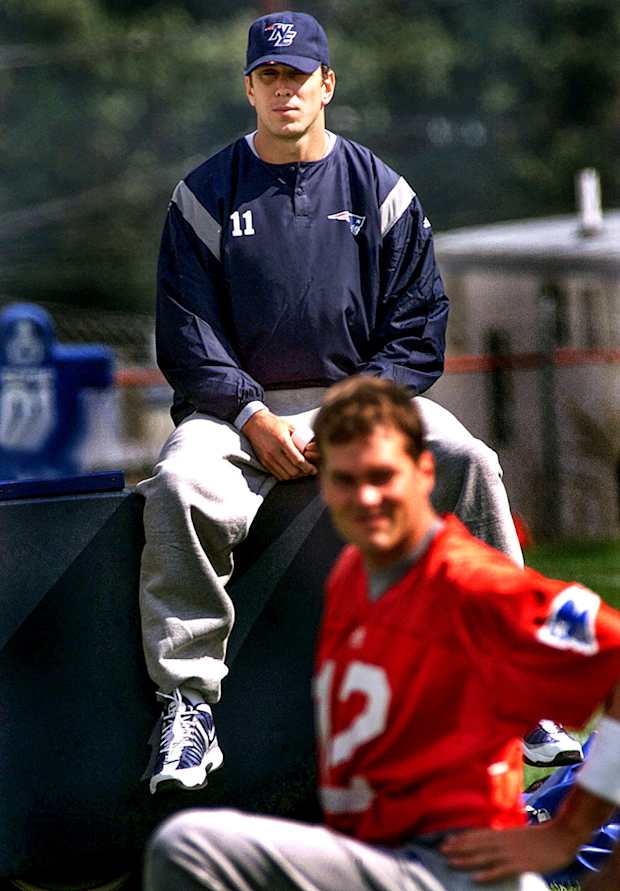
In those days, NFL teams guaranteed far less in contracts than they do even now. Bledsoe’s deal, for instance, contained only $6 million guaranteed against injury (compared to $140 million for Mahomes). Either way, both highlight just how much funny money is included in NFL agreements, where total years and compensation are more like ideal suggestions than concrete terms. Bledsoe, of course, was injured six months after signing, and his replacement went on to lead the Patriots to the Super Bowl title that season—and then five more after that.
Bledsoe and his nine-figure-deal became expendable. He learned then what NFL contract history has long demonstrated: Whatever loyalty a player shows or whatever length of time or total dollars he agrees to, the numbers that get splashed in headlines are misleading, if not downright inflated, more often than not. Bledsoe was traded to Buffalo, and renegotiated in '04, was released in '05 and signed a completely different agreement within hours with the Cowboys. The percentage Bledsoe actually received on his $103 million agreement clocks in at 21.3%—and a significant portion of that came from his $8 million signing bonus.
* * *
Shortly after Mahomes signed, networks and reporters began to describe The Contract as the largest deal in sports history, an NFL first, the amount surpassing what Mike Trout agreed to with the Angels in 2019: an eye-popping 12-year, $426.5 million extension. But such notions make prominent baseball negotiators wince, since Trout, as many note, is better positioned to collect on his sum total.
There are similarities to both deals beyond the headlines. Like Mahomes with Steinberg, Trout signed with a smaller agency and a long-established veteran agent in Craig Landis, his father’s former teammate. Trout, like Mahomes, elected to stay with the team that drafted him. Like Mahomes, his deal includes perks and restrictions. Both players cannot be traded without their consent. Trout receives a hotel suite on the road and a stadium suite for 20 home games. Like Mahomes, he cannot play basketball, or ride jet skis, or do anything that might be considered dangerous. For instance, Trout also can’t serve as a pit crew member, or do something called sky surf, or try any sport that involves using a firearm.
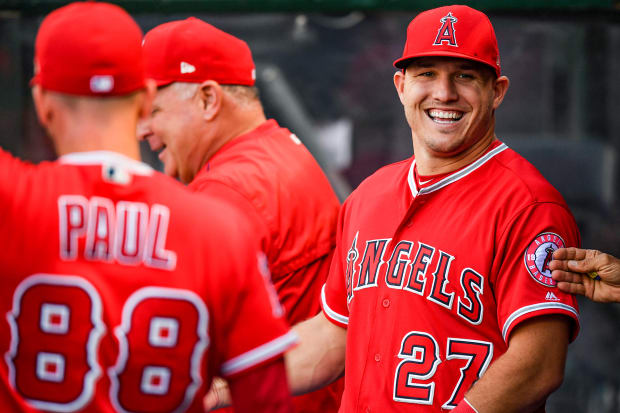
For all they hold in common, though, there are also important differences in the agreements. The biggest: guaranteed dollars. Were Mahomes to suffer a career-ending injury tomorrow, he’d make $140 million; Trout, in the same scenario, would collect his entire total, a difference in the neighborhood of $300 million. All the outs and “guarantee mechanisms” that stretched the Mahomes agreement to over 100 pages aren’t included in Trout’s contract, which runs only 12, because it’s not complicated or deceptive in nature the way that all NFL deals, even the groundbreaking ones, can be.
For all the celebrated contracts signed in NFL history, retired Giants quarterback Eli Manning has actually banked the most cash, or $252.3 million over 16 seasons. Meanwhile, five baseball and five basketball pros have exceeded Eli’s sum, with more on the way as stars in those sports collect on money that has already been guaranteed. Mahomes, meanwhile, is at this point guaranteed less than struggling Orioles slugger Chris Davis ($161 million), which says more about NFL contracts than his specific NFL contract. Perhaps that’s why many contract experts believe the first athlete to sign for over a billion dollars will come from baseball, where there’s a luxury tax rather than a firm salary cap, allowing for blank-check choices among billionaires who desperately want to win. As likely: an NFL player inks a $1,000,000,000* deal, with a fraction of that total truly guaranteed.
* * *
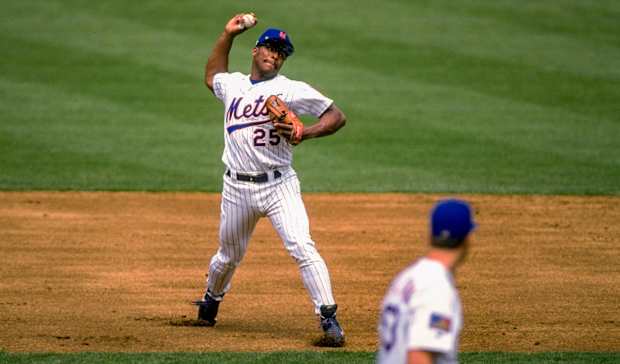
The Contract will now join other famous deals in sports history, like the agreements for McNabb, Bledsoe and Trout. Along with, of course, the one that lawyer/agent Dennis Gilbert created for slugger Bobby Bonilla that binds the Mets to pay him $1.19 million annually on July 1 for 25 years, through 2035. Talk about long-term; Bonilla will turn 72 the same year his payments end. His agreement highlights the extended interest in the most famous contracts in sports history, along with the interconnectedness of that world. For instance, Gilbert has long known and advised Steinberg, and one of Bonilla’s teammates in Queens was Pat Mahomes Sr., father of the all-galaxy quarterback.
When Gilbert created the atypical structure, he says he cared little about how other agents viewed the deal, which was criticized like The Contract. But Gilbert had put together over a thousand agreements, and he believed that long-term stability mattered, that too many players went broke when their careers ended. “When the money is there, you go for it,” he says, and he went for it, just spreading out the total so that Bonilla would be set for his years between when he retired and when his pension started to kick in. The deal continues to look more prescient over time, which taught the lawyer an important lesson. “Look, just because a contract is different,” he says, “doesn’t mean it’s worse.”
The stability sentiment, while especially prudent from any negotiator’s perspective, does ignore the fairest gripe over Mahomes’s pact: its impact on the market. The length of the contract could influence star quarterbacks, especially those approaching free agency, to land deals that run shorter in length. Dak Prescott, for instance, didn’t want the fifth year the Cowboys insisted on this summer, resulting in the sides failing to reach a long-term deal. Watson, meanwhile, landed the kind of blockbuster agreement that would have reset the market had Mahomes not extended with the Chiefs first. For that reason, many see The Contract as an outlier, rather than the start of a new, longer trend —another notion countered by Cabott, who says one NFL GM already told him “you really screwed me up here” in terms of the blueprint that the Mahomes agreement provided.
Prescott, like Watson, could sign an extension for a higher yearly average and shorter duration. He could mimic, say, LeBron James, who landed a series of mini (in time) and mega (in money) NBA deals, which helped him dictate decisions on coaches and teammates, because some of his leverage derived from the constant threat that he could leave. But what of the players with less leverage? “I’m happy for Patrick in that the numbers are more like what you’re seeing in other sports,” McNabb says. “It’s just the years in it [that’s an issue]. It’s like when Brady messed up the market for a lot of us. We had to explain to our organizations, our GMs, that his [deal] was a bargain deal.”
All of which leads to another, equally fair question: should Mahomes really care about the market, over himself or his team?
* * *
As for the beer manager who broke The Contract news, Katie Camlin meets all the usual requirements for membership in good standing with Chiefs Kingdom. She keeps a favorite photo of herself as a toddler, wearing a KC cheerleader uniform. She had banked resolve through all the mistakes, missed field goals and unfortunate bounces that made each playoff loss more agonizing. She can cite favorite players who weren’t superstars, like Daniel Sorensen, the safety she affectionately calls Dirty Dan. And she gushed over Mahomes way back during the ’17 preseason, long before he became the team’s starter, let alone the face of the NFL.
She even has a special fork that her boyfriend held aloft during Super Bowl LIV last February, summoning good karma. Even after Mahomes secured a comeback triumph and the Chiefs snagged the franchise’s first championship in half a century, Camlin refused to wash the utensil, lest it lose its considerable powers.
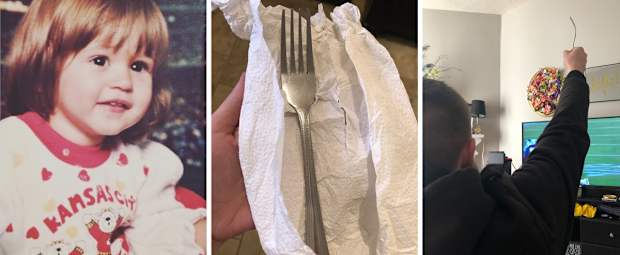
She topped that this summer, tweeting her way into an unlikely position as a footnote in Chiefs and NFL history. It was a sequence of events almost as improbable as the perennially hard-luck franchise in barbecue country becoming an NFL dynasty. Camlin’s path to internet fame began when she was furloughed by a brewing company after COVID-19 began to spread. To pay her bills, she took a job at that liquor store downtown. And, on one otherwise-regular afternoon shift in July, the beer manager at Plaza Liquor arrived just in time to hear some incredible news: Her colleague had just sold six bottles of Dom Perignon to a Chiefs employee who let slip that he required the bubbly for a major celebration.
Now, Camlin realizes all that’s in play—the history, the magnitude, how this one very big and very long agreement will impact the future of the NFL. “I do have this fantasy in my head where in non-COVID times they bring Patrick into the store and we have a hug,” she says. “It’s borderline emotional to think about. He’s amazing. The contract is amazing. Who cares about [the criticism]? He’s ours.”
This is the life that The Contract has been given. It will be scrutinized and analyzed, celebrated and picked over, for years to come. The takeaways might change, as could the parameters. But not the significance. Pick away, critics, Mahomes and his reps and his fans say. Half a billion is half a billion, and this agreement, while not exactly as it seems on paper, will find its place in the evolution of NFL deals.
Wednesday, 9 September 2020
Monday, 7 September 2020
New on SI: How Lamar Jackson Is Becoming a Better Quarterback ... While Staying the Same Guy
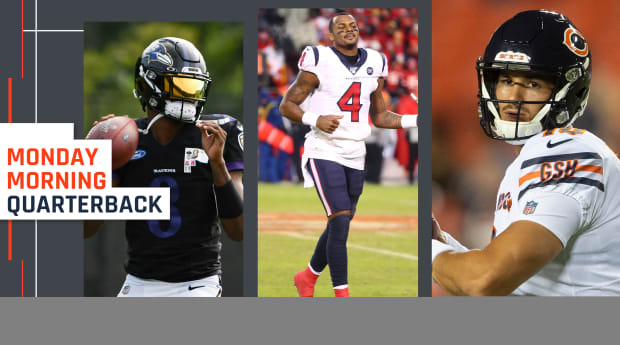
Lamar Jackson's 2019 success could have gone to his head, but he seems just as humble as he did a year ago. Plus, how Dwayne Haskins and Mitchell Trubisky won their respective quarterback jobs, comparing Deshaun Watson's contract to Patrick Mahomes's, why Leonard Fournette is out of Jacksonville and more.
The Lamar Jackson I spoke to Saturday was, really, the same Lamar Jackson I spoke to a year ago, after he served noticed to the football world by posting a perfect passer rating in his hometown in Week 1 of the 2019 season. The humility was the same. The matter-of-factness in discussing his accomplishments was the same. The deferring to the team over himself was the same. Even his tone was the same.
We have six days left until he kicks off his encore. There’s no need to worry about Jackson changing.
And that much was abundantly clearly when—as he had a couple times with me last year—he quickly and politely interrupted a thought of mine he knew he was about to disagree with. This started when I asked, innocently enough, if he’d watched Super Bowl LIV, three weeks after he and the Ravens were eliminated from the AFC playoffs.
“Nah, I didn’t watch it. I didn’t want to,” he said. “It wasn’t painful, it’s just that we weren’t performing, and I wanted to be there. So I was like, All that’s gonna do is make me mad. So nah, I’m just gonna stay away from it. Plus, I was tired, I had all these events down there, I was in Miami myself. I was tired, for real.”
Tired or not, absent or there, Jackson knew who won the game. And so I then wondered aloud to him if he looked at Patrick Mahomes’s path—second-year phenom/MVP who became a third-year champion—as he tried to chart his own.
Of course, I continued, all you guys keep tabs on one another, and how every guy stacks up against the next. That’s where he stopped me.
“Nah, nah, nah—not me!” Jackson said, laughing. “I worry about what we got going on right here. We got put out in the first round, I’m trying to get where they was. I don’t really care what they did, how they got there. I’m focusing on doing it myself. Just get me a ring, that’s what I’d take from it. Go get yourself a ring.”
That’s Jackson. He’s confident, unabashedly himself, and unafraid to set the record straight. And all of it comes off in a naturally endearing way. It’s not just how he comes off, it’s who he is.
Which is one big reason why I believe Jackson’s next act could be every bit the thrill ride his last one was. And you can tell he believes it, too, even with the bar set so incredibly high.
***
Our last MMQB column before the games begin is here, and we’re coming out of cutdown weekend and into the great unknown of a very different NFL season. In this week’s column, you’ll find …
• Ron Rivera on picking Dwayne Haskins as Washington’s QB.
• Matt Nagy on picking Mitch Trubisky (after all that!) as Bears QB.
• The Deshaun Watson deal, and what it means.
• More on Jadeveon Clowney, Leonard Fournette and the week’s news.
But on Sept. 7, 2020, we’re starting in Baltimore, with the guy who took the NFL by storm starting on Sept. 8, 2019.
***
One thing I’ve noticed the last few months is that we tend to complicate
Jackson’s stardom. And some of that is fair to do. We ask if Jackson is running too much, because his workload last year was so heavy, and we’ve seen other quarterbacks pay the toll running takes on their bodies. We ask if the league will catch up to the Ravens offense, because few centered on option concepts have stood the test of time.But Jackson being who he is makes it easy for him to present answers to these questions. His response to it, really, is simple—it’s just football. And football just so happens to have always been simple for him.
He explained to me his offseason regimen in a way that sounded like he was preparing for junior year back at Boynton Beach High. It sucked for him losing April, May and June with his teammates. And he did try to make up for it by staging two sets of workouts for them in Hollywood, Fla., like a lot of other quarterbacks did this offseason. Still, that left a lot of time for him to fill, and he filled that time … simply.
“I tried to stay in shape as much as I could,” Jackson said. “I jogged around the neighborhood with my hoodie on. I’d throw in the backyard to keep my arm going. I worked out with those guys those two times, probably two hours each [workout]. That was about it.”
Of course, Jackson’s being coy. That wasn’t really it. There’s more to where he’s going next.
But, again, I’m not sure it’s as complicated as we make it out to be.
Jackson told me as much as he worked on polishing his game as a passer this offseason, he was also working on who he is as a runner—because that’s part of the deal, too. And while Baltimore has to move its offense forward, Jackson’s coach, John Harbaugh, pushed back hard on the idea they’ll have to reinvent things any more than anyone else will. Mostly, I sensed, because he knew that question went back to old doubts about his quarterback.
“Nobody catches up with anything,” Harbaugh told me. “Everything’s always changing. To get philosophical here, the one thing that never changes is the fact that things are always changing. That’s just a fact. So to think we’re gonna run the same plays from the same formations we did last year, of course not. There are gonna be wrinkles and tweaks to it. Some of it will be clear and obvious to the naked eye. And others will be subtle, and clear to the more educated football eye.
“That’s just how it works. To me, it’s obvious.”
In other words, of course the Ravens have to keep innovating, and of course Jackson has to keep evolving. And there are very specific ways the Ravens are seeing it happen, even if he was coy by positioning a few runs around a subdivision as his preparation for 2020.
For one, there’s very little question that he’s become more intricately involved in developing the offense. And that much was clear to his coaches in team meetings. It’s growth. It’s ownership. It’s what happens with the great quarterbacks—when they go from learning a team’s system to making it their own.
This really started before the draft in 2018, when Harbaugh challenged then-OC Marty Mornhinweg, current OC Greg Roman and QBs coach James Urban to devise a detailed plan for what a Jackson-led offense would look like if the Ravens drafted Jackson. That plan went into action when Jackson took over for an injured Joe Flacco that fall, and kicked into overdrive with Roman in command of it in 2019.
Over those two years, really, most of Jackson’s input in the offense was collaborating with coaches to ID plays and concepts he liked and didn’t like, so they could streamline what was going in each week. This year, even without a game played yet, has been different. Now, Jackson’s bringing ideas: Hey, what if we have the receiver on the backside of this concept run a dig instead of a go?
Jackson explains it, as you’d expect, in a very matter-of-fact way: “I’ll voice my opinion on certain things, what I see in the defense or how I feel like we’ll have a better opportunity to put some points on the board, that’s all.” But for a quarterback, doing that signifies a big step forward.
“I’m not outspoken in the meeting room,” he said. “I don’t know why, it’s just never been me. I just let coach do his thing. I just learn what I’m supposed to do and help out if I can. But yeah, I’m getting comfortable, which is why I’m expressing myself sometimes.”
Then, there are very specific pieces of his game that he’s drilled on this offseason. And really, three of them should show up pretty quickly. One is accuracy throwing outside the numbers—the Ravens, and Jackson, know there will be opportunity there, given how their run game forces defenses to stack the box. Another is consistency in Jackson’s movement within the pocket, which is easy to overlook because of his ability to escape it.
“I just want to keep getting repetitions with that,” Jackson said. “Being consistent is the main key for me.”
The third thing is the big play. Baltimore hit a lot of shots early in the year in 2019, but that fell off later in the season. So Jackson’s made it a point to work on that with his receivers—a challenge considering they lost a whole spring of work and a slate of preseason games—and his receivers, in turn, have invested too. Hollywood Brown and Mark Andrews are playing faster now, as a result of their work. Miles Boykin is a year older, and rookies Devin Duvernay and James Proche bring game-breaking ability too.
“Down-the-field passes, we hit a lot of those early on in the season, but not really as the season went on,” Jackson said. “So we just keep working at that, keep getting better at that, and the sky’s the limit for us.”
And on top of the on-field improvements, Jackson’s finding his voice as a leader, too. If you’ve been around him, it’s not hard to understand why, really, he’s never going to be the most demonstrative guy in the locker room. He leads his own way and getting the guys down to Florida in the spring was proof of it. In fact, when I asked what the toughest part of the COVID-19-affected offseason was, he didn’t hesitate with his answer.
“Not being able to get with guys to throw!” he said. “Some people couldn’t fly to other states, they were closing down airports, so I wasn’t able to get with my guys.”
Bottom line: His relationships with his teammates are strong, something that was evident over and over again last year (remember how Mark Ingram was with him on TV?) as his star rose. And because those relationship are there, his increased prominence among his teammates has come as naturally as everything else has.
“I know he’s always communicating with guys, that’s just his way,” said Harbaugh. “The great thing about Lamar is he doesn’t change. He’s gonna be himself. He’s not gonna get caught up in any of the hype. He’s humble. He’s very hungry. He wants to be a better player. He knows he’s got a lot to learn. He pushes his guys big-time, he pushes them at practice, he competes against the defense really hard. He’s real demonstrative out there, he wants to win every play, and I think the guys really respond to that.
“That’s what they love about him, he’s so genuine, he doesn’t change. He knows more football. He’s had some hard knocks, he’s gone down in the playoffs a couple times, those are real experiences that you grow from, that callous you, that toughen you up. That’ll only make him a better leader.”
***
As we went through the tweaks to the system, his focus on technical quarterback improvement and his leadership, it was clear there was one factor that could override a lot of the progress in these areas, and it was much more rudimentary than any of them. Jackson sure could’ve gotten himself a big head over the last year. That, actually, would be pretty understandable.
He doesn’t turn 24 until January, and within four months he went from being a curiosity as a pro football player to the game’s most exciting star to the second unanimous MVP pick in the 100-year history of the NFL. For most people, that would be a lot to process. And it would seem tough for anyone to stay grounded under those circumstances, which is why I wanted to know how he has remained, in fact, the exact same guy.
“The Lord,” he answered. “You know, he put me in this position. And I’ve always been humble before I was in this position, so it don’t make sense for me to get here and just start acting out of character, or not acting like I’ve been there before. When I won the Heisman in college, I didn’t really look at that like it was a big deal either. But to everyone else it was. Same with the MVP. I’m just a humble person. I just chill.
“I don’t really look at stuff like other people do.”
Tucked in there is the fact that Jackson actually has been here before. He won the Heisman as a 19-year-old in 2016 and returned to Louisville the next fall for his junior year, in which he threw (3,660) and ran (1,601) for more yards than he had the season before. Jackson said that, because COVID-19 threw this offseason so far out of whack, there wasn’t a ton he could draw from that experience to this one.
"We were off for probably a month, and then we were right back into it [at Louisville],” he continued. “This season, here, coming off the MVP, COVID came, so I wasn’t able to get with my guys. And I’m not really worried about expectations, how people feel like I should come out and play, anyway. “
But maybe that’s just it.
He’s worried about playing football, not everything that comes with it. And so our storylines—how he’ll bounce back off the crash landing in the divisional round last January—aren’t really of his concern. That’s probably why, when I asked Harbaugh about Jackson’s handling of the loss, he shot back, “I’m not a psychologist,” and why he’s so sure his quarterback won’t get caught up in all the trappings of his 2019 star turn.
In fact, Harbaugh almost sounded like he was channeling Jackson in continuing with his answer, “I’m not into all that. … You move forward to the next game. You try to improve your game.” In other words, he’s sure Jackson will.
“I think he’s equipped very well to handle it, because he’s humble,” Harbaugh said. “He’s very motivated, certainly team-oriented. He says it every day, you gotta win the Super Bowl, gotta win it all. He’s got a good long-term mindset, but he understands you have to do it one day at a time. He really does. So it’s not something we have to talk about or make a big deal about, because I feel like he gets it.
“The accolades, whatever they are, the expectations, those don’t really impact your thinking or your mindset or anything, unless you allow them to.”
Jackson, he knows, won’t. And if there was any question on where his mind is right now, after this very different offseason, there shouldn’t be. Because it’s where it always was.
“Just on going out there,” Jackson said, “and putting on a show.”
And if that show is the same as last year, too, it’ll sure be one worth watching.
***
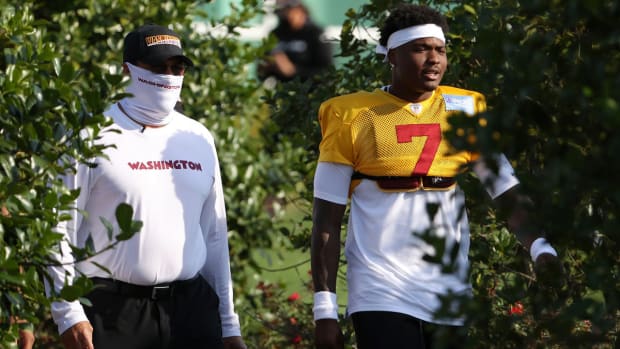
RIVERA'S TRUST IN HASKINS
After a thorny, unconventional offseason, new Washington coach Ron Rivera is content with where he is with reaffirmed starting quarterback Dwayne Haskins. And he has two people to thank that you may not expect.
One is ex-Ohio State coach Urban Meyer. The other is former Panthers QB Cam Newton.
What’s really interesting is how his experiences with those two informed Rivera on best practices for handling his quarterback situation over the last six months, and yet the two led him on very different paths.
Let’s start with the one that Meyer set out for Rivera. The Washington coach reached out to Meyer in January, and the two started a dialogue that eventually led to an in-person meeting in Indianapolis at the combine. Through their talks, Rivera learned about Chase Young, who Washington would wind up drafting second overall, and his new No. 1 receiver Terry McLaurin, but mostly his intent was to get into what made Haskins tick.
Meyer was clear.
“He really explained Dwayne to me,” Rivera said. “And the biggest thing he told me, You have to challenge him, Coach. Challenge him. And so when I met with him, after I’d studied him and watched him on tape, I challenged him. I challenged him on a couple things. I challenged him to be more mature, and not worry about what’s going on in the world of social media. Two, I talked about working on leadership, understanding how important it is to lead, and sometimes lead by example, not necessarily through what you say.
“I also challenged him on transforming himself, both physically and mentally. And then I challenged him on working on specific aspects of his game, his footwork, his decision-making, his movement skills.”
Rivera got a hand from his daughter on the social media end of things—she works in that area for the team and set her dad up to follow Haskins—and as a result he got to see Haskins responding to the challenges on several different fronts.
“It was good, because it looked like he was putting the work in. He was working with his teammates, he was working out, he was posting his transformation,” Rivera said. “I tried to watch it. It was great to see, it really was, because he’d taken what I told him to heart, and it just showed how serious he was about transforming who he is as a football player.”
And that, in turn, showed up in Zoom meetings through the spring too, with coordinator Scott Turner and quarterbacks coach Ken Zampese affirming what Rivera had seen, which set Haskins up for the next challenge Rivera set up for him—actually winning the job.
Remember, Washington had options. Kyle Allen started games for Rivera and Turner in Carolina. Alex Smith was coming back off a horrific knee injury, but brought with him 15 years of NFL experience, and Rivera made it clear that the starting quarterback spot would have to be earned—but he said that, with a twist.
And that’s where Rivera’s experience working Newton in Carolina came in. Remember, the two arrived in Charlotte together in 2011, new coach and new franchise quarterback.
Obviously, a lot went right through the early years for Rivera and Newton. Over a five-year stretch, starting in Newton’s third year, Carolina went to the playoffs four times, won the NFC South three times, and the quarterback was league MVP in a season that ended in the Super Bowl. But there were also some things, along the way, that Rivera would learn, and one was simple—your quarterback has to know he has your trust.
“The biggest thing with Cam was just showing him, Hey, I trust you and I’m behind you,” Rivera said. “And it’s funny because the more trust I showed Cam, it just really seemed to get him going. He really appreciated the trust. So with Dwayne I tried to do that right off the bat—Hey, I trust you, I believe in you. They respond, Give me this, give me this, and they do it. It’s been amazing. Cam was unbelievable. If I ever had an opportunity to go back and look at a couple things, and change a couple things, I would really just change that one thing.
“What’s helped me is I’ve been looking at Dwayne like that.”
So that quarterback competition? Yeah, it was sort of rigged. Rivera told Haskins he’d have to win it—then gave him every opportunity to do so. The coach wanted to give Haskins every rep with 1s he could, so he could see him and so Haskins could see that he believed in him, and was going to trust him with the offense. As Rivera explains it now, “I just felt like we had to leave Dwayne where he was and let him continue to grow.”
And that happened, in part, because Haskins knew he wouldn’t get the rug pulled from underneath him with a single bad throw, which is just how all this had worked with Newton.
“I think it’s a thing where you’re kind of hesitant because you really don’t know,” Rivera said. “But as I began to give [Newton] more and more trust, all of a sudden, I started to see how much it cut him loose. He didn’t want to make a mistake because he didn’t want to lose my trust. But as soon as I showed him, Hey, I trust you, dude, I’m gonna support you, I’m behind you, soon as I showed that to him? Man, he was unbelievable. It’s like, everything he’s doing in New England? Doesn’t surprise me one bit. It really doesn’t.”
Just the same, it didn’t surprise Rivera, having been through that, that Haskins grew up a bunch as a result of having that trust. And while the two goals here may sound at odds with one another—trust him, but challenge him—they really aren’t. Really, as Rivera sees it, the trust demands responsibility, and responsibility ties into the challenges.
“The one thing I learned is that when I held Cam up to that higher standard, man, he lived up to it,” Rivera said. “So I’ve been on Dwayne about doing things the right way and holding him to a higher standard, just letting him know, I’m gonna treat you like everybody else, but my expectations for you are higher than everybody else’s.”
That Haskins is sitting here as starter in September is a good sign that, thus far, he’s met those expectations. And Rivera’s clearly got bigger ones coming for his new quarterback.
***
HOW TRUBISKY WON THE JOB
So where Washington wasn’t your traditional quarterback competition—and the Dolphins and Chargers have, similarly, stacked first-team reps for their veteran guys—the Bears were the one team during this strange summer to have a real, true-to-life, winner-takes-all battle at the position in training camp.
That one ended Friday, when coach Matt Nagy called Mitchell Trubisky and Nick Foles to come to his office separately on the players’ day off to tell each, one-on-one, that Trubisky had pulled off what most of us on the outside figured he probably wouldn’t, outdistancing Foles for the job. And for all those reasons why few believed Trubisky could do what he did this summer, Nagy has renewed respect and faith in the team’s reaffirmed starter.
“This kid now, he’s had some adversity thrown his way,” Nagy said. “When you have a guy where, there’s another quarterback that they trade for, they’ve declined your fifth-year option, there’s a lot of stuff that would beat down a lot of other guys. And he stared it right in the face and said, Let’s go. That’s what he did. I don’t know how you don’t like that. So far, he’s done everything we asked of him. Now, we want to see how it translates into the season.”
That, of course, remains the big question—and we’ll get to the difficulty for the Bears in getting the best read on that. But for right now, the reason Nagy told me he picked Trubisky relates right to the above. Going into this offseason, and on the final day of a tumultuous 2019, one that ended sideways both personally and team-wise, Trubisky was given a specific list of areas Nagy wanted him to work, as Nagy worked to revamp the coaching staff.
1) Improve footwork.
2) Stay in the pocket—don’t get flushed out as easily.
3) Control what you can control, and be yourself.
4) Work on getting through progression in the offense.
5) Have a great next-play mentality.
Then, the team traded for Foles—meaning for the first time since Nagy arrived in 2017, Trubisky would have to win the job—and after that, COVID-19 hit, leaving the former second overall pick to work on this stuff on his own.
And that was tough enough in the spring, before summer hit and it became clear that the pandemic wasn’t done messing with the Bears’ plans. This competition, it turned out, would happen without the benefit of preseason games, and have to go down really in a span of three weeks of padded practices.
That challenged Trubisky. It challenges Foles. It challenged the coaches.
“That would’ve been really good, to see those guys compete in those game-like situations,” Nagy said. “We were going to play our starters a lot more in the preseason, and we were gonna play the quarterbacks even more than that. That would’ve been fun to see. One of the things you find out in this competition, if you asked both of them, they might say it was one of the most challenging or difficult parts of it, you could never really get in a rhythm because of the plays being split so down the middle.
“So for instance, if there’s a six-play drive, there might be times when we’re able to sneak them six plays in, so Mitch’ll take six, and then two series later, Nick gets those six plays back. But a lot of times, it was like eight-play drives with the first group, and Mitch was taking four and then Nick was taking the next four. … You’re never in full-drive type mode. And in a preseason game, you’re able to get more of that. And for both of them, that was one of the biggest drawbacks.”
But the Bears did it the way they did to make it as pure a competition as they could—and with coordinator Bill Lazor, pass-game coordinator Dave Ragone and QBs coach John DeFilippo all giving input, and having different levels of experience with the two (Lazor and DeFilippo had a ton of background with Foles, Ragone with Trubisky, and Nagy with both) they were able to tailor a derby that showed the staff most of what It needed to see.
At same time, Nagy told all those guys to wipe the slate clean for both quarterbacks. “That was one of the stipulations we talked about on the front end: zero agendas,” Nagy said. So everyone was trying, as best they could, to see things with a fresh set of eyes, and it was close enough where the head coach might think Trubisky won a day, an assistant may disagree with him and then that scenario was reversed the next day.
Through all that, Nagy said, he saw a distinct toughness from Trubisky in how he competed for the job. As Nagy pointed out, neither being knocked around in the media, nor being compared to draft classmates Deshaun Watson and Patrick Mahomes, nor having a potential replacement traded for or that option declined in May seemed to weigh on him.
“You see that arrow up and that growth,” Nagy said. “Growth is a word … some people can get impatient, and that’s O.K. But we’re in a place now, myself and Mitchell, and for where we’re at, this is the exciting time now, to be able to see his third year in this offense, to be able to see more growth, and see what he can do with it.”
Part of the growth was, through the competition, coming back strong after Foles may have had a better day than he did, and it was earning the trust of his offensive teammates all over again. Mostly, it was just going out there and playing.
And slowly, the coaches saw Trubisky start to check those boxes. His footwork was better. He had more poise within the pocket. He was going deeper into his progressions. He was leading naturally, in his own way, and managing bad moments by responding with good ones. Now, it was close enough to where, when Nagy called those three assistant coaches together one final time, he wasn’t sure where the meeting would go.
But what he did know was that Trubisky had already answered the bell.
“What we looked for ultimately was to see, are they making the same mistake twice?” Nagy said. “How are they handling the coaching? How are they handling teammates? You just have a feel for it, you really do, and it was definitely close. But in the end, [after the meeting], we knew that Mitch won the job, and that’s what it’s all about.
Where it goes next, and how the change in the spring and summer schedule affected it, really does remain to be seen. But for now, Nagy’s at peace with the call he made.
And when I asked how long a leash Trubisky has—and how he’ll keep his new/old starter feeling like he’s not getting pulled the minute something goes wrong—Nagy answered, in essence, that he’ll cross that bridge when he gets to it. [Note: He doesn’t really plan on getting to it.]
“It goes back to that—control what you can control,” Nagy said. “And it’s a positive thought versus a negative thought. And we don’t even discuss it, because that just goes to bad places. We think positively, like, Hey, we can’t wait, there’s an excitement, a laser focus, a mentality right now. It’s a feeling of positivity within our team, not just at the quarterback position, but across the board. Being a part of that as a quarterback, being a part of that as a head coach, there’s a real pure excitement to get this thing started.
“That’s probably for others to debate and discuss, that’s their world.”
Back in Nagy’s world, things get simpler now. He’s got a new starting quarterback. And while few would’ve believe it would be the old starting quarterback again, Nagy’s pretty happy seeing what going through all of this revealed about the guy.
***
DESHAUN'S PAYDAY
Deshaun Watson and Patrick Mahomes are going to be linked forever—the same way that, say, Eli Manning, Philip Rivers and Ben Roethlisberger are—because they came into the league together. And as such, it makes sense now to look at the contracts the two signed this summer, and put them side-by-side.
But first, let’s acknowledge this: These huge paydays are, first and foremost, confirmation that they’ve lived up to where they were drafted, which is a big accomplishment in itself.
That Mahomes lasted to the 10th pick, and Watson to the 12th pick, and both were plucked by teams trading way up the board to get them, is a good reminder that this outcome was hardly ordained. In 2017, opinions on the two (and I can confirm this from my draft notes, after talking to teams that April) varied wildly, and both guys are only scratching the surface now of where they can go as players.
Now, on the contracts, this won’t be apples-to-apples. Mahomes’s deal (negotiated by Chris Cabott and Leigh Steinberg) is an outlier in its length (a 10-year extension), and structure (with rolling guarantees locking the team into its quarterback); while Watson’s (negotiated by David Mulugheta) is far more conventional, and a significant one in its uptick over the standard for traditional quarterback deals, most recently set by Russell Wilson.
On its face, Watson’s deal is a four-year extension worth $156 million, while Mahomes’s deal is worth $450 million in new money over its decade of new years. But there’s obviously a lot more to dive into here …
• Over the life of the Watson contract (2020-25), Mahomes will make $8.7 million more, but a big part of that was Mahomes having $27.6 million left on his rookie deal, while Watson had $18.7 million left on his (due to draft position, and the pricier option for top-10 picks). In new money? Man, was it close. Watson ($156.0 million) edged out Mahomes ($155.8 million) by just $200,000 even.
• As far as new-money cashflow goes, Watson wins. It’s $27 million to $8.03 million through Year 1, $20 million to $6 million through Year 2, $55 million to $35.45 million through Year 3, $92 million to $75.9 million through Year 4, and $124 million to $113.85 million through Year 5.
• The fully guaranteed total toggles back and forth a little. At signing, Watson got $73 million and Mahomes $63 million. Mahomes’s total rises to $103.5 million in March. And in March 2022, Mahomes will be at $141 million, while Watson will be at $110.7 million.
• Obviously, then, the biggest difference comes into focus—Watson’s deal expires in March 2026, while Mahomes’s deal expires in March 2031. So let’s say they both make it through the next six seasons. Watson, again, will have made $200,000 more in new money than Mahomes (before accounting for incentives). Very close. Then, Watson would be free. Mahomes would have six years left on his deal, at $294.2 million, which is a little more than $49 million per year.
***
And that, really, is where this gets fun. If Watson plays well, he’ll likely be negotiating another deal in 2024 or ’25. Will the quarterback market—after second deals for guys like Lamar Jackson and Kyler Murray and, by then, maybe even Joe Burrow and Trevor Lawrence—be beyond the $49 million mark?
It’s a fair bet that it will be, with the new television deals and an influx of gambling money potentially pushing the salary cap into the stratosphere. Mahomes is protected if that doesn’t happen. Watson’s deal is, in a certain way, a bet that we will get there (and most players, including Dak Prescott, for one, prefer shorter deals like Watson’s).
It’s a bet, too, that Russell Wilson has already won once. The Seattle QB did a four-year deal in 2015 at $22 million per, which positioned him to get another deal in 2019, that one at $35 million per.
That’s a 59% markup, by the way. If things played out similarly with Watson, that’d mean signing a deal at more than $62 million per year in 2024. Does that seem unlikely? Sure, it does. But all the same, deals like the ones Watson and Mahomes just got probably would’ve seemed crazy four years ago.
Anyway, we’re all winners here in that we get to see these two lock horns for real in just three days. And we can hope the financial game they’re playing is still relevant years from now, because that would mean they’re still playing the way they are now.
***
TEN TAKEAWAYS
It’s possible to think the clear-the-decks nature of the Jaguars’ offseason has been done with an eye toward (potentially) taking a quarterback in 2021 and, at the same time, knowing that the Yannick Ngakoue and Leonard Fournette moves weren’t signs of tanking. Really, everything Jacksonville has done the last six months has been about turning the page and setting a younger foundation. They have three of the top 45 picks from April (CB C.J. Henderson, DE K’Lavon Chaisson, WR Laviska Shenault) in their building to show for that. They know they’re not winning 12 games this year, so naturally the idea they could be in play for Lawrence, Justin Fields or Trey Lawrence this April hasn’t escaped them. But really, whether they get there or not wasn’t going to ride on their ability to keep Fournette or Ngakoue happy for another year. Those two didn’t want to be there. And, in turn, it’s pretty understandable why coach Doug Marrone—and this has become more Marrone’s program this year than it was before, for sure—wouldn’t want them around anymore either. If this year’s going to be about developing young players like Henderson and Chaisson, and making determinations on others like Gardner Minshew, having guys who are basically running the clock out on their contracts so they can leave doesn’t exactly help build an environment conducive to that. So, yeah, it does look like the Jags are positioning themselves like the Dolphins did last year, where they’ll be in position to take a quarterback. But no, shedding those two guys in particular isn’t really all that significant to getting there.
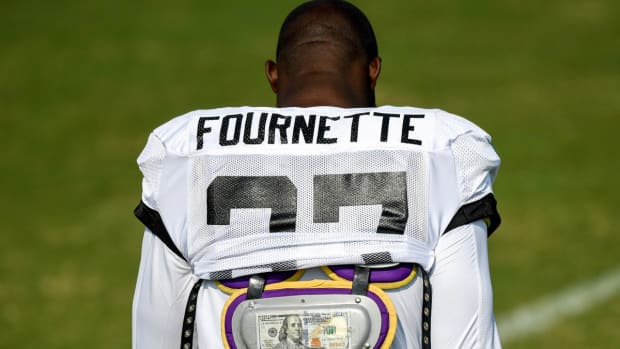
Fournette’s story, while we’re here, is a great cautionary tale on fit. And really this story starts with Fournette as a 15-year-old—which is around the age he became a local icon of sorts in New Orleans. From that point forward, he was treated as if he was the LeBron James of football (I actually went to see him play back then, on the advice of ex-Patriot and LSU star Kevin Faulk) by the people around him. By the time NFL teams had started to dig into who Fournette was, there was no secret to it. Rumors of special treatment at LSU were out there (example: He didn’t have to stay at the team hotel with the rest of the players the night before games), as was the rep he’d grown, and maybe it was a result of all this, as someone who didn’t deal well with authority. Ex-Jacksonville EVP Tom Coughlin was warned how Fournette might not be a match for the program he and Marrone were planning to build. Then, after a great first year, the chickens came home to roost. He could be moody and grumpy, and mostly because he was never going to fit into a my-way-or-the-highway environment. Those who did have a good relationship with him were the ones who met him halfway. Others thought Fournette was more enamored of the things that football afforded him than of the game itself. And things got to the point last year where he was late and would fall asleep in meetings, so the writing was on the wall on this one. Now, it’s possible things are a lot different in Tampa. Bruce Arians has always been able to handle egos, and the locker room there is very strong (the Jaguars did believe losing leaders like Marcedes Lewis, Paul Posluszny and Chris Ivory after his first year affected Fournette’s behavior). And even if Fournette’s style is a little dated, his talent is undeniable. For all those reasons, I can see why Tampa took a flier. But given the history, it’s not hard to see where things went wrong in Jacksonville—or why he’s gone.
Smart move by the Eagles to scoop Josh McCown up off waivers. We discussed this with McCown’s agent in late July, and it’ll be pretty much as he laid it out back then—McCown will get to live at home, take part in meetings from there and pull down $12,000 per week ($204,000 for the season). But there is a twist. McCown had been living in North Carolina, but when high school football season was postponed there (he’d been coaching at his sons’ school), he and his family decided to pull up stakes and move to East Texas, near where he grew up, owned a lake house and much of his extended family lived. One son, Owen, is now the starting quarterback at a local high school there, and his second son, Aidan, is a sophomore. So that’s where McCown will be working from, and his brothers (one of whom was an NFL quarterback himself) are close by to help him get in the field work he’ll need. The side benefit for McCown here—other than living the American Dream of pulling down a great paycheck in mesh shorts—is twofold. One, he loves the Eagles coaching staff, and he loves the quarterback room, and that love is mutual. Carson Wentz, in fact, has told guys in Philly that he wants McCown there as a resource, after having had him around in 2019. Two, McCown has aspirations to become an NFL head coach, and this will give him another level on which he can relate inside a locker room. He’s been a guy fighting to get in the league, he’s been a backup, he’s been a starter and he’s been a gameday inactive. But he’s never been a practice squad player, and this will give him that experience. So all in all, this is a pretty good deal. The Eagles get their quarantine quarterback, and give Wentz that valuable resource back. McCown gets that valuable layer of experience, and to be with a group he likes a lot—and the commute will be pretty manageable too.
The idea of the “final 53” could be proven a fallacy over the next few weeks. Over the weekend, the NFL felt the impact of the cancellation of the preseason. Without those games to go on, teams were flying blind on other teams’ players, which is why just 17 of those let go on cutdown day were claimed on waivers, way down from the 36 claimed off the initial cutdown last year. Now, here’s a twist—teams might still be flying blind on their own players a little, too. I was talking to someone Sunday who mentioned to me that every year, through the spring and into the start of training camp, there are players who coaches fall in love with, only to have their hearts broken when those guys fail to translate their practice performance onto the preseason game field. This year, that hasn’t happened, because there haven’t been games. So there may well be players on just about every roster who hit the game field, and aren’t quite what their coaches thought they were. Which could lead to the normal roster churn of this week spilling through September—with young guys coming off rosters and veteran street free agents potentially going on. We’ve obviously got a lot of weird stuff ahead of us, in the season of COVID-19. This would be one more thing to watch for.
Jadeveon Clowney sought, and found, the right result. Clowney’s best play was always going to be heading to a place where he knew the system and would be able to assimilate quickly. His background with Titans coach Mike Vrabel (Clowney’s position coach from 2014-16 and coordinator in 2017 in Houston) gives him that in Nashville. So why did this take so long? It was, as it usually is, about the money. Understandably, Clowney hoped to cross the $20 million per year plateau, as plenty of his edge-rushing peers have. It didn’t happen in March, in part due to his injury history, in part due to his murky past in Houston. Then, the effects of COVID-19 hit the NFL, and future cap uncertainty was attendant to that, making it even more difficult to get paid. Bottom line, Clowney’s financial expectations had to change. Some teams were willing to go to $15 million for him, though none he wanted to play for. The team I was told he had his eyes on all along—Baltimore—wasn’t reciprocating the love. And the teams he was connected to most (Tennessee, Seattle and New Orleans) lingered in the range of $10-12 million. The Saints tried, but $10 million was really as far as they could responsibly go. The Seahawks had a number in mind (I’m told it was around $10 million, too), and weren’t budging much. Tennessee, conversely, showed flexibility—and my guess is the incentives that can take him from $12 million to $15 million are there to help Clowney save face after walking away from the latter number. If it seems like a lot of work to get to an obvious end result, it was. But that Clowney got there is what matters. And he’s there now.
I’ve heard good things out of Green Bay about Aaron Rodgers’s mindset, and more than just how he’s managing his relationship with rookie Jordan Love. He’s even referenced, and spoken wistfully, internally about how things worked with Brett Favre, when Rodgers was in Love’s spot all those years ago. Being in Year 2 in Matt LaFleur’s offense has helped too, for obvious reasons, as has the ascent of a couple young guys around him. One is fourth-year back Jamaal Williams, who’s flashed in the past but hadn’t found real consistency until this summer. He’s cut weight, looks quicker, smarter and stronger, and has been sparked by competition from second-round pick A.J. Dillon. And another one is third-year receiver Marquez Valdes-Scantling. To be honest, I was a little hesitant to point him out, because I touted him last summer too—ahead of a 26-catch season. But the physical tools have always been there with the UCF product and he, again, has the look of a guy ready to break out.
While we’re in the NFC North, keep an eye on Chicago’s rookie class. Fifth-round receiver Darnell Mooney has been really solid in camp, and his 4.38 speed could add an element to the Bears’ offense that it’s missing right now. And a classmate he’s gone one-on-one with plenty through the early stages, second-round corner Jaylon Johnson, has impressed too. Add second-round TE Cole Kmet to the mix—and Kmet’s one of those guys who’s solid all the way around in a he’s-gonna-have-a-10-year-career kind of way—and you have a group that should contribute pretty quickly. And getting that kind of production from a class that lacked a first-rounder (the last piece of the Mack trade) would be huge for a Chicago team that’s aging quickly in some key spots.
The Josh Rosen story was written early last year. I remember last September, people asking why Miami wasn’t starting Rosen—after all, they needed to get answers on him and Ryan Fitzpatrick, effective as he can be, wasn’t going to be the starter longterm—and the answer I found was strikingly simple. The Dolphins felt like they already knew what they had. Eventually, Rosen would get his shot, but it only confirmed how the staff felt, as did how the offense got on track once Fitzpatrick got back in the lineup. So how did Rosen’s star fall so quickly? It might be as simple as a lot of people (myself included) being wrong. The truth is, in Miami, it was a little bit of everything. For such a smart kid, Rosen wasn’t processing as quickly as the coaches would’ve liked. He didn’t have good feel for how fast the rush would come in the NFL. He didn’t get rid of the ball fast enough. He didn’t see the field fast enough. He relied on his arm to bail him out too much He played, as they saw it, with a general lack of urgency. On top of that, while people wound up liking Rosen there, it was acknowledged he was an acquired taste—he could come off as arrogant, and not one of the guys, until people took the time to get to know him better (and found he was actually a decent guy). Which, of course, played into preconceived notions of him. All of that was tough for Rosen to get past. Really, where the coaches could see the talent was as he threw in one-on-ones. Outside of that, there wasn’t a ton to work with. And I’ll admit, it was tough to wrap my head around it after having heard about Rosen’s gifts since he was an 18-year-old UCLA freshman. But that was the reality of it. It’ll be interesting to see what happens next, with Rosen reunited with Bucs OC Byron Leftwich (who coached him in Arizona), and in a room with Tom Brady. Hopefully, he gets a good long look there, and a real shot to right all that’s shown up wrong in his game.
I can’t imagine being Sidney Jones this weekend. The former second-round pick was shopped last week, then cut on Saturday. He cleared waivers Sunday, then signed on to join the Jaguars practice squad. But really, that story started in Seattle on the morning of March 11, 2017. That was Jones’s pro day, and the day everything changed for him—he snapped his Achilles on the final position drill of the workout. Prior to that, Jones was widely viewed right alongside Marshon Lattimore as a top corner in the draft class. Lattimore actually tweaked his hamstring at that year’s combine, then came back and did drills at his pro day, then went 11th overall to the Saints. Since, he’s made two Pro Bowls, and was named Defensive Rookie of the Year in 2017. Jones, meanwhile, fell to 43rd overall, where Philly took a flier on him. He missed all but one game of his rookie year rehabbing the Achilles, and struggled to stay healthy the last two years, playing in just 21 games, and starting eight of them. Lattimore has already made $12.8 million, is on the books for another $2.8 million this year, and is in line for a monster extension. Jones has made about $4.8 million, and sits on the fringes of the NFL. And all of this came down to a bad break in a pro day workout, which is a pretty good example of how thin the line is between making it and washing out in pro football.
On the bright side, for Philly, the roster cutdown was another good example of the depth of its roster. Three of the 17 guys claimed off waivers were Eagles, and they were one of only two teams to have multiple players poached (the Chiefs were the other). It’s a small thing, of course, but one that scouting departments take great pride in annually—knowing your roster is well-regarded around the league to the point where there’s demand for the guys you just let go. So here’s hoping GM Howie Roseman, VP of player personnel Andy Weidl, assistant director of player personnel Ian Cunningham, VP of football administration Jake Rosenberg and senior adviser Tom Donahoe got a chance to crack a beer on Sunday night after things settled down, and feel good about the job they did.
***
SIX FROM SATURDAY
With the season underway, we’re transitioning our Six from the Sideline section back to a college football/draft focus. Or we’ll have it that way as long as college football can survive the pandemic. So here’s Volume 1 for the 2020 season.
1) Trevor Lawrence has shown a lot of leadership off the field through the muck of the run-up to the 2020 season. He showed it again on Sunday by taking up for his teammates and friends in being the front man for a large group of college football players asking for schools and football programs to take five actionable steps aimed at making real change. We’ve seen Joe Burrow being similarly vocal on social justice lately, and it’s pretty cool to see younger players feeling compelled to step forward.
2) Tennessee had 44 players sidelined from workouts last week, and had to cancel Saturday’s intrasquad scrimmage as a result. Most interesting to me is that coach Jeremy Pruitt said the great majority of guys were taken off the field as a contact-tracing measure. I’ve seen how vigilant the NFL has been about it—the red light on the tracers on guys’ wrists and around their necks are hard to watch—and it’s not hard to see where that could wind up being a problem in college football. I’d stay tuned in on where the Vols’ situation goes.
3) I was floored to hear that Michigan president Mark Schlissel hadn’t talked to coach Jim Harbaugh at all (they’d texted and emailed, per Harbaugh) before voting to cancel the Big Ten season. Maybe it’s me, but I’d think doing something that could literally cost a school’s football players millions in future NFL earnings merits a conversation with the football coach.
4) NFL folks told me they’d have to do less than basketball, baseball and hockey to mask the empty stands—mostly because of how the sport is shot versus the others. Most of that rang true in what I watched of Southern Miss/South Alabama and Army/Middle Tennessee this weekend. During the actual game action, you couldn’t tell the normal crowd wasn’t there.
5) I’m legit fired up to see Lawrence play on Saturday. The idea of that seemed pretty unlikely a month ago, but here we are.
6) If you missed Kirk Herbstriet on Saturday, watch this … now.
***
BEST OF THE NFL INTERNET
Len seems excited to be relocating in Florida …
… and to play for Bruce Arians and with Tom Brady.
I tried to tell you guys about Joe Judge. If he was trying to be a Bill Belichick knockoff, I’m not sure this would be the way to do it.
Ouch.
What MDS and Clark are saying here is absolutely true. And it doesn’t mean you can’t criticize players. It’s more an acknowledgment of just how hard it is to even get invited to a training camp at the NFL level.
The Texans repurposed this over the weekend, and it’s a good sign of who Watson is—he gave his first game check to cafeteria workers struggling in the aftermath of Hurricane Harvey. I’m not sure how many 22-year-old rookies would’ve even thought to do that.
And you should take the time to watch the first 13 minutes or so of this—the Texans had Clemson coach Dabo Swinney, Astros ace Justin Verlander, a Make-A-Wish kid fighting leukemia who Watson befriended and Watson’s family on to congratulate him on his new contract. Credit to Houston PR chief Amy Palcic for setting up a real cool look into Watson’s life.
He’s got 156 million reasons to smile.
Yup, that worked on me. I felt ancient seeing him on TV the other night.
Good to see the camaraderie there. Adrian Peterson landing in Detroit was, of course, in large part due to Peterson’s background with Lions OC, and ex-Vikings OC Darrell Bevell, and it should be good for the young backs there (Johnson himself and D’Andre Swift). But here’s a cool side plot to whole thing: Peterson needs 1,054 yards to move into third on the all-time rushing list, which would mean passing … Barry Sanders. It seems unlikely that Peterson would do it this year, as a Lion, but it also would’ve seemed unlikely a few years ago that Peterson would still be playing. So I’m not ruling anything out.
***
WHAT YOU NEED TO KNOW
Football is damn close to being here. Just four days away. And we went pretty much the entire column without mentioning the NFL’s handling of the pandemic, which means we’re in a pretty good place to be kicking off with Chiefs/Texans.
We’ll have more on that one coming in the MAQB.
Thursday, 3 September 2020
Tuesday, 1 September 2020
New on SI: An NFL Head Coaches’ Guide to a Creating Culture Change
Congrats on your new gig. Here's how to change the culture of your NFL team in one year.
So, you’re a new head coach who has spent a few weeks around your team to mixed results. Some days things seem to be going well. Some days, it just feels like you’re just not connecting to all the players you inherited. This is much harder than it looked on Zoom throughout the early spring months when you could have someone from IT throw the Tiger King background onto your screen for an easy laugh to break the tension.
Fear not, though. We’re here to provide an essential service. Just like our best-selling guide for how new head coaches can avoid an early exit
by systematically blaming everyone around them, we also have an answer for redirecting the focus of a new club. We call it our Premium Culture Change Guide and for less than half of a subscription to Pro Football Focus (which you should also start looking at) you can keep your team and the pesky media eating out of your hand for the entire season.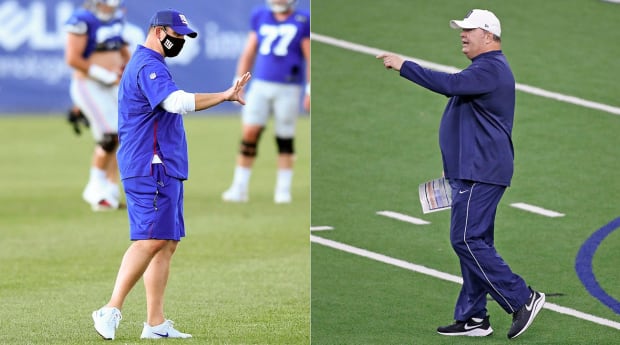
1. Immediately release your most interesting player.
Is there a player on your roster who has any opinion whatsoever on the world at large outside of football? Is he popular with the fanbase? You know what to do. These “thinkers” are only going to get in the way of your master plan, which is a firehose of vague platitudes that you’ll launch at the players on day one—“We want to be a tough, physical team that controls the line of scrimmage and wins football games”—without any direct instruction on how to achieve said goals. The problem with guys who ask questions is that they might end up motivating other players to ask questions, stuff that isn’t germane to progress like: “Why are we doing this?” Or, “Didn’t you tell us this word meant something else yesterday?” Or, “It seems like a lot of the guys are super confused, could you explain it in a different way?” Stuff like this gets in the way of our true goals: To appear sweaty and tired in front of the media so that they write stories about how sweaty and tired we are. This is why you worked hard all these years. Sweaty and tired.
2. Dismantle the existing ping-pong tables and signage. If the ping-pong table has already been dismantled, order a new one.
Remember, you are the stepdad. If the situation calls for George Patton, throw on a green helmet and start banging out pushups. If the situation calls for Neil from The Santa Claus, then throw on a funny sweater and begin listing off all the Malcolm Gladwell books you’ve read. NFL head coaches have kept the furniture moving and printing businesses thriving throughout even the most difficult of times. Teams will spare no (relative) expense when it comes to fulfilling a coach’s wild-eyed vision of what a locker room should look like, even if that means replacing one 30-foot-by-25-foot billboard that says Alignment, Assignment, Technique with a new one that says Fundamentals. Do they mean the same thing? Yes! Could you survive one minute longer with the old one hanging in the hallway near the main entrance bathroom? No chance.
Winning this battle of passive aggression against the previous regime is paramount to your campaign of success. You need to prove you did it your way, which, consequently, is a lot like the previous guy’s way but you just have to make it sound a little different.
3. Completely regress into your past and begin to act like the wild, out-of-date mentors of your childhood.
Think the gym teacher from The Wonder Years. Embrace being one of those insane, pre-scientific athletic coaches who are skeptical of everything from stretching to plant-based protein. Begin running laps after practice, hiking up your shorts and ordering tall glasses of whole milk in front of the other players. Force your men to climb a large rope in the middle of the room. All of this worked for you, right? It made you into the successful coach you are, which means that six dozen millennials from diverse backgrounds are sure to fall in line.
4. Sign a geriatric veteran who you once shared a bagel with during a one-year stop with a previous team to legitimize the operation.
Remember that 38-year-old tight end who you coached at the positional level five years ago? That’s the guy we need right now. Is he fast? No. Can he catch? Not really anymore, no. Will he contribute on special teams? Absolutely not. Does he cost well above the veteran minimum? You bet. This is the key to everything. Bring in the guy everyone knows you’re paying just to tell everyone else in the locker room that you have an idea of what you’re doing. There is no way the other players will see through this. It’s a fool-proof plan.
5. Alienate a high-profile player who you cannot cut and hold him as an example.
Stars make things complicated. Sure, they are “good” players who “make the offense work” but they get in the way of how much credit you’ll eventually get for wins and losses. This can’t happen! That perennial 1,000-yard wide receiver who needs a contract extension? Drag your feet on that. Your ascending star quarterback who had a breakthrough last season? Fire his position coaches and install a completely new system. The cornerback, who is so talented that the entire defensive scheme rests on his shoulders? Dismiss his accomplishments publicly and start complementing the nickel corner with an opposing QB completion percentage of 85%. Remember, Bill Belichick yelled at Tom Brady for 20 years and they had a completely healthy relationship. Completely healthy! No repressed rage or anger there. It’s important for the bad players on your team to see you yelling at the best player, because it shows them that when they follow all your plans and become a great player, they can get screamed at in front of scrubs too! Ah, luxury.
So, that should get you started. Remember, when becoming a head coach, it’s incredibly important to constantly praise America, its democratic ideals and the military while running your team like the dictatorial regimes they fought against for hundreds of years. And, when it all inevitably goes south, remember, you still have plenty of options.
Monday, 31 August 2020
New on SI: How Tom Brady is Already Getting the Most Out of His Teammates in Tampa
Tom Brady's training camp in Tampa Bay: high standards, encouraging words and a players-only meeting. Plus, how football took a back seat to social justice issues this week, Yannick Ngakoue's move to Minnesota, recapping Albert's camp trip and much more.
TAMPA— I spent two days down here and, full disclosure, Day 1 had me wondering.
There were throws in the dirt. There were drops. Maybe strangest of all, there was No. 12, the hyper-intense, hyper-detailed legendary prize-fighter of a quarterback, in the middle of it all, handing the situation with, weirdly enough … positivity?
Nice play, Huddy!
Way to go, Mike!
Great bench route, Chris!
All day, fellas!
This, at least to me, looked like a different Tom Brady than the one I’d seen in New England over the last two decades. And coupled with the practice I was watching—the kind that would set him off on the practice fields of Foxboro—I started to think about, and probably overthink, what I was seeing.
That was eight days ago. The next day, last Monday, I asked Bruce Arians about this relentless sunshine-pumping, coming from the most relentless competitor I’ve ever been around.
“Oh, I don’t think there’s any doubt about it,” Arians told me, laughing. “I mean, he has not gotten on anybody’s ass at all. If he’s gonna get on anybody’s ass, it’s back behind when somebody else is taking reps. Then, he’ll talk to them.”
And then, Arians revealed that Brady actually did say something after that practice.
“He gave a great speech to the whole offense, once the coaches left the room,” Arians continued. “His leadership is unquestionable. But man, he is so positive with those guys out there. They’re just eating it up.”
Meet the new Tom Brady, same as the old Tom Brady.
The packaging is different. But the idea hasn’t changed.
The second day I was there was much better.
***
We’re 10 days out from real NFL football. I can’t wait, nor can I wait for all of you to get a look inside this week’s column. Here, you’ll find …
• A look at a wild week in the NFL on the social justice front.
• Details on the big Sunday trade that made Yannick Ngakoue a Viking.
• A fun look at the seven-camp swing I took.
• A ton of notes.
But we’re starting at Camp 12.
***
As it turns out, that players-only meeting wasn’t exactly Brady flipping over the Gatorade table, either. Instead, the quarterback, after waiting for the coaches to clear the room, delivered a very clear, concise message to his teammates.
“You gotta show up every day,” is how O.J. Howard recalled it. “There’s no days off. With a lot of guys in general, for me, playing football over the years, when you have so much talent, it can get to the point where you start going through the motions, because you can depend on someone else to step up and make a play. But it shouldn’t be that way. It should be everyone on the same page, everyone coming with their hard hat every day.”
“Tom, he expects us to come to work with a lot of energy and to compete every single day,” second-year slot receiver Scotty Miller added. “And we set these goals, and we gotta put in the work to achieve these goals. That’s what he expects from us every single day, to go out there with our goals in mind, give it our all and compete with energy. If we do that, as you know, we got all the talent in the world, all the talent we need to get to where we want to go.
“That’s what Tom wanted out of us—we cannot take a day off, ever.”
Which is how we get back to this being the same Brady.
He’s 43 now and, by all accounts, he’s done everything he can to blend in with everyone else here. The stories of how he greets new teammates—Hi, I’m Tom—as if he needed the introduction to them are the same as they were in New England. By now, you know
he organized the workouts on the campus of tony Berkeley Prep this summer, and he played a couple rounds of golf before camp with Arians and quarterbacks coach Clyde Christensen.“I think we split,” Arians said. “He had the pro for his partner, the pro shot like 65. So we got our ass kicked that day. But I think Clyde and I got him the next time.”
But make no mistake about this—his presence is felt in every inch of this place, and has been since the minute he arrived. That, in fact, is part of what attracted the Bucs to him in the first place. They knew that Brady’s standard would be their collective standard once he punched the clock the first time and they’ve gotten what they paid for, in full, in that regard.
That meeting was one piece of it. There are plenty more.
Attention to detail. Brady’s played quarterback in the NFL for two decades, so his volume of knowledge is off the charts. That much doesn’t need to be restated. But what you may not know is that it’s at the point now where he’s not just capable of running an offense—if you’re a teammate of his, he could probably be your position coach too.
And by that, I mean, there are pretty minute details he’s drilling the fellas on.
“Last year, I had a problem—I never really noticed it, it was just a bad habit. I would, when I was running my vertical routes, or routes down the field, turn my head back too soon, and it’d have me running with my shoulders sideways,” Howard said. “And Tom kept stressing to me, Keep your shoulders forward, keep your arms pumping, and find the ball late, just track it. He’s done a great job with me on that. I’m keeping those shoulders straight, and it helps allow me not to slow down in my routes.”
“One thing that he’s focused on with me, let’s say I’m running a deep ball, whether it be a fade or go, there’s certain yardage where, once we beat the DB, he wants us to get our eyes up, get our eyes back to him,” Miller said. “That way, he can really feel us out, he can tell if we want a back-shoulder ball, or if we really beat the guy, he’ll put it over the top. We have a bunch of different deep concepts where he wants us to give us his eyes at specific yard markers. That’s one detail that’s been key for us.”
So in Howard’s example, a teammate of Brady’s is playing faster. In Miller’s, a teammate is helping Brady throw a better ball. And everyone benefits.
Building confidence. Here’s why I chose to speak to Miller and Howard: Several Bucs people brought them up as guys who’ve exploded as players for having Brady as their quarterback. Part of that’s from details like the ones mentioned above. Another part is simpler. They’re more confident, in general, getting to work with him.
“When the Greatest of All Time tells you you’re pretty good—like, Hey, what a route! Great job! Or, Try this, and it works—it gives you a ton of confidence,” Arians said. “That’s really all it takes, that one little bit of confidence, and he can take that next step to become a heck of a player.”
Both guys confirmed that, as I was told, they are playing with more confidence than they had been before. It helps, of course, being in their second year in Arians’s offense.
But neither questioned that Brady’s helping to unlock that self-assuredness, too.
“He just gives us so many specifics, in where he wants us to be, so many details,” Miller said. “So when I know those things, and I know exactly what I’m doing out there, and what he wants me to do, I think that really helps me go out there and play fast, and be myself and make plays.”
“How to get open on certain routes, how he’s expecting the defender to play certain coverages vs. certain routes, and what he expects out of us as receivers and tight ends, all of that has allowed me to play fast,” Howard said. “It’s definitely been really helpful for me.”
The standard’s up for the coaches, too. Over the years, both Josh McDaniels and Bill O’Brien have said how tough it was coaching Brady—he was so smart, and so prepared, that an offensive coach had to work overtime to give him something new or challenge him in a way he hadn’t been challenged before.
Arians has certainly felt that.
And for him, Christensen and senior assistant Tom Moore, the time they had working with Peyton Manning in Indianapolis helped ready them for this experience. So just as Brady’s been pushed to learn a whole new language (Howard told me the offense is “really the same” as it was last year), he’s pushing the staff in his own way—which probably explains why he and OC Byron Leftwich were inseparable in the two days I was here.
“The verbiage was all new, so that part was a little hard on him,” Arians said. “Just learning all the verbiage—Hey, I wanna change this protection, what’s that called? And getting to where it’s a second language to him, that’s still happening. But yeah, having been with Peyton, as his coach, if it was an hour meeting, you better have two hours’ worth of stuff, because if you brought an hour, he’d buzz through it, and get bored, then get pissed.
“And it’s the same with Tom. He wants all the information. It’s fun, I’m happy he’s into the virtual reality stuff too, because that really has allowed him to get live reps over again.”
He’s holding himself to that standard too. Which is probably the ultimate key here. It’s hard to preach it if you’re not practicing it. Brady is, without question, doing that, and that virtual reality program is proof.
Per Arians, Brady hadn’t used the technology, from a company called Strivr, before. The coach actually started with it back in Arizona, and Carson Palmer raved about it to Arians (see Peter King’s 2015 story for The MMQB about Palmer using it), so Arians went to Brady with the idea. Brady, in turn, saw it as a new way to stack more work on top of what he was already doing in learning his new offense.
That is to say, he embraced it right away.
“Everything we do, we film for virtual reality with Strivr,” Arians said. “When you go back in, you put a headset on and you’re actually back at practice. And you see the exact play you just ran, versus the right blitz, so you can have all those practice reps over again. You can sit in the room and drop back, or just sit there and watch it. We did this all the time in Arizona, our backup quarterbacks, that’s how they got a lot of reps in practice.
“He’d never had it. He was like, ‘Wow, this is really cool.’ You turn around and see the running back, you look out, you see the coach. It’s crazy how good it is.”
So when another player walks by the room, after another 100-degree practice, and sees Brady wearing a headset in a dark room, and moving his feet around like a boxer during some downtime? Chances are, he’ll feel compelled to be just as invested.
***
Now, the elephant in the room is that what Brady’s doing is, and continues to be, without precedent. We saw how fast Manning lost it at the end. Brett Favre, too. And Brady’s 43, which makes it difficult not to think that a quick demise will eventually be in play.
But the quarterback the players are seeing in Tampa is the same one many of them have watched since they were kindergartners—and that’s not an exaggeration (Howard was a first-grader when Brady won his first Super Bowl, and Miller was in preschool). And if he can maintain that, which, again, isn’t guaranteed, then there are a lot of pieces in place here.
Brady’s got Mike Evans, Chris Godwin and Miller at receiver; Howard, Rob Gronkowski and Cam Brate at tight end; Ronald Jones and Shady McCoy at tailback; plus a line that’s improved, and is adding a first-round tackle.
“I’m pretty stoked, man,” Howard said. “We have a lot of talent. It’s gonna be special to see. Every week, it’s gonna be a new guy making plays. There are always guys making plays here, every practice. Live bullets, it’s gonna be fun to go out there every week and see—Hey, it may be your day, it may be Scotty’s day, it may be someone else’s day. It’s gonna be fun.”
Miller then used the same word, stoked, before adding, “I’m extremely excited.”
Arians is too, for sure. And it’s not just because of that talent he’s putting around Brady, either. It’s all of the above, plus how this has become Camp 12 and how that’s affected everyone in the building.
The expectations externally are, of course, higher than they’ve been for Tampa since Jon Gruden’s heyday. And that’s OK with the guys here. Because internally, thanks to Brady, that bar’s been set even higher. For the coach, that much was clear on that Sunday, eight days ago, after he heard what came out of that meeting.
“It was just reinforcement, Hey, there’s too much talent in here. We’ve gotta pick it up, we don’t have that much time left,” Arians recounted, before emphasizing that he’s trying to drive that home too. “Every day I talk to them about it. If we stay healthy, if we beat the virus, we’re gonna beat a lot of teams.”
And if you listen to Brady out there, it’s not hard to hear how he deeply he believes it.
***
FOOTBALL TAKES A BACK SEAT
Overnight, Monday into Tuesday, Lions coach Matt Patricia got a text from his chief of staff, Kevin Anderson, that was pretty simple and direct.
You see what’s happening in Wisconsin?
Patricia woke up to that on Tuesday morning and, since he’d been knee deep in camp work, answered that he hadn’t seen much yet, but that he’d get right on it. It didn’t take long for the 45-year-old, as he started reading, to understand the gravity of the situation.
“I don’t really feel like talking about football,” he told the players, as they gathered for a team meeting a couple hours later, coming back from a day off on Monday.
So for about two-and-a-half hours thereafter, the coaches and players spoke frankly and openly about the shooting of Jacob Blake, which, to those in the room, felt like a continuation of the discussions they had in the aftermath of George Floyd’s killing in May. And as the meeting wound down, the coaches handed the baton to the players, asking them how they’d like to handle the rest of the day.
On Tuesday, practice wound up getting canceled and the team staged a demonstration outside its practice facility, one that went viral on social media, with veteran safety Duron Harmon addressing the media thereafter. Eventually, later in the week, the Lions would get back to work. But the precedent they set sparked a tidal wave of cancellations across sports.
On Wednesday, the Milwaukee Bucks decided to strike instead of playing against the Orlando Magic, and the NBA’s whole playoff slate for that night was canceled. And NFL teams started to follow the Lions’ lead too.
In Indianapolis, the Colts’ social impact committee went to coach Frank Reich to voice its feeling that football needed to take a backseat for a day, after a players-only meeting earlier Wednesday night. Reich agreed, and addressed the team on Thursday morning, fully willing to concede that he needed to follow the players’ lead on this one.
What he said, I’m told, was along these lines: What happens with white privilege, we want to talk about these things when it’s convenient for us. The Black man doesn’t have that luxury.
From there, the Colts had all players and coaches register to vote, then the players went into six hours of meetings with David Thornton and player engagement staff. They came out with four areas where they wanted to focus their efforts: voter registration, police relationships in the Black community, education for underprivileged children and food access for school kids who might be missing classroom time due to the pandemic.
So did teams like the Lions and Colts change the world this week? Maybe not.
But I’d tell their stories to give you a microcosm of what’s happening in the NFL. These are sensitive topics for a lot of people and, as such, in some places the discussions within teams got emotional and even contentious, from what I understand. But as I see it, that’s a good thing.
That means people are being honest with each other, and making themselves vulnerable, and my feeling is that’s what leads to real progress. In fact, that’s probably why we saw so many teams emerge from these meetings with actionable plans—because they were able to sort through what was really important to the guys in the room.
And that says, to me, that the league took more steps forward on the social front this week, and more meaningful ones than those taken simply by writing checks.
What’ll be interesting from here is to see owner involvement. Eagles owner Jeffrey Lurie, who’s been pretty progressive in this area for some time, said on a call with local and national media on Sunday that he sees a “sea change” among owners—“they’re embarrassed by our country, embarrassed and hurt.”
I can say that players are eager to see the owners show it. I’ve been asked a lot the last couple days if I think NFL players might walk away from games like the NBA, WNBA, MLB and NHL players did last week. The truth is, I’d need to know what’s happening in our country at a given time to answer that. I don’t know what the climate will be in America in 10 days, when the Chiefs and Texans kick off, nor do I have a clue what it’ll be in two months.
But I do know this—the players will want the support of their bosses going forward, no matter what happens next, and that could impact their decision-making in how they handle wherever all of this goes. If Lurie’s right, they’ll get it.
***
YANNICK GETS HIS WISH
Overnight on Saturday into Sunday, the Vikings and Yannick Ngakoue’s camp were working through proposals—some that included a lower base and incentives, others just a hard cut from the $17.788 million franchise tag Ngakoue had been assigned in March—and by the time the sun came up in the Central time zone, the deal was done. And one thing was abundantly clear.
Ngakoue very badly wanted out of Jacksonville.
How badly? He was willing to take $5.788 million less (without incentives) than he otherwise would’ve made just to stay with the Jaguars for the next four months. And so now, on that one-year, $12 million deal, he gets to play opposite Danielle Hunter, and for Mike Zimmer, on a team that’s made the playoffs in three of the last five years and had a top-10 scoring defense the last five years in a row.
The rest of the fallout for the parties involved …
For Ngakoue: The trouble here is next year’s franchise tag number might wind up being lower than this year’s (because of the falling cap) and, in taking the pay cut, he loses the benefit of the second tag being 120% of his previous year’s cap number. That said, the Vikings made a good-faith pledge to Ngakoue’s camp to negotiate a fair long-term deal when it’s allowed by rule, after the 2020 season. He’ll still be just 25 then. And he’s seen as an exceedingly good fit for Mike Zimmer’s defense, which should help him put up the kind of year that would prompt a mega-offer from Minnesota.
For the Vikings: They replace Everson Griffen and, again, have one of the best bookend pass-rush tandems in football, and give a core that’s aging—Kirk Cousins is 32; Harrison Smith is 31; Kyle Rudolph and Adam Thielen are 30; Anthony Barr and Eric Kendricks are 28—another Pro Bowl-level talent to go to battle with. And Hunter, also 25, and Ngakoue set up as pieces to build around long-term, after the older guys are gone.
For the Jaguars: All the way back at the draft, you heard, Jacksonville’s the Trevor Lawrence team, which was essentially a way of saying that the Jags were stripping down the operation in 2020 with their eyes on 2021 and beyond. Hard to argue that now, when you look at the list of players gone from a stellar defense that carried the team to the AFC title game just 31 months ago …
• DE Yannick Ngakoue
• DE Dante Fowler
• DL Calais Campbell
• DT Marcell Dareus
• DT Malik Jackson
• LB Paul Posluszny
• LB Telvin Smith
• CB Jalen Ramsey
• CB A.J. Bouye
That’s a lot of talent out the door. Conversely, the Jags had three of the top 42 picks in April’s draft (C.J. Henderson, K’Lavon Chaisson, Laviska Shenault), and have four picks in the first two rounds of next year’s draft. That doesn’t guarantee anything, and they’d still almost certainly need to be the worst team in football to get Lawrence (it’s unlikely whoever lands that pick trades it). But at the very least, the direction here is clear. Also, waiting wound up being prudent. The Vikings’ haul was the first hard offer they got that involved a second-round pick (and they got the 2022 conditional fifth, that could be a third or fourth, to boot).
And so, with five days left until final cuts, the trade market finally moved. We’ll have more on that in a minute.
***
A CAMP TRIP UNLIKE ANY OTHER
This year’s camp trip was super different for me. Normally, I’ll try and see close to three-quarters of the league between the end of July and the opener. And this year, because of (very understandable) access rules, there wasn’t great value in doing that.
But what’s happening now is historic, and so there was plenty of value in getting out and seeing how all of this was working. So I decided I’d rent a car, go down the East Coast and hit all the teams I could along the way—then go to Florida to see a certain older man who spent his professional prime in the Northeast, and chose to go to a warmer climate to close out his career.
The result was a seven-camp itinerary, and a bunch of stories gathered along the way. And some smaller stuff for me to parcel out to you guys too. Here’s some of that …
Signs of COVID-19
Patriots: At the far end of the team’s practice field, there’s a giant trailer that’d been used for … I’m not sure what over the years. I’ve never seen it open before. This year, there are two windows that, from far away, almost look like where you’d order from a food truck. One has a sign that says “athletic training” on it, the other “equipment,” two vital pieces of the football operation displaced as a result of distancing measures taken.
Jets: When you pull into the team’s expansive suburban facility, and get past the guard shack, you basically circle the practice field to get to the parking lot—and once you take a right at the corner, you can see a line of four tents set up to left, with maybe a dozen workers in hospital scrubs, plastic jackets and masks. By the time I arrived, their busy time had just ended. Media was instructed not to show up before a certain time, which allowed for all the testing to happen as guys arrived, and before reporters got there.
Giants: Four luxury coach busses are parked right at the side of the practice field, in a way that looks vaguely like a visiting high school team would arrive for a scrimmage. Why are they there? The Giants moved 90% of their football operations into MetLife Stadium, across a massive parking lot. So the players and coaches commute over from the stadium to the team’s practice facility, to use the fields there, via bus.
Eagles: I brought a neck gaiter and a cloth mask with me on the trip. The Eagles were the one team I visited where that wasn’t good enough. As all reporters enter, and go through the normal protocol—getting your temperature taken, and showing that you answered the standard questionnaire online—they’re handed paper masks (the kind you’d get in a hospital) for practice. Which, I learned on that day, get really warm when it’s 90 and humid.
Ravens: Anyone who’s been to Baltimore’s facility knows why it’s referred to as The Castle. It was modeled after a well-known country club, and looks palatial as a result. And while that ambiance is still there, it’s definitely a different feeling pulling past security and entering the facility, which is tucked in the woods in Owings Mills. The first thing you see? Three signs: Testing A-G, Testing H-Q, Testing R-Z.
Buccaneers: Here, media arrives at a prescribed time, and then lines up for temperature taking—without anyone getting out of a car. Once you pull up to the gate of a fenced-in parking lot, to the right of the team facility, you show the guard a green checkmark on your phone, signifying completion of a COVID-19 questionnaire, and then you dip your head, so he can take your temperature.
Dolphins: After going through the same stuff I did at the previous six stops—filling out a questionnaire on symptoms and who I’d crossed paths with, and getting my temperature taken—a PR assistant handed me a pass with a seat assignment (not normal at camp). It said 118 and basically had me sharing a relatively expansive pavilion area atop the stands with the Miami Herald’s Armando Salguero. The purpose, obviously, was to keep reporters spread out, and we got an internet connection, large fan, and power outlet for our troubles.
Name to watch
Patriots: OLB/ILB Josh Uche. Primarily an EDGE player at Michigan, New England saw inside/outside versatility with Uche because of his build and instincts, and it’s clear that he’s made an impression early in training camp. Bill Belichick has overseen transitioning EDGE/linebacker hybrids off the line of scrimmage in the past (Tedy Bruschi, Mike Vrabel, Kyle Van Noy). And if Uche can pull it off, it sure could help fill the void left by Dont’a Hightower’s opt out.
Jets: TE Chris Herndon. It wasn’t hard to see him jump out on the day I was there, and it’s just as obvious, talking to people there, how losing Herndon last year (he only played in one game, due to injury and suspension) affected Sam Darnold. The staff loves the rapport they’ve seen between the two with Herndon back now. If Darnold’s draft classmate can stay healthy, he could well wind up being a centerpiece in the passing game.
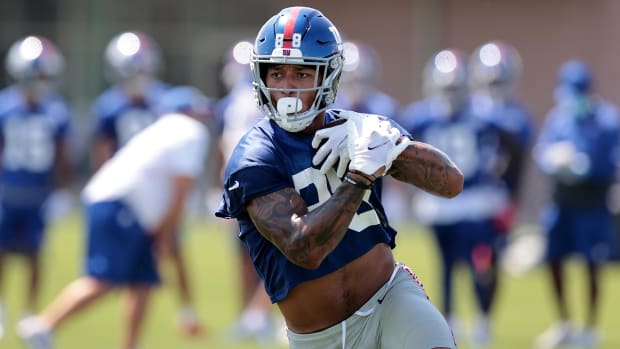
Giants: TE Evan Engram. It’s not breaking any news to say Engram’s got a boatload of ability. Everyone knows that. Everyone also knows that injuries have been a problem. But what was interesting to me was just how dominant he was in practice the day I was there, and how he’s fit into new coach Joe Judge’s program. In the former first-round pick, the staff has found a worker, and a very football-intelligent player, which is exactly what they’re looking for across the board.
Eagles: DE Josh Sweat. The former five-star prep recruit looked freakish on the day I was there, and Philly has pretty consistently seen the big, long defensive end flash that ability the last few weeks. I watched him at the end of a two-minute period absolutely turnstile left tackle Andre Dillard (obviously, before Dillard got hurt) for a sack. Sweat’s another guy where health remains the question. But man, he can play.
Ravens: WR Hollywood Brown/TE Mark Andrews. Alright, so these aren’t really breakout candidates—these guys were 1-2 in catches, yards and touchdown catches for the team last year. But both guys changed their bodies this offseason, and the coaches believe both are playing faster as a result now. Which is a pretty scary prospect, given all the Ravens were already giving defenses to account for.
Bucs: CB/S Antoine Winfield Jr. The second-round pick has been making plays on a daily basis, and Tampa’s going to find a way to get him on the field as a rookie. For Arians, Winfield brings hints of what the coach had in Tyrann Mathieu and Budda Baker in Arizona, a combo safety who can do a million different things. Having a player like that also should go a long way in further unlocking Todd Bowles’s hyper-aggressive scheme.
Dolphins: G Solomon Kindley. Post-Laremy Tunsil, Miami needs help all over the offensive line. Kindley, a fourth-round pick, looks ready to give it to the Dolphins. Through a physical camp, he’s excelled to the point where I’d be surprised if he isn’t starting against the Patriots on Sept. 13. He’ll likely be one of two or three rookies on that line, which also happens to be why going with Ryan Fitzpatrick, for now, is the smart play for Miami.
Lingering question
Patriots: How will the rookies play? New England may wind up relying on more of them this year, and more heavily on them at certain spots (LB, TE), than they’ve relied on a group of rookies in a decade, going back to the Devin McCourty/Rob Gronkowski/Aaron Hernandez class of 2010.
Jets: Who’s playing receiver? There are questions about the line, too, but at least there they know who’ll be on the field. At receiver, it’s more of a scramble, with Breshad Perriman, Chris Hogan, Jamison Crowder, Denzel Mims, Braxton Berrios and darkhorse Jeff Smith in the mix.
Giants: How will rookies fare at the tackle spots? It sure looks like you could have both spots manned by draft picks, with Andrew Thomas on the left side and Matt Peart on the right. How they hold up should help determine Daniel Jones’s 2020 fate.
Eagles: Who’s playing guard? With Dillard down, and Jason Peters back out at left tackle, the question is who’ll take Brandon Brooks’s old spot. They’ve spent a lot of time developing Matt Pryor, drafted Jack Driscoll high and have an intriguing prospect in ex-Australian rugby star Jordan Mailata as contenders. But it’s important to remember that, in Brooks, they’re replacing an elite player.
Ravens: How do the pieces in the secondary fit together? With Earl Thomas gone, DeShon Elliott slides into his old role. But then the questions become how they deploy Jimmy Smith, who could become the kind of combo player Brandon Carr was last year, and how Chuck Clark is affected. High-class problem here, but one that has to be worked out for Wink Martindale to run as flexible a scheme as he did last year.
Bucs: Is there enough offensive line depth? Tristan Wirfs turned a corner over the last 10 days at right tackle and Alex Cappa’s coming along at guard, so Tampa feels good about the two question marks they entered camp with up front. But a couple injuries could create a very real problem.
Dolphins: How young is too young on the offensive line? Yup, another line question in a year where lines are going to be tested, thanks to the relative lack of work they’ve gotten together. Miami has three guys in Austin Jackson, Robert Hunt and Kindley who they like. Would you be OK playing all three? There’s not a ton of NFL precedent for it.
***
TEN TAKEAWAYS
The trade market’s been slow, and I’m not sure how much the Ngakoue deal shifts that paradigm. Thing is, we knew for months that Ngakoue was available. There was another trade this week, with linebacker Raekwon McMillan going from Miami to Vegas, but that was the result of the Dolphins actively shopping McMillan. Situations like those are fairly cut and dried. The players were clearly available. Conversely, deals aren’t happening organically this year, as they normally would be, for a few different reasons.
1) No one is getting to see other teams’ players in preseason. So most talks between teams to this point, I’m told, have consisted of personnel guys asking, Where are you guys heavy and where are you guys light? And there’s a lot of guessing going on.
2) The prospect of a cap shortfall in 2021 gives teams less financial flexibility to take on guys with big numbers in future years, or work on extensions with guys in contract years.
3) Despite the NFL’s outstanding start on the COVID front, teams still have their guard up, and they know that depth could wind up being a bigger factor this year than ever before (and it’s always important). So, naturally, spare parts are less dispensable.
4) Expanded practice squads, and the allowance for six veterans to be among the 16, changes some dynamics. There might be, for instance, a guy who won’t make your 53 this year that you’d have shopped in the past, but now want to sneak through to your practice squad.
Now, some things may wind up shaking loose this week. I certainly think there’ll be players out there on the block for fiscal reasons. And in other cases, maybe some team will take a swing on a guy who might not have been thought to be available—and hit. But for the most part, the way things are trending, I’d guess there’ll be less trade action in general than we’ve had in the past, and maybe a lot less than we had in a very active 2019.
LSU WR Ja’Marr Chase is one college opt-out who should get your attention. Not only is he fully expected to be the top receiver taken next year, had he been draft-eligible, he may have been the first receiver to go back in April, too. “He’s easy [to evaluate],” said one AFC college scouting director. “He’s a first-rounder, no doubt about it, and the best receiver in the class. You can compare his height and weight to [Minnesota opt-out Rashod] Bateman, but he’s a step faster, he’s stronger, just a really strong kid, with very good hands. And he’s a really good athlete. … He comes from a good [high school] program there in New Orleans, he was a five-star recruit, yeah, he’s an easy evaluation. He blocks, he plays hard, just does everything. He’s just really good, there are no holes in skill set. You’ll have to see how fast he is, that’s the question, but word out of there is he’s faster than you’d think.” So yeah, tough to argue with the call Chase is making.
I think Brian Urlacher’s social-media activity last week is indicative of how we’ve stopped listening to each other. If you missed it, the Hall of Famer lined up Brett Favre playing through his father’s death—and starring in a MNF game the night after it happened—as an equivalent to NBA players deciding not to play playoff games this week. It’s a little ridiculous to compare the two to begin with. Favre played through personal tragedy, in part because he thought it was the best way to honor his dad. If he’d decided he couldn’t go that night? I don’t think anyone would’ve thought less of him. He made a choice that was his own, and his way of going through the grieving process was, I’m pretty sure, respected by everyone. What happened in Wisconsin last week connects in no way to that, nor does the response of the NBA players. In fact, if I try and contort myself to find the connection, it’d actually be this—just as Favre’s decision to play that night illuminated his dad’s life, the basketball players’ collective decision not to play illuminated a problem that’s deeply personal for a whole lot of them. But that’s just the false equivalency piece of it. To me, what’s worse is completely ignoring what athletes across sports were doing in skipping practices and games this week. My interpretation is that they were saying, We won’t be your distraction this time around. I’d say it worked, too. Instead of listening to that, though, Urlacher drew his own conclusions. Which, to me, reflects how we’ve become so divided as a country. No one seems to listen to anyone outside their own echo chamber anymore. And that sucks.
I’m excited to see what the Seahawks secondary looks like. Jamal Adams has come as advertised through his first few weeks in Seattle. But just as notable has been the emergence of second-year centerfielder Marquise Blair—who flashed speed and playmaking ability throughout, now 16 months out from Seattle having taken him in the second round. And theoretically, you could say that he’d be easy to slot into the old Earl Thomas role, with Quandre Diggs as a movable piece. The only thing is that Blair has the flexibility to move down and cover in the slot. And Adams does too. And this is why Pete Carroll and those in Seattle have been pretty tight-lipped about where the defense he’s run for over a decade there is going next. Given the versatility of the three safeties, and that the Seahawks are happy with outside corners Shaquill Griffin and Tre Flowers, Carroll and DC Ken Norton have a lot at their fingertips, and I’d expect they’re going to look a little different on defense than they have as a result.
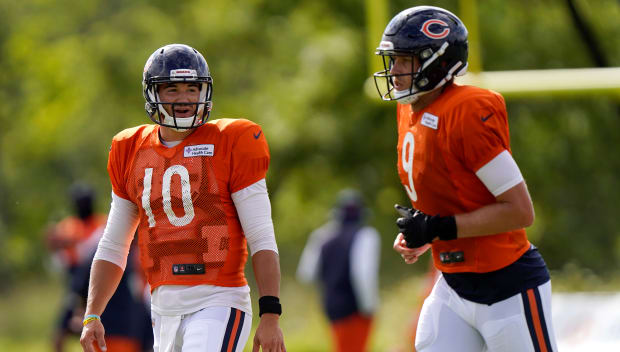
My sense is that Nick Foles is a nose ahead of Mitch Trubisky in the Bears’ QB competition. And it doesn’t surprise me, while we’re there, that Matt Nagy would want to try and keep quiet who the winner of that derby is until the very end (which is what he said he’ll do after Saturday’s scrimmage at Soldier Field). To me, it’s the only true-to-life battle at that position in the league. In Miami, Ryan Fitzpatrick is taking the first-team reps. Tyrod Taylor’s doing the same for the Chargers. And Cam Newton’s clearly emerged in New England. It’s hard to blame those coaches, given the constraints at hand, and the need to build rapport and develop a scheme for the offensive players ahead of Week 1. In Chicago, as Nagy promised, the reps have been split, and if you’re going this far into the summer with it (we’re seven days away from a game week), then I understand wanting to keep the Lions, at the very least, in the dark on who they’re preparing to face in Week 1 for long as possible. In the end, I do think Foles will maintain the slim lead he has now. But I also believe the Bears coaches are being earnest in wanting to see more before making the call there final.
Alexander Mattison’s emergence in Minnesota adds an interesting layer to the Dalvin Cook saga. One big reason why NFL teams are so reluctant to give running backs big money is pretty simple—they’re too easy to find. You don’t need to spend a first-round pick on one. And maybe if you’re looking in the third or fourth round, you won’t find Zeke Elliott or Saquon Barkley. But what you might find is often close enough. Which brings us to Mattison. The Vikings spent a third-round pick on him in 2019, he averaged 4.6 yards per carry as a rookie and he’s hit the ground running in Year 2. I’m told he looks faster and more explosive than he did before, and has had a great camp carrying himself like a seasoned pro. Now, is he Cook? Probably not. But consider this—Mattison is due just $2.2 million total over the next three years. Re-upping Cook might cost you $15 million per year. I’m not great at math, but I’d say it wouldn’t be hard to come by an analysis that going with Mattison over Cook after this year is the right thing to do. And that also, by the way, is why Cook has to do all he can to get paid. His leverage, based on all the above, isn’t getting stronger with time.
I’ve heard the Texans’ work through a month has been crisp. And that’s, at least in part, thanks to the focus over the last couple years on culture. The players the Texans have brought in—guys like Brandin Cooks and Randall Cobb—are pros, and the practices have reflected that, as has the toughness of a team that’s now built through the lines of scrimmage. It took some gambling, of course, to get here, and it’s certainly possible the exodus of guys like Jadeveon Clowney and DeAndre Hopkins will exact a price when the games come. But my sense is Bill O’Brien has the building where he wants it. And it’s something he actually brought up, when we discussed players policing each other this year, in being careful COVID-wise. “Every year, your team’s different. This year we really wanted to have a team that had really good leaders,” he told me. “Deshaun Watson and J.J. Watt and Brandon Dunn and Bernardrick McKinney and Darren Fells, and then we added other great leaders like Brandin Cooks and Randall Cobb, in addition to Nick Martin and Laremy Tunsil, guys like Justin Reid, there’s no doubt that they’re going to police each other. These guys wanna win. It’s really important to them to be a winning football team.” And, again, that’s shown up, with kickoff just 10 days away.
I’m not surprised in the least to hear Dwayne Haskins’s assessment of his relationship with Alex Smith, a few weeks in. In meeting with the D.C. media, Haskins referred to Smith as a “big brother” and a mentor, and that would surprise no in San Francisco or Kansas City, who saw him with Colin Kaepernick or Patrick Mahomes. Just the same, I know Haskins’s excitement for Smith is genuine. “He got some 9-on-9 reps in, and a couple times, he felt how real that pass rush is," Haskins said. “Alex is an ultra-competitive guy, and we had a conversation after practice today about just how important it was for him to get back out there. I'm extremely happy for him, proud of him, have so much respect for him and know what type of guy he is on and off the field.” There’s also, obviously, real football benefit here for Haskins and Kyle Allen, in working with Smith. The staff there has seen it up close—how Smith is able to draw on his own experiences, and his ups and downs, to give the younger QBs lessons. And his off-the-charts retention in learning the offense has both set a high bar for the others and given Smith instant credibility as not just a player, but a teacher in that room. I don’t know if Haskins will wind up being the long-term answer in D.C., or if Allen will be either, for that matter. But I do know that both guys have a better shot at it, and the team will probably get an answer on it more quickly, because Smith is in the room.
File this away: Solomon Thomas is playing really well in Niners camp. The first draft pick of the Kyle Shanahan/John Lynch era has been largely a disappointment in San Francisco, and the team didn’t pick up his injury-guaranteed fifth-year option for 2021. And yes, the thought of it clicking for Thomas has come up before—a year ago the arrival of then-new D-line coach Kris Kocurek, who brough an aggressive style and wider splits, was expected to be a boon for Thomas. Thing is, last year, in a loaded position group, snaps were hard to come by. This year, with DeForest Buckner gone, there should be more opportunity for Thomas. And the Niners are at least hopeful that the former third overall pick is in as good a position as he’s ever been to take advantage of it.
One thing that was crystal clear at training camp: There was a ton more 11-on-11 than I’ve become accustomed to seeing. So the idea that coaches might rethink the idea of camp? Yeah, you can throw that out the window all together. The loss of joint practices and preseason games, and any semblance of offseason on-field work, simply had coaches trying to replace what they could of what they were missing. And it was interesting in talking to John Harbaugh about his brother Jim, and whether he’d consulted with the Michigan coach on how they work around time constraints at the college level. John said he had, but then added that even what colleges are working with isn’t totally applicable. “I always know what they’re doing as far as how he organizes his camp, his scripts, his timeframe,” John said. “It is like the colleges, but the difference is the colleges, they have spring practices, and they also build up to this. They bring their guys back in June and they’re there all summer, they’re working conditioning all summer, they’re doing individual workouts. They even do 7-on-7 on their own, they do group work on their own. According to the rules, it’s legal. So it is like college in the pure sense of training camp. It’s not like college in that we’re not getting as much work as they’re getting leading into it. It’s not exactly like college.” And thus, in many ways, NFL coaches were working, in certain ways, from scratch on this one. And that the result of that was fairly consistent, from camp to camp, to me, was interesting.
***
SIX FROM THE SIDELINE
1) Yes, I watched Austin Peay-Central Arkansas on Saturday night. And yes, I checked on Saturday morning to see if College GameDay was on. (It wasn’t.)
2) In the weirdest of college football seasons, we have more games this coming weekend, but not a major conference game until the weekend after that. The first one? Trevor Lawrence and Clemson take on Wake Forest at noon on Sept. 12.
3) The Big Ten’s handling of the cancellation of its fall season has been a total crapshow. That’s established, and reinforced, by how the other conferences were caught off guard by the announcement, after working with the Big Ten on plans before that. And now, as I see it, the league (and I’m a fourth-generation Big Ten alum, for clarity’s sake) has an opportunity. They can watch the SEC, ACC and Big 12 open camps. They can watch the rates at their own schools. They can, yes, communicate with their football coaches. And they can be open-minded in considering an October start in the process. Whether the conference office or school presidents like it or not, the Big Ten is much more SEC than it is Ivy League. Football is a huge part of the identity of our schools. And it should be treated as such.
4) Really great idea by the NBA to turn their arenas into polling places in November, and it should be especially important in an election year when, because of COVID, having a lot of space is really important.
5) That mess between the Mets and MLB commissioner Rob Manfred on canceling the game the other night was … not that surprising, given how baseball has handled 2020.
6) My camp trip was the first time I'd left New England since the lockdown began in March, and I gotta say that I'm worried for our cities. Pretty tough seeing these places I'd been countless times looking like ghost towns, with storefronts boarded up, and pieces of their identities stripped away. I don't know how we're going to fix it, but it’s going to take a lot of work.
***
BEST OF THE NFL INTERNET
Good message, but I have a feeling there’s a BCC on this tweet, so to speak.
We all thought 2012 was a banner draft class for quarterbacks. I’m not sure many thought the 5' 10" guy who was the sixth taken among them would wind up being the best one.
Mike Tomlin’s going into Year 14 in Pittsburgh, just one shy of Bill Cowher’s 15 years. Watch this, and you’ll see how he’s been able to last that long. And you’ll also see, or get a reminder, that X’s and O’s aren’t the biggest part of that job.
This, from the team that’s been at Ground Zero for all this over the last three months. S/o to Mike Zimmer, for turning it over to his players.
This is great.
Not hard to notice how Joe Burrow was out in front in May in the aftermath of George Floyd’s killing, and now he’s out in front again. Good for him.
Listen to Brian Flores.
Didn’t expect the no-look from Ryan Fitzpatrick (and while we’re here, I’ll send our best to him and his family as they grieve the loss of Fitzpatrick’s mother).
And here’s the guy we do expect the no-look from, plus a reminder that we’re now 10 days away from getting to watch him play in a real true-to-life football game.
Imagine trying to cover Emmanuel Sanders.
You won’t find an NFL person who hasn’t been rooting for Teddy Bridgewater the last four years. One of the most likable, genuine guys in the league, and now a fantastic story, too.
J.K. Dobbins has already impressed the Ravens coaches with his competitive streak and his feel out there. And I’m told Mark Ingram’s really taken him under his wing, recognizing that Dobbins is in great position to be his successor as Baltimore’s bell cow.
I usually don’t use my own tweets here, but Lurie wasn’t screwing around on that call.
***
WHAT YOU NEED TO KNOW
Media access to practice ended in a lot of cities on Sunday. And I’m not telling you that to complain. I’d hope most of us in my line of work have made peace with this being a very different year, and this is after we’d normally be getting kicked out of practice (calendar-wise) anyway.
But I do believe we’ll feel two impacts on that end.
1) The information flow heading toward opening weekend is going to shift in the coming days.
2) Teams can now effectively set their depth charts and work on more specific scheme stuff without as much concern for it becoming public knowledge.
And so, really, this just sets another piece of uncharted territory as we continue on with this season of unprecedenteds.
Subscribe to:
Comments (Atom)